
Estimated reading time: 9 minutes
Key Takeaways
- Travis Kalanick has launched a new robotics company called Atoms, built around the idea of “physical AI.”
- Atoms has raised $1.7 billion, led by a16z, with Uber itself as an investor putting in $100 million.
- Reports suggest Atoms is developing robotaxi technology and has held early talks with Uber about deployment.
- Atoms acquired Pronto, bringing controversial engineer Anthony Levandowski back into Kalanick’s orbit.
- Job listings reveal work on urban autonomous driving, sensor fusion, and vehicle actuation systems.
- Public trust remains low – only 5% of Americans have ridden in a driverless car.
Table of contents
- Key Takeaways
- The Comeback Nobody Saw Coming
- What Is Atoms, Exactly?
- The Robotaxi Question
- Anthony Levandowski Is Back in the Picture
- What the Job Listings Reveal
- Uber’s Robotaxi Strategy – And Why Atoms Fits In
- The Public Is Still Wary
- The Verdict: Unfinished Business, Indeed
- Frequently Asked Questions
Travis Kalanick, the man who helped change the way the world gets around, may be gearing up for his most dramatic move yet. The co-founder who built Uber into a global ride-hailing giant – and was then forced out of his own company – is reportedly eyeing the next frontier of transportation: driverless ride tech. And if the signals are right, the industry he once disrupted may never look the same again.
This is the story of Travis Kalanick’s Atoms, a robotics and physical AI company that is quietly pulling together some of the most explosive names, biggest dollars, and most controversial histories in the autonomous vehicle world. It is a story about comebacks, unfinished business, and a technology that could reshape the lives of hundreds of thousands of drivers.
The Comeback Nobody Saw Coming
To understand why this story matters so much, you have to go back to 2017.
Kalanick resigned as Uber’s CEO in June 2017 following intense pressure from investors. The exit came in the middle of a major crisis: allegations of sexual harassment, workplace culture problems, executive dysfunction, regulatory battles, and a high-profile legal war with Google’s self-driving spin-off, Waymo. He later departed Uber’s board entirely on December 31, 2019, with Uber saying he was leaving to focus on new ventures.
For a while, Kalanick kept a lower profile. He built out CloudKitchens, a ghost kitchen company operating under the parent entity City Storage Systems. But that was never going to be the final chapter for one of Silicon Valley’s most driven, most controversial, and most ambitious founders.
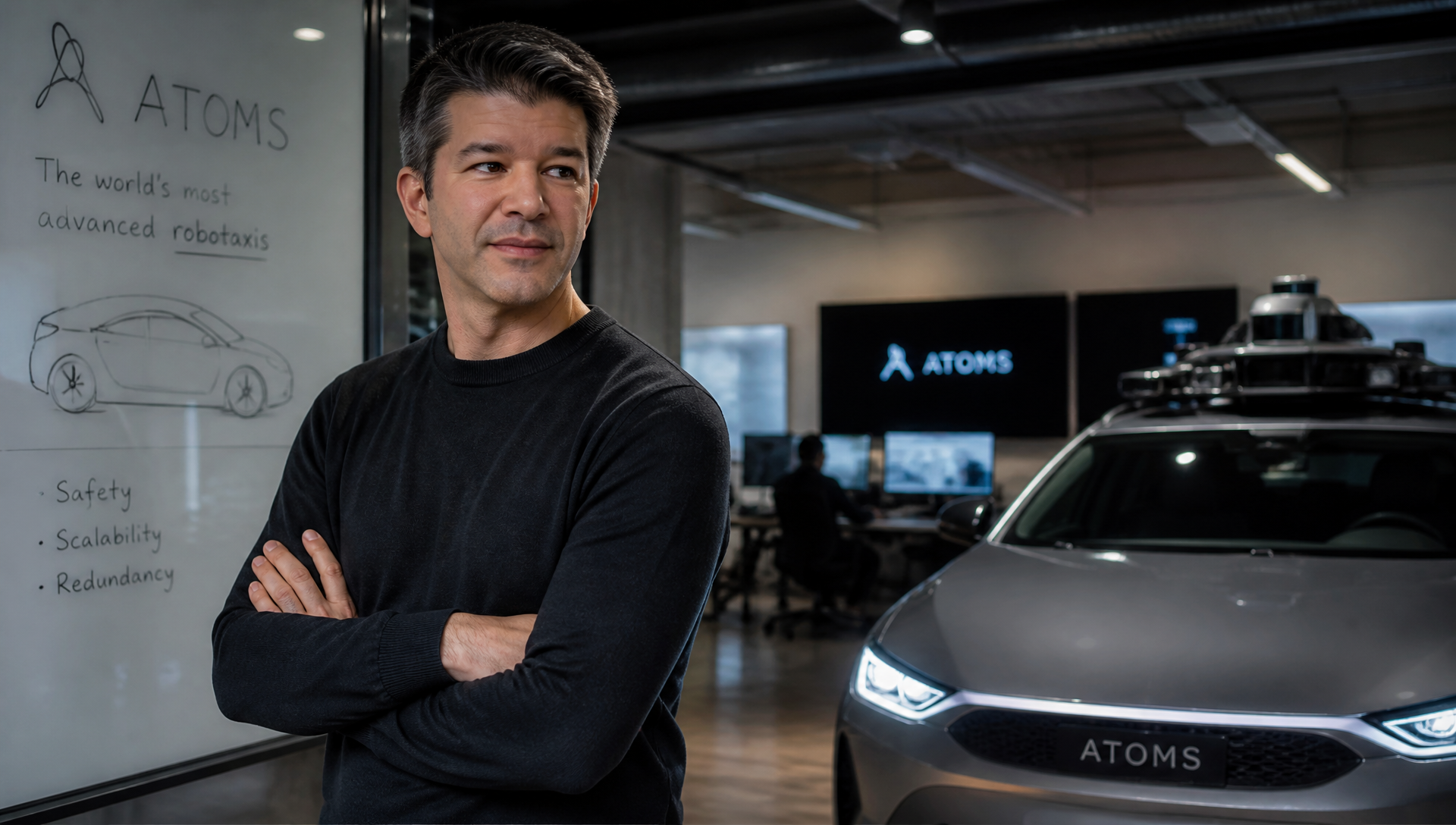
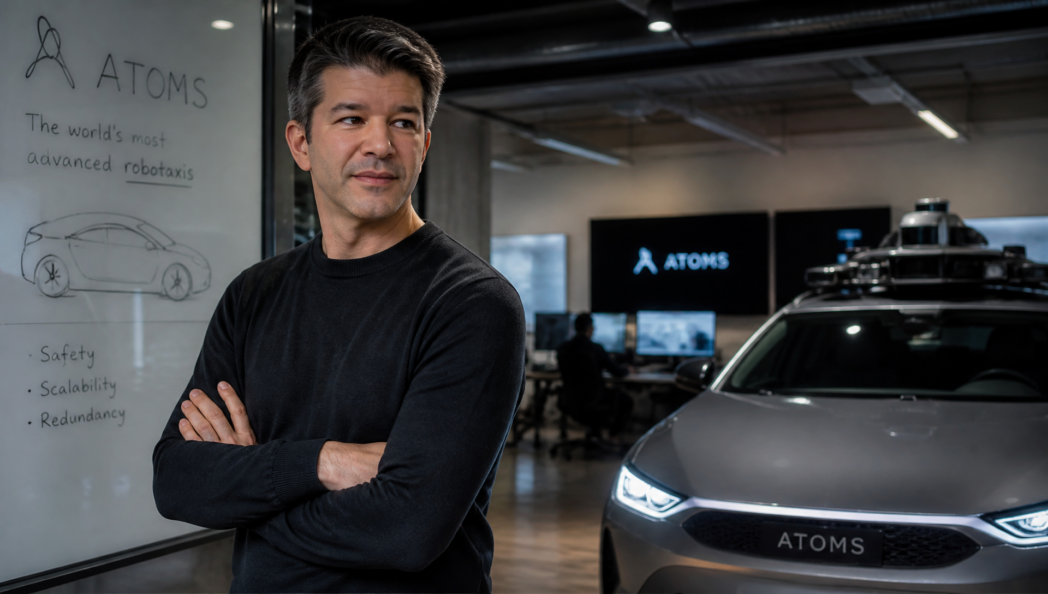
Now, Kalanick has officially launched a new company called Atoms, which grew out of City Storage Systems and positions itself around what it calls “physical AI” – the idea that the next wave of artificial intelligence is not just about software, but about machines that can understand, predict, and control the real world. Atoms targets three major industries: food, mining, and transport.
And it is that third one – transport – that has the entire tech world paying attention.
What Is Atoms, Exactly?
Atoms describes itself as a company building specialized robotics and automation for the physical world. On its Vision page, Kalanick frames Atoms Transport as a “wheelbase for robots” – a platform for moving autonomous machines through the real world.
The company’s own framing on its “Unfinished Business” page leans hard into the comeback narrative. The phrase alone says everything. This is a founder who believes he has something left to prove.
In July 2026, Atoms announced it had raised $1.7 billion in an equity round led by Andreessen Horowitz (a16z), with Ben Horowitz joining the board. Even more eye-catching: Uber was listed as an equity partner in that round, reportedly investing $100 million into Atoms. For a company that once pushed Kalanick out the door, that is a remarkable plot twist.
As a16z’s own post titled “Travis Is Back” puts it, the firm is explicitly backing the idea that specialized industrial robots – not humanoids – are the real near-term opportunity in the world of physical automation.
The Robotaxi Question
Here is where the story gets truly explosive.
According to a report from TechCrunch, citing the Financial Times, Atoms is reportedly developing robotaxi technology and has had early discussions with Uber about using Atoms technology on Uber’s ride-hailing network. This is a stunning claim – the founder Uber forced out may now be building the very technology that powers Uber’s driverless future.
Atoms, for its part, reportedly denies that it plans to enter the robotaxi market, calling itself an industrial software and automation company with “no plans to enter the saturated robotaxi market.” The Next Web also reports that Atoms acknowledged Uber is a partner and that Uber may use Atoms technology for ride-sharing if it turns out to be useful.
That careful phrasing opens a door, not closes one.
The distinction that matters here is the difference between being a robotaxi operator – owning the vehicles, the app, the licenses, the liability – and being a robotaxi technology supplier, the company that builds the autonomy stack that someone else, perhaps Uber, deploys at scale. The available evidence points much more strongly toward the second model. Atoms may not be launching a consumer ride-hailing app. But it may be building the intelligence that makes someone else’s driverless cars work.
Anthony Levandowski Is Back in the Picture
If Kalanick’s return was not dramatic enough, there is one more name in this story that makes the whole thing feel like a Silicon Valley screenplay: Anthony Levandowski.
Levandowski is one of the most gifted and most controversial engineers in the history of autonomous vehicles. He helped build Google’s early self-driving program, later joined Uber through the acquisition of his startup Otto, and became the central figure in Waymo’s landmark lawsuit against Uber over alleged theft of self-driving trade secrets. In 2020, Levandowski was sentenced to 18 months in prison for theft and attempted theft of trade secrets connected to Google’s self-driving car program. He received a full presidential pardon from Donald Trump in January 2021.
After that saga, Levandowski went on to lead Pronto, a company building autonomous haulage systems for mines and quarries. Atoms has now acquired Pronto, bringing Levandowski back into direct orbit with Kalanick for the first time since their shared Uber chapter ended so chaotically.
Pronto is not a robotaxi company. But it is a real, operational autonomous vehicle company. It claims deployments across more than 100 trucks, a global agreement with Heidelberg Materials, and a system that hauled more than two million tons at a Texas quarry in under eight months. The autonomy expertise Pronto brings to Atoms – in perception, vehicle control, fleet orchestration, remote operations, sensor fusion, and real-world deployment – overlaps significantly with what you need to build an autonomous urban transport system.
The gap that remains is the hardest one in the industry: urban driving. Pedestrians, cyclists, construction zones, unpredictable intersections, city-by-city regulation – that is the challenge that has humbled every major autonomous vehicle program. Atoms has not publicly proven it can crack that yet.
What the Job Listings Reveal
When companies are not ready to talk publicly, their hiring pages often tell a more honest story.
Atoms’ job listings on Greenhouse now include roles with explicitly autonomous transport language. One Staff Machine Learning Engineer role describes working on “next-generation autonomous transport platforms” and lists responsibilities including:
- Reinforcement learning and distillation for trajectory planning
- Multimodal models that translate visual perception and behavioral goals into vehicle actuation
- World models built from multi-sensor driving logs
- Adaptation to urban environments and edge cases
- Camera, lidar, and radar sensor fusion
- Model optimization for low-latency vehicle edge hardware
- Data pipelines for rare driving scenarios drawn from multi-petabyte datasets
That is not the job description of an industrial mining company. That is the job description of a company building autonomous driving technology for complex, real-world environments.
Atoms’ full careers board also lists a dedicated Transport Operations Recruiter, alongside roles in machine learning infrastructure, data science, legal, real estate, and finance. Pronto’s own listings include path planning, multi-vehicle coordination, and dispatch system roles for autonomous haul trucks.
Taken together, this is not a company winding down its autonomy ambitions. It is a company building them up, quietly and fast.
Uber’s Robotaxi Strategy – And Why Atoms Fits In
Understanding why Uber would invest $100 million in Atoms requires understanding how Uber thinks about autonomous vehicles today.
Uber is no longer trying to build all robotaxi technology in-house. Instead, it has become a platform for autonomous vehicle deployment – a marketplace connecting riders with whatever AV technology its partners develop. In February 2026, Uber announced Uber Autonomous Solutions, presenting itself as a global platform offering AV companies access to training data, fleet financing, regulatory support, and fleet operations.
Uber already says AVs are rolling out in limited sections of cities like Atlanta, Austin, Dallas, and Las Vegas through existing partners. The company tells drivers that autonomous vehicles are intended to complement them, not replace them – a message that will face growing scrutiny as deployment scales.
So why back Atoms specifically? The answer may be strategic optionality. Uber has multiple AV partners – but backing Kalanick’s new autonomy play gives it an inside seat if Atoms builds something that changes the game. A possible future where Atoms builds the technology and Uber owns the distribution is one of the most logical ways this story could end.
For some context on what that might mean for people on the road: the U.S. Bureau of Labor Statistics recorded approximately 204,200 taxi drivers and about 455,700 taxi drivers, shuttle drivers, and chauffeurs combined in 2025, with taxi drivers explicitly including ride-hailing workers. The arrival of scalable robotaxi technology would have enormous consequences for those workers – even if Uber’s current messaging insists otherwise.
The Public Is Still Wary
It is worth remembering that for all the investor excitement around driverless cars, most ordinary people are still not convinced.
A February 2026 Pew Research Center survey found that only 5% of U.S. adults had ever ridden in a driverless car, and a striking 71% said they would be “not too” or “not at all” comfortable riding in one. Most people have strong opinions about robotaxis, but almost nobody has personal experience with them.
That trust gap is enormous – and it is exactly the kind of challenge that requires not just better technology, but better safety records, better transparency, and better public communication. The history of Uber’s own self-driving program is a sobering reminder of how quickly things can go wrong. In March 2018, an Uber self-driving test vehicle struck and killed pedestrian Elaine Herzberg in Tempe, Arizona. The NTSB later cited the safety operator’s distraction and Uber ATG’s inadequate safety culture as contributing factors. Uber ultimately sold its ATG self-driving unit to Aurora in 2020, entering a strategic partnership alongside the sale.
That dark chapter in the Waymo-Uber self-driving war also included Uber settling with Waymo in 2018 for approximately $245 million worth of equity and an agreement not to use Waymo’s trade secrets. It was one of the most consequential legal settlements in the history of Silicon Valley.
Kalanick, Levandowski, and Uber are now back in each other’s orbit – on the same battlefield where it all collapsed the first time.
The Verdict: Unfinished Business, Indeed
So what do we actually know?
We know that Atoms exists, is led by Kalanick, and has raised $1.7 billion with Uber as an investor. We know that Atoms acquired Pronto and brought Anthony Levandowski back into Kalanick’s world. We know that Atoms’ job listings describe work on autonomous transport platforms, urban edge cases, and vehicle actuation systems that go well beyond ghost kitchens or mining trucks. We know that credible reporting from the Financial Times, summarized by TechCrunch and The Next Web, says Atoms is developing robotaxi-related technology and has had early discussions with Uber about using it on Uber’s network.
What we do not know is whether Atoms will launch its own passenger robotaxi service. The company says it will not. But the gap between “we are not entering the robotaxi market” and “we are building autonomous transport technology that a major ride-hailing platform might deploy” is a very interesting gap to sit in.
The story to watch going forward is simple: does Uber officially name Atoms as an AV technology partner? Does Atoms file testing permits in an AV-friendly state? Does Pronto’s autonomy team start showing up under the Atoms Transport banner rather than Atoms Mining?
Because if any of those things happen, the most fascinating founder comeback in recent Silicon Valley history will have arrived at its most remarkable chapter yet. The man who once built the world’s biggest taxi company – powered entirely by human drivers – may be about to help build the version with no humans at the wheel at all.
And for startup founders watching this space: the robotaxi revolution is a reminder of just how fast entire industries can be remade when the right technology, the right funding, and the right ambition converge at the same moment. The race is on.
Frequently Asked Questions
What is Travis Kalanick’s new company, Atoms?
Atoms is a robotics and “physical AI” company founded by Travis Kalanick, targeting food, mining, and transport industries. It grew out of City Storage Systems, the parent company of CloudKitchens.
Is Uber investing in Atoms?
Yes. Uber was listed as an equity partner in Atoms’ $1.7 billion funding round, reportedly contributing $100 million.
Is Atoms building a robotaxi service?
Atoms publicly denies plans to enter the robotaxi market. However, reports from the Financial Times and TechCrunch suggest the company is developing autonomous transport technology and has had early talks with Uber about potential deployment on its network.
Why is Anthony Levandowski involved?
Atoms acquired Pronto, Levandowski’s autonomous haulage company, bringing him back into Kalanick’s orbit after their shared and controversial history at Uber.
How does the public feel about driverless cars?
Trust remains low. A Pew Research survey found only 5% of U.S. adults have ridden in a driverless car, while 71% said they would be uncomfortable doing so.