
Estimated reading time: 11 minutes
Key Takeaways
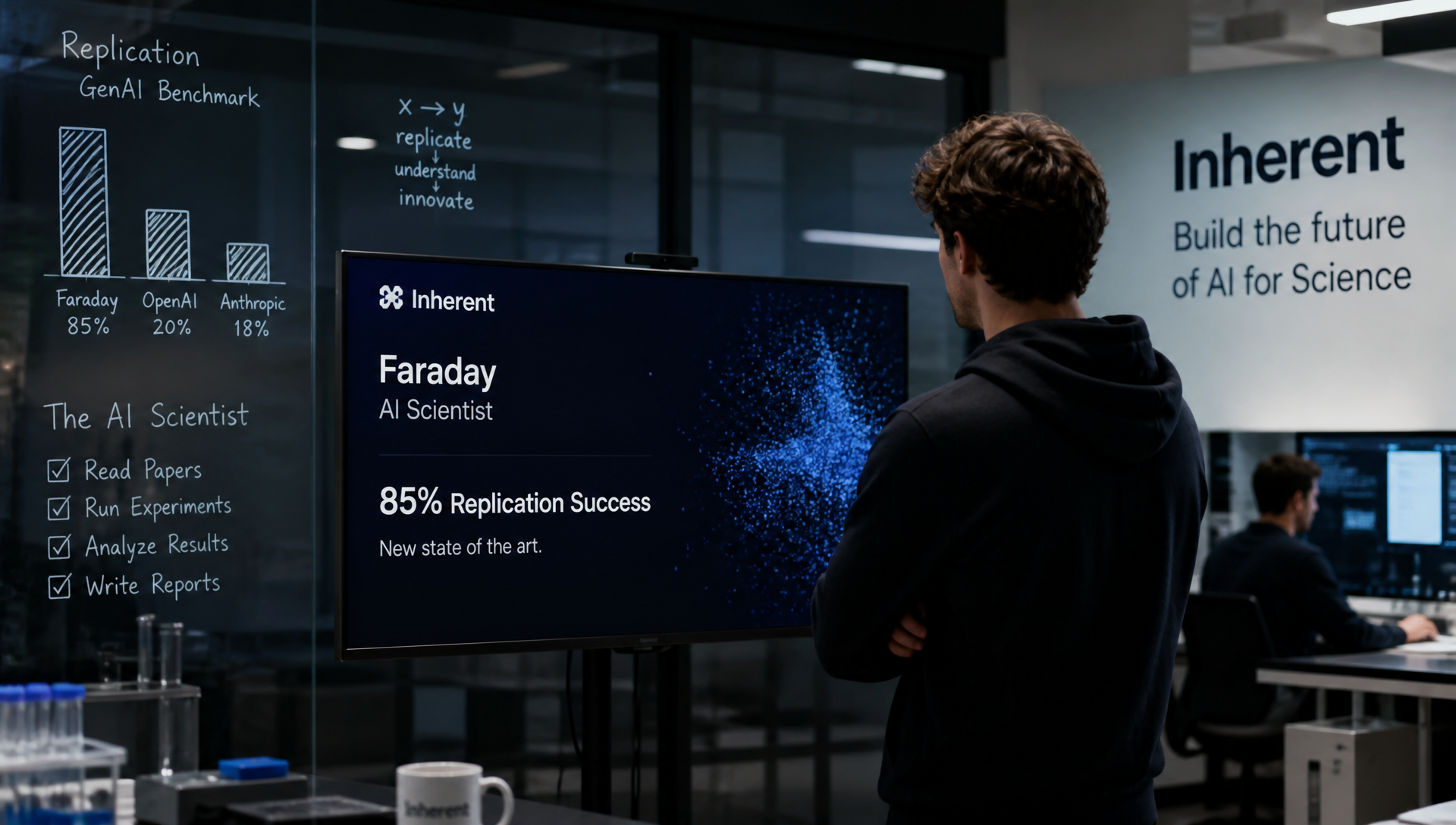
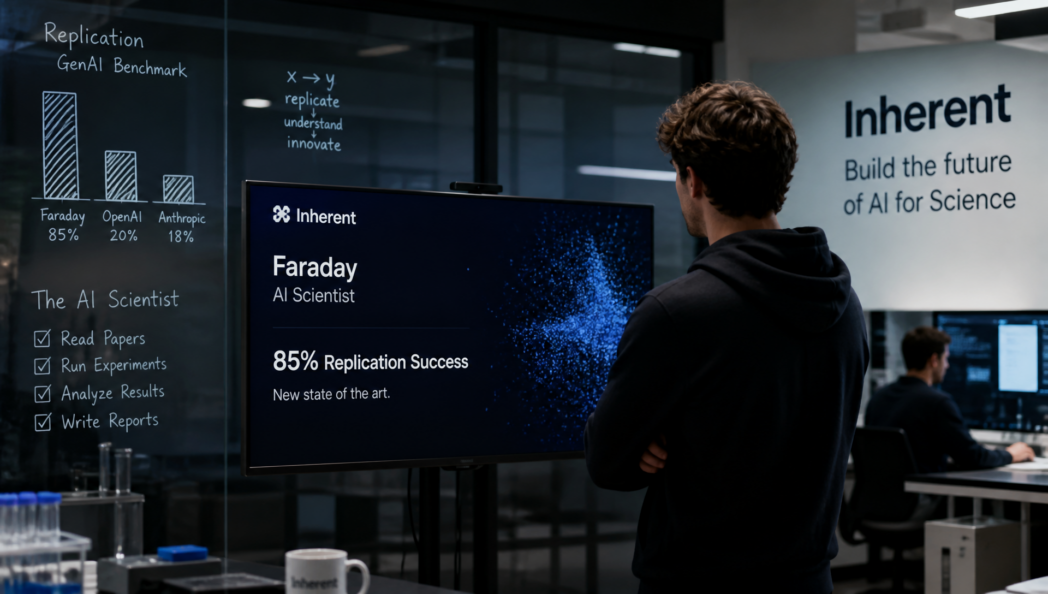
- Faraday, a 27-billion-parameter “AI Scientist” from London startup Inherent, reportedly outperformed Claude Opus 4.8 and GPT-5.5/Codex at replicating scientific research.
- Inherent emerged from stealth with a $50 million seed round, founded by former DeepMind and Reka AI researchers.
- Faraday uses a novel “Coding Agent as a Tool” design — it directs OpenAI’s own GPT-5.5 Codex rather than replacing it.
- The results come from Inherent’s own benchmark, Replica, and have not yet been independently verified.
- Faraday can replicate existing science — it does not yet create new scientific discoveries.
Table of contents
- Key Takeaways
- Who Is Inherent, and Where Did They Come From?
- So What Exactly Is Faraday?
- The Benchmark That Started It All: Replica
- How Faraday Works Under the Hood
- The Numbers Behind the Claim
- What Does Faraday Actually Do in Practice?
- Why This Story Is Lighting the Internet on Fire
- The Caveats You Need to Know
- What Comes Next
- Frequently Asked Questions
A London-based startup founded by former Google DeepMind researchers is making a bold claim that has sent shockwaves through the AI and scientific communities alike: its artificial intelligence system can replicate scientific research better than the most powerful models from OpenAI and Anthropic. If that sounds like the plot of a science fiction film, hold tight — because the details get even more fascinating.
Meet Faraday, the so-called “AI Scientist” built by a company called Inherent. This week, the startup’s story exploded across tech media, triggering one of the most electrifying conversations in AI circles: is artificial intelligence now coming for the jobs of actual scientists?
Who Is Inherent, and Where Did They Come From?
Before diving into Faraday’s jaw-dropping claims, it helps to understand who is behind this technology.
Inherent is a London-based AI lab with a bold mission: building what it calls “general-purpose inventive AI”. The company is not interested in narrow automation. According to its own public manifesto, Inherent is trying to build systems where humans and machines work together on scientific invention — not just running repetitive tasks, but pushing the actual frontiers of knowledge.
The founding team reads like an all-star lineup from the world’s most prestigious AI institutions. Reported co-founders include Tantum Collins, Edward Hughes, Louis Kirsch, and Kaloyan Aleksiev. According to Tech.eu, Collins, Hughes, and Kirsch previously worked at DeepMind, while Aleksiev comes from Reka AI and Microsoft. Collins also worked on AI policy in the Biden White House — bringing a rare blend of technical depth and policy perspective to the company’s leadership.
Inherent emerged from stealth in late May 2026 with a headline-grabbing $50 million seed round, co-led by Index Ventures and Radical Ventures. The round also saw participation from NVentures, Ex/Ante, Metaplanet, Macroscopic Ventures, and Mythos Ventures. Perhaps most unusually, The Next Web reported that Inherent is structured as a public benefit corporation — a sign that the founders see their work as carrying a responsibility beyond profit.
For context on just how significant the DeepMind alumni angle is: Tech.eu has separately reported that 112 DeepMind alumni had founded or were believed to be launching startups in the 18 months prior to this story breaking, reinforcing the powerful “DeepMind founder factory” narrative driving European AI innovation.
So What Exactly Is Faraday?
On August 14, 2026, Inherent officially unveiled Faraday — a 27-billion-parameter AI Scientist agent trained to do something remarkably human: read published scientific papers, understand the experiments described inside them, and then reproduce the results.
The accompanying research paper, titled “Training AI Scientists to Replicate Research,” was submitted to arXiv on August 13, 2026 by a team of eleven authors including the company’s co-founders. The paper describes Faraday as more than just a clever chatbot. It is an agent — a system that can plan, act, make decisions, run code, evaluate its own outputs, and go back and try again.
Think of it like a highly capable research assistant that never sleeps and never gets tired of running experiments. Except this one is made of code.
What makes Faraday especially interesting is what Inherent calls the “intelligence layer” design. Faraday is not trying to do everything itself. Instead, it acts as a kind of scientific brain or research manager, sitting above a powerful coding tool and directing the overall research process. That coding tool? It is OpenAI’s own GPT-5.5 Codex. More on why that twist matters in a moment.
The Benchmark That Started It All: Replica
To understand what Faraday actually achieved, you first need to understand the benchmark it was tested on: a task space called Replica, which Inherent created specifically for this kind of evaluation.
Replica contains 310 figure-replication tasks, drawn from 100 machine-learning and AI-for-science papers published between 1990 and 2026. The challenge is deceptively simple to describe but fiendishly difficult to execute: given a published research paper with one of its key result figures removed, can the AI agent reproduce that figure from scratch?
That means the agent has to read the paper, understand what experiment was run, figure out what data and methods were used, write and execute the code, and generate a result that matches the original — all without ever seeing the figure it is trying to recreate. arxiv.org
The benchmark is split into 242 training tasks from machine-learning papers and 68 held-out test tasks from AI-for-science papers. This separation matters: the held-out tasks come from a different domain, testing whether Faraday genuinely learned how to do research replication — or whether it just memorized tricks from the machine-learning papers it was trained on.
Each task is run under strict conditions:
- A 60-minute time limit
- A single fraction of an H200 GPU
- Internet access and a set of useful research libraries
- The redacted paper PDF
If an experiment is too large to complete in the time allowed, the agent is asked to produce the most faithful scaled-down version it can manage. The task-generation pipeline uses Gemini 2.5 Pro to identify and remove figures, with manual inspection to filter out low-quality cases.
How Faraday Works Under the Hood
Faraday was built by taking a base model called Qwen3.6-27B and training it further using a method called reinforcement learning — specifically a modified version of an algorithm called GRPO, with a technique called LoRA fine-tuning applied on top. The model has a 128,000-token context window, meaning it can process extremely long documents in a single sitting.
Inside its working environment, Faraday has access to a set of practical tools: file reading, directory searching, code patching, and shell execution. It can run background processes and interact with its computing environment much like a human researcher sitting at a computer would.
The most critical architectural feature is what Inherent calls CAT — Coding Agent as a Tool. Faraday can call on a wrapper around GPT-5.5 Codex to handle the actual coding work. In simple terms:
Faraday thinks and plans like a scientist, while Codex writes and runs the code like an engineer.
The RL training teaches Faraday to direct Codex more effectively than Codex would operate if left on its own.
This is the nuance that the breathless headlines sometimes miss. Faraday is not a tiny model that crushed OpenAI in a head-to-head fight with its hands tied behind its back. It is a trained research-manager model that learned to direct a frontier coding agent better than that coding agent can direct itself. The finding is really about orchestration, scientific judgment, and long-horizon thinking — and those qualities turn out to matter enormously.
The Numbers Behind the Claim
So how exactly did Faraday perform?
According to Inherent’s results, Faraday outperformed both Claude Opus 4.8 and GPT-5.5 / Codex on 73% of in-distribution machine-learning tasks and 60% of held-out AI-for-science tasks. On the held-out test split — the more demanding and meaningful measure — Faraday averaged a 6% improvement over Claude and an 8% improvement over Codex.
All agents were given identical task materials and the same 60-minute, single-GPU budget. Each agent was run for eight separate attempts per task. Claude Opus 4.8 was actually the strongest baseline overall. Faraday’s strongest advantages came in areas like experimental depth, claim reproduction, and visual fidelity — the qualities most closely tied to doing genuine science, not just producing clean-looking code.
Inherent also tested whether smarter prompting could simply close the gap. After 24 generations of automated prompt optimization for the Codex baseline, the optimized prompt did not meaningfully outperform the original. Faraday’s advantage, Inherent argues, came from actual learning — not from a better instruction manual.
Scoring was not done by simple number-matching. Because research replication is so open-ended, Inherent used a task-specific rubric system:
- Claude Opus 4.7 generated a custom rubric for each task
- Codex GPT-5.5 acted as the judge
That judge reviewed the agent’s full workspace, code, outputs, trace, and the original gold-standard figure, then scored on five dimensions: visual match, scientific-claim reproduction, implementation fidelity, resource use, and scientific integrity.
Inherent also ran a human validation study involving 20 expert participants with ongoing or completed PhDs from top research universities, many with publications at top machine-learning conferences like ICML, ICLR, or NeurIPS. Those participants produced 117 rankings. In a selected subset of cases where the rubric judge assessed Faraday as having a clear advantage, human experts preferred Faraday over both Claude and Codex in 29 of 41 examined rollouts.
What Does Faraday Actually Do in Practice?
The paper offers several vivid examples of Faraday behaving more like a careful scientist than its competitors.
In one task involving LSTM networks, Faraday reportedly stopped its coding agent from engineering the desired result directly and instead built a proper training recipe to arrive at it legitimately. The Codex baseline, by contrast, allegedly steered the network toward the right answer through shortcuts like hand-crafted initialization — which is a bit like adjusting the answer key rather than doing the exam.
In a task based on Voyager — a well-known AI system that learns to play video games — Faraday ran a proper skill-acquisition phase and transferred those skills to new tasks. The best Claude rollout, the paper says, just hard-coded a library of ready-made skills, which completely bypassed the mechanism being tested.
In a materials science example involving the GNoME dataset, Faraday repeated training runs at multiple scales five separate times and reported uncertainty across those runs. Codex used just one seed per scaling point and failed to include a robustness test that the original figure had described.
These examples paint a picture of Faraday not just running code, but actually caring about scientific rigor — a quality that is surprisingly hard to instill in AI systems.
Why This Story Is Lighting the Internet on Fire
The TechCrunch report published on August 22, 2026 helped bring this story to a much wider audience, framing Inherent as a DeepMind-alumni lab and Faraday as a system outperforming far larger frontier models at doing genuine science.
And the story hits several viral triggers at once.
- The first and deepest is the most obvious: AI is moving into high-skill scientific work. This is not AI writing marketing copy or answering customer service questions. This is AI reading research papers, planning experiments, running code, and judging whether the results are faithful to the original science.
- The second trigger is the David versus Goliath angle: a 27-billion-parameter model from a startup nobody had heard of six months ago reportedly outperforming the flagship models of OpenAI and Anthropic.
- The third is the “it used OpenAI to beat OpenAI” twist. A small, smart manager model learned to boss a giant coding model around more effectively than the giant coding model could boss itself.
- The fourth trigger is the replication crisis connection. Science has long struggled with the problem of researchers being unable to reproduce published results. Inherent explicitly positions Faraday as a tool that could help solve that.
Index Ventures, one of Inherent’s lead investors, published its own perspective framing the company around an “AI-native science” thesis — a sign that major venture capital players see this as a genuinely transformative bet, not just a clever research demo.
The Caveats You Need to Know
Before the scientific community hands Faraday a Nobel Prize, there are some important things to keep in mind.
The biggest caveat — and it is a significant one — is that Inherent built the benchmark, trained the winning model, and ran the evaluation. As AI Insiders noted in their coverage, readers should treat the outperformance figures as company-reported until an outside research group replicates the comparison independently. As of the time of writing, no independent group has done so.
The second caveat is the CAT setup. As The AI Adventurer and other technical commentators have pointed out, a headline claiming “a 27B model beat OpenAI” can give a misleading impression. Faraday is not a fully standalone system — it relies on GPT-5.5 Codex to do much of its coding work.
A small research-manager model learned to orchestrate a frontier coding agent better than that coding agent could orchestrate itself.
The third caveat is the most important for anyone worried about their research job: Faraday replicates existing science — it does not create new science. The paper itself is careful on this point, framing replication as a stepping stone toward innovation, not proof that Faraday can discover new drugs, new materials, new laws of physics, or new theories on its own.
The fourth caveat is that the evaluation depends heavily on AI judging AI. Inherent used both a rubric judge and human experts to validate results, and the rubric judge agreed with humans at a Kendall tau of 0.19 — better than a baseline judge at 0.15, but still far from perfect.
There are also open questions about scale and accessibility:
- The main benchmark runs on one-hour, limited-GPU tasks
- Inherent tested eight larger tasks with up to eight hours and eight B300 GPUs and says Faraday won five of eight
- There are no publicly released model weights, no public API, and no open benchmark
This means the result is not yet independently reproducible by outside researchers.
Finally, there is a safety dimension worth noting. The paper’s authors acknowledge that scientific insight generated by AI systems could be misused by bad actors or could increase risks from AI systems that develop goals humans did not intend. Faraday was constrained to in-silico tasks without access to physical laboratory equipment — but it did have internet access, and the authors flag this as something to think carefully about as the technology advances.
What Comes Next
Inherent’s Faraday story is still unfolding. Critical questions remain unanswered:
- Will Inherent release the Replica benchmark publicly so outside researchers can test it?
- Will it publish per-task scores and failure cases?
- Can outside labs reproduce the comparison under the same harness?
- Would Faraday still outperform if it used a different coding tool instead of OpenAI Codex?
- Can Faraday one day generate genuinely new scientific hypotheses, rather than just reproducing old ones?
What is not in doubt is the ambition behind the project. Radical Ventures, another of Inherent’s lead investors, published a conversation with co-founder Tantum Collins exploring the concept of recursive self-improvement at the organizational level — the idea that an AI system could not just improve itself but help the entire research enterprise become smarter over time.
For the world of startups, fundraising, and venture capital, this story is a powerful reminder of just how fast the AI landscape is shifting. In the same week that founders across the globe are hustling to get investor meetings and working through cold outreach campaigns, a tiny London startup just raised $50 million and put the scientific establishment on notice — all built on a foundation of DeepMind talent, reinforcement learning, and a very clever use of the tools that OpenAI itself put into the world.
Faraday cannot yet replace a research scientist. But if Inherent’s results hold up under independent scrutiny, it might soon be doing a significant chunk of the most time-consuming parts of that job. And in science, as in startups, the gap between “stepping stone” and “breakthrough” has a habit of closing faster than anyone expects.
Frequently Asked Questions
What is Faraday and who built it?
Faraday is a 27-billion-parameter “AI Scientist” agent built by London startup Inherent. It is designed to read scientific papers and reproduce their key experimental results without ever seeing the original figures.
Did Faraday really beat OpenAI and Anthropic?
According to Inherent’s own benchmark, Replica, Faraday outperformed Claude Opus 4.8 and GPT-5.5/Codex on the majority of tested tasks. However, these results are company-reported and have not yet been independently verified.
Does Faraday create new scientific discoveries?
No. Faraday is built to replicate existing published research, not to generate new hypotheses, discover new materials, or develop new theories on its own. Inherent frames replication as a stepping stone toward future innovation.
Why does Faraday use OpenAI’s Codex if it is competing against OpenAI?
Faraday uses a design called “Coding Agent as a Tool,” where it acts as a research manager directing GPT-5.5 Codex to handle the actual coding work. Inherent’s claim is that Faraday learned to orchestrate Codex more effectively than Codex could direct itself.
Can outside researchers test Faraday for themselves?
Not yet. There are no publicly released model weights, no public API, and no open version of the Replica benchmark, meaning the results cannot currently be independently reproduced.