
Estimated reading time: 9 minutes
Key Takeaways
- SpaceX officially closed its acquisition of Cursor (Anysphere, Inc.) on August 14, 2026, in a deal valued at approximately $60 billion.
- The deal was structured as an all-stock transaction, with Anysphere shareholders receiving hundreds of millions of SpaceX Class A shares.
- Cursor survives as a wholly owned SpaceX subsidiary — the product isn’t going anywhere.
- SpaceX’s strategy appears centered on vertical integration: compute infrastructure, AI models (Grok), and now the developer application layer.
- The deal raises real questions about data privacy, the future of engineering jobs, and AI market consolidation.
Table of contents
- Key Takeaways
- What Actually Happened?
- The Timeline: From Partnership to $60 Billion Acquisition
- What Even Is Cursor?
- So Why Did SpaceX Buy a Coding App?
- Is SpaceX About to Replace Engineers?
- What About Your Code? The Privacy Question
- The Big Picture: A New AI Empire Taking Shape
- Frequently Asked Questions
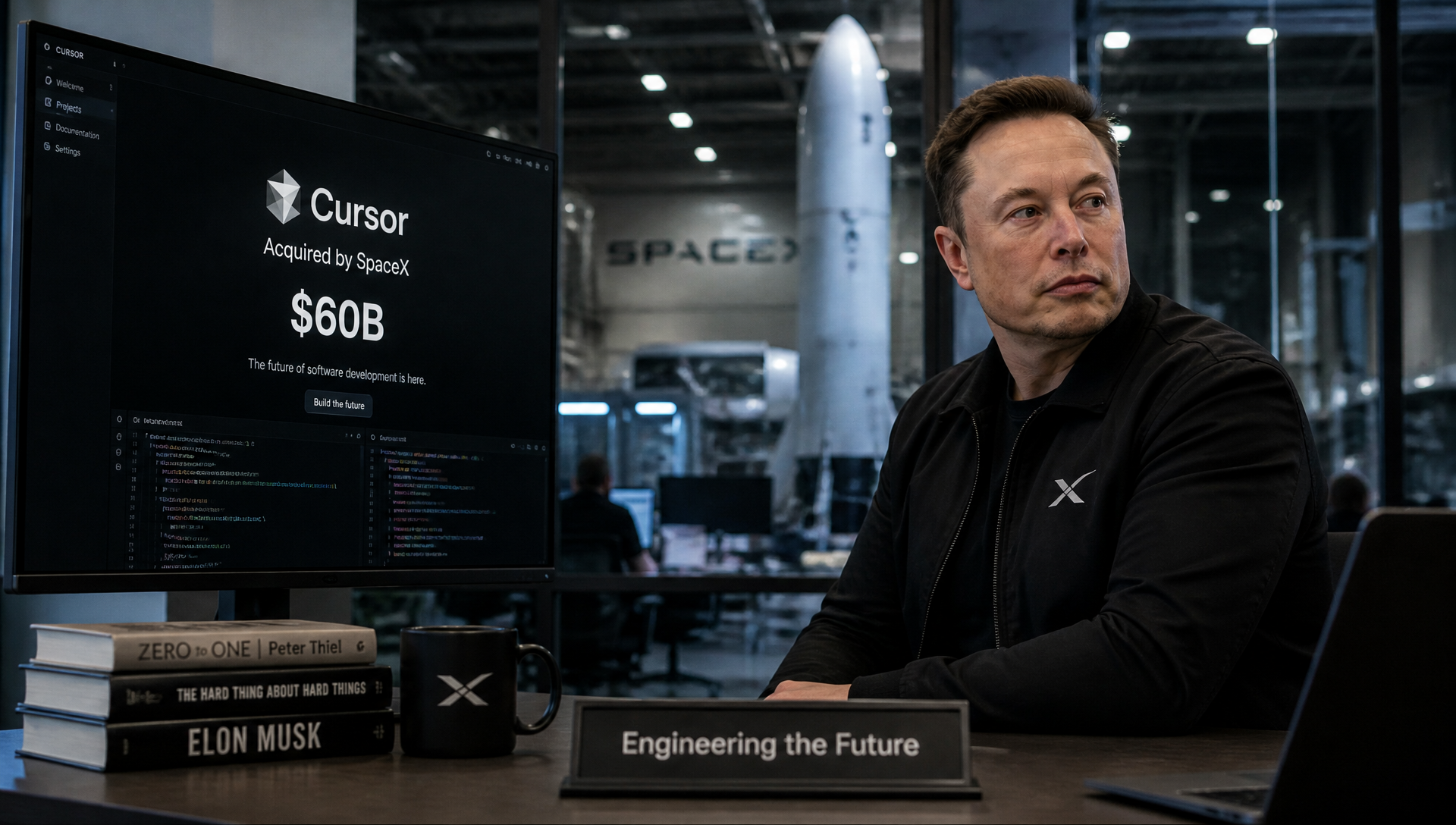
SpaceX has officially closed its acquisition of Cursor, the wildly popular AI coding tool, in a deal valued at approximately $60 billion. Yes, you read that right. Elon Musk’s rocket company — the same one launching satellites and sending humans to space — just bought one of the most powerful AI coding assistants on the planet. And the tech world is buzzing with one very big question: why?
This is one of those stories that sounds almost too strange to be true. A rocket company buying a coding app. A $60 billion price tag. “AI teammates” taking over software development. Grok models getting smarter. And somewhere underneath it all, a very real anxiety about what this means for the millions of software engineers who write code for a living.
Let’s break it all down — the facts, the timeline, the money, and what it actually means for the future of software development.
What Actually Happened?
On August 14, 2026, SpaceX officially completed its acquisition of Anysphere, Inc. — the San Francisco startup behind the AI coding tool Cursor. The deal was confirmed in a blog post published directly on Cursor’s own website, which stated plainly: “We have officially been acquired by SpaceX.” Bloomberg Law also reported that the deal became effective that same day, according to a regulatory filing.
Cursor survives as a wholly owned SpaceX subsidiary. The product isn’t disappearing — it’s just now part of one of the most powerful and ambitious technology empires on Earth.
The deal was structured as an all-stock transaction. According to an SEC filing, Anysphere shareholders received approximately 389,289,254 SpaceX Class A shares, with vested Cursor RSUs (restricted stock units) converting into rights to receive an additional 1,752,426 Class A shares before tax withholding, and unvested RSUs and options converting into roughly 29.1 million SpaceX RSUs and 44.4 million SpaceX options, as reported by Investing.com.
This was a monster deal. And the story of how it came together is just as fascinating as the deal itself.
The Timeline: From Partnership to $60 Billion Acquisition
This didn’t happen overnight. The SpaceX-Cursor relationship had been quietly building for months before the world noticed.
April 2026: The Quiet Beginning
The first hint came on April 19, 2026, when SpaceX entered a compute agreement with Cursor, according to SpaceX’s EU prospectus approved by BaFin. Under this arrangement, SpaceX would provide GPU cluster capacity — essentially massive computing power — and Cursor would contribute personnel, data, datasets, documentation, know-how, workflows, prompts, specifications, and software code. SpaceX also received the right — but not the obligation — to acquire Cursor entirely. (SpaceX EU Prospectus)
AP News reported in April that SpaceX had the right to buy Cursor for $60 billion later in 2026, or instead pay $10 billion simply to “work together” with the company. Cursor, for its part, said the partnership would allow it to tap into xAI’s Colossus infrastructure to scale its model intelligence.
The two options on the table said a lot: SpaceX could get a collaboration for $10 billion, or full ownership for $60 billion. They chose ownership.
June 16, 2026: The Deal is Signed
SpaceX filed a Form 8-K with the SEC on June 16, 2026, announcing that SpaceX, its subsidiary X67 Inc., and Anysphere had entered into a definitive merger agreement. Under the agreement, X67 Inc. would merge into Cursor, with Cursor surviving as a wholly owned SpaceX subsidiary. The deal was expected to close in Q3 2026, subject to regulatory approvals. (SEC Filing)
Axios called it the largest acquisition ever of a venture-backed startup outside of Musk’s xAI self-dealing context — a truly staggering milestone in startup M&A history. Axios also reported that Cursor had raised $3.38 billion since its founding in 2022, backed by heavy hitters including Thrive, Andreessen Horowitz (a16z), the OpenAI Startup Fund, Accel, Coatue, Nvidia, and others.
July 27, 2026: Regulatory Green Light
The Australian Competition and Consumer Commission (ACCC) approved the transaction at Phase 1 on July 27, 2026, saying the deal was unlikely to substantially lessen competition. The ACCC noted that while SpaceX’s group includes xAI — which develops Grok and offers a tool called Grok Build — Cursor uses a mix of third-party large language models and its own proprietary Composer model, and that the merged entity would still face multiple competitors in the AI coding tool space. (ACCC Determination)
August 14, 2026: The Deal Closes
And then it was done. Cursor’s official closing post confirmed the acquisition was complete, and that the vision going forward is building stronger AI models together with SpaceX. The post even mentioned that Grok 4.6 offers an early look at what they can build as a combined team.
What Even Is Cursor?
If you’re not a software developer, you might be wondering: what is Cursor, and why is it worth $60 billion?
Cursor is an AI coding tool built by Anysphere, a startup founded in 2022. It functions like a supercharged coding assistant — a tool that sits inside a developer’s environment and helps them write, review, edit, and debug code using AI. Developers can choose from a range of AI models to power it, including models from major AI labs or Anysphere’s own proprietary Composer model.
Cursor has become one of the most talked-about tools in the “vibe coding” wave — the growing trend of using AI assistants to generate and modify software at high speed. It competes directly with tools like Anthropic’s Claude Code and OpenAI’s Codex, and it has a massive, loyal user base among professional software engineers. (AP News)
And according to Reuters, via Investing.com, Cursor had reached roughly $2.6 billion in annualized B2B revenue by the time of the deal, with enterprise sales growing sharply. That revenue number is a crucial detail — it transforms the conversation from “SpaceX buying a cool toy” into “SpaceX acquiring a serious, revenue-generating AI infrastructure layer.”
So Why Did SpaceX Buy a Coding App?
This is the question everyone is asking — and the answer is actually several answers layered on top of each other.
1. It’s About Grok
SpaceX’s EU prospectus says clearly that the Cursor collaboration is designed to help improve existing AI models, including Grok, and to jointly develop AI models and related tools. Cursor’s closing post echoes this, saying the team will work with SpaceX to build stronger models, pointing to Grok 4.6 as an early sign of what that looks like.
In other words, Cursor isn’t just a product — it’s a training ground. Every time a developer uses Cursor to write or refactor code, that interaction is a signal. Millions of those signals, from expert developers, help make AI models smarter. SpaceX wants that feedback loop.
2. It’s About Vertical Integration
SpaceX’s prospectus frames the Cursor deal as part of a broader strategy to vertically integrate compute infrastructure, AI models, and applications. Think of it this way: SpaceX has the computing power (through xAI’s Colossus infrastructure), it has the models (Grok), and now it has the developer-facing application layer (Cursor). That’s a full stack — from raw GPU compute all the way to the tool a developer opens every single morning.
3. It’s About Developer Distribution
AP News reported that SpaceX saw major value in Cursor’s distribution to expert software engineers — a customer base SpaceX didn’t previously have direct access to at scale. Cursor isn’t just a coding editor; it’s embedded into the daily workflow of hundreds of thousands of professional developers. That’s a remarkably powerful distribution channel.
4. It’s About Competitive Pressure
Investing.com, citing Reuters, reported that the acquisition gives xAI stronger footing in AI coding — one of the first AI markets generating meaningful and rapidly growing business revenue. The same report framed the deal as SpaceX moving to close the competitive gap with OpenAI and Anthropic, both of whom have strong AI coding offerings of their own.
5. It’s About Workflow Data
This one is subtle but important. SpaceX’s prospectus noted that Cursor would contribute not just data, but workflows, prompts, specifications, and software code as part of the compute agreement. SpaceX didn’t just want an app — it wanted the entire intellectual layer of how expert developers use AI to write, modify, and debug software.
Is SpaceX About to Replace Engineers?
Here’s the question that’s making developers nervous — and rightfully so.
The honest answer is: SpaceX isn’t officially saying it’s replacing engineers. Cursor’s own closing post frames the mission around helping people “spend less time writing code and more time solving harder problems.” That’s productivity language, not replacement language.
But here’s where it gets interesting.
Cursor itself has publicly described the evolution of its product — from completing lines of code, to writing whole functions, to now creating “AI teammates” that can be given real, substantial coding tasks. That’s a meaningful shift in language. And SpaceX’s filings show the company wants Cursor’s developer workflows, data, and code signals to improve Grok and automate more of the software development pipeline.
“SpaceX is trying to make AI so good at coding that the nature of engineering work shifts fundamentally.”
That’s not proof that engineers are about to be handed pink slips. But it is strong evidence that SpaceX is working hard to make AI coding agents dramatically more capable — and that will inevitably change what engineering work looks like.
For startup founders watching this space — especially those building tech products or relying on engineering teams — this is a development worth paying very close attention to.
What About Your Code? The Privacy Question
There’s another angle to this story that deserves serious attention: what happens to your code now that Cursor is owned by SpaceX?
Cursor’s data-use page draws a clear line based on user settings. With Privacy Mode enabled, customer data is not used for training by Cursor, and model providers are under zero-data-retention arrangements. But if Privacy Mode is switched off, Cursor may use and store codebase data, prompts, editor actions, code snippets, and other code data to improve AI features and train models.
Cursor’s security page also notes that Privacy Mode is available to free, Pro, and Enterprise users, and can be enabled by team or enterprise admins to prevent training on user data.
The important nuance here is that SpaceX’s prospectus references “data and datasets” contributed by Cursor in the compute partnership — but this does not necessarily mean private customer code from Privacy Mode users. Cursor’s own policies draw clear distinctions based on user settings and enterprise controls.
That said, with SpaceX now owning the platform, developers and enterprises will almost certainly be keeping a close eye on how Cursor’s data policies evolve in the months ahead.
The Big Picture: A New AI Empire Taking Shape
Step back for a moment and look at what SpaceX now controls: rocket and satellite infrastructure, massive GPU compute through xAI’s Colossus, one of the world’s most advanced AI models in Grok, and now one of the most widely used AI coding tools on the planet.
This is not the profile of a rocket company dabbling in software. This is the profile of a company building a vertically integrated AI empire — one that spans from the hardware layer all the way to the daily workflow of software engineers worldwide.
For the startup and venture capital world, this deal sets a precedent that will echo for years. The $60 billion price tag — confirmed as the largest acquisition ever of a venture-backed startup in this context by Axios — signals that AI developer tools are no longer a niche market. They’re strategic infrastructure. And the companies that own that infrastructure will have enormous leverage in the AI economy ahead.
For startup founders navigating fundraising and building tech products right now, the message is loud and clear: the AI coding landscape is being rapidly consolidated at the top. The tools developers rely on today are quickly becoming owned by the largest players in tech. How that reshapes competition, pricing, and access is a story that’s only just beginning.
SpaceX didn’t buy a coding app. It bought a front-row seat to the future of how software is built — and perhaps, who builds it.
Frequently Asked Questions
How much did SpaceX pay for Cursor?
SpaceX acquired Anysphere, Inc. (the company behind Cursor) in an all-stock deal valued at approximately $60 billion. Anysphere shareholders received roughly 389,289,254 SpaceX Class A shares, plus additional shares and options from vested and unvested RSUs.
When did the SpaceX-Cursor deal officially close?
The acquisition officially closed on August 14, 2026, as confirmed on Cursor’s own blog and in a regulatory filing reported by Bloomberg Law.
Is Cursor shutting down now that SpaceX owns it?
No. Cursor continues to operate as a wholly owned subsidiary of SpaceX. The product remains active, and the stated vision is to build stronger AI models together going forward.
Will SpaceX use Cursor to replace software engineers?
SpaceX has not officially stated it intends to replace engineers. Cursor frames its mission as helping developers spend less time on routine coding and more time on harder problems. However, filings show a clear intent to make AI coding agents dramatically more capable, which will likely reshape what engineering work looks like over time.
Is my code safe if I use Cursor?
According to Cursor’s data-use policies, enabling Privacy Mode ensures your code is not used for training and model providers operate under zero-data-retention arrangements. Without Privacy Mode enabled, Cursor may use codebase data, prompts, and code snippets to improve AI features and train models.
Why did SpaceX, a rocket company, want an AI coding tool?
SpaceX’s strategy appears focused on vertical integration — combining compute infrastructure, AI models like Grok, and developer-facing applications like Cursor into one connected stack. The deal also gives SpaceX access to expert developer workflows, distribution, and competitive positioning against OpenAI and Anthropic in AI coding.