
Estimated reading time: 12 minutes
Key Takeaways
- AI psychosis is a new metaphor describing tech CEOs who drastically overestimate AI’s readiness to replace human workers at scale.
- Real-world layoffs are accelerating, with 115,430 tech employees already let go in just the first months of 2026.
- Studies from UC Berkeley, NBER, and METR show that productivity gains from AI are far weaker than CEOs publicly claim.
- A new workplace problem called “workslop” is emerging, where AI floods teams with low-quality output that overloads human managers.
- The world’s biggest AI CEOs are deeply divided on whether mass job losses are coming or not.
- AI is a genuinely powerful tool, but the productivity data does not yet fully support the boldest CEO assumptions driving today’s workforce decisions.
Table of contents
Welcome to the HeyEveryone.io blog! I am Nikita Blanc, the founder. We spend our days helping smart startup founders just like you. We know that startup fundraising is incredibly hard work. You spend months searching for angel investors. You send out countless emails for your cold outreach to investors. You dream of getting venture capital to grow your amazing ideas.
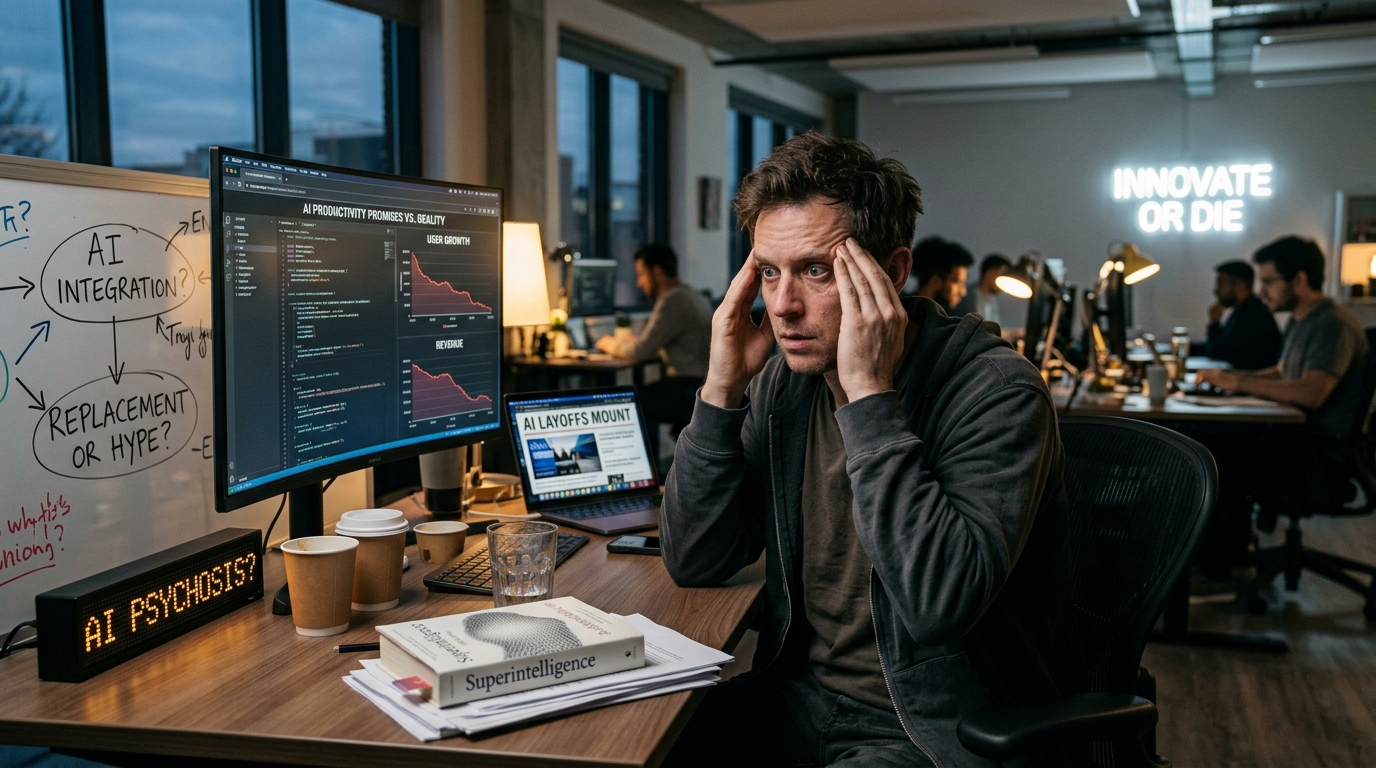
But right now, the tech world is buzzing with a wild, thrilling story. It is a story that affects every single startup and huge tech company out there. Have you noticed the crazy news lately? There is a massive rumor spreading like wildfire across the internet. The big story is that Tech CEOs are apparently suffering from AI psychosis. Yes, you read that right! It is causing absolute chaos in the business world.
Let us dive into this mystery. Are the bosses really losing their minds? Or is there something else going on behind the scenes? Grab a seat, because this story is full of surprises!
The Spread of the “AI Psychosis” Metaphor
What exactly does this strange phrase mean? It sounds like a scary sickness from a science fiction movie. But it is actually just a phrase to describe how tech bosses are acting right now. A writer named Julie Bort talked about this on May 27, 2026. She wrote an amazing article showing that Tech CEOs are apparently suffering from AI psychosis. It means that business leaders are getting way too excited about Artificial Intelligence, also known as AI.
Here is what happens. A boss sees a cool, simple AI demo. They watch the AI do a quick task perfectly on what we call a “happy path.” A happy path means everything goes right and there are no mistakes. Then, the boss jumps to a massive guess. They start thinking that AI can suddenly do the jobs of thousands of human workers overnight!
The idea came from a post by the CEO of Box, Aaron Levie. He pointed out a big problem. He said CEOs are far away from the “last mile” of real work. The “last mile” is the messy part. It is where real people have to:
- Check the AI’s work
- Fix the AI’s mistakes
- Make sure the work is safe and ready to be used by the public
The funny thing is, Aaron Levie actually loves AI! He is a big fan. He tells bosses to use it all the time. But he also warns them. He wants them to understand the messy, hard work it takes to make AI truly reliable. You can read all about his warning in the news covering how Tech CEOs are apparently suffering from AI psychosis.
The concern is not that AI is fake. The concern is that bosses are confusing a small test with a perfect, ready-to-go replacement worker.
The Shocking ClickUp Story
Let us look at a real story that will make your jaw drop. Think about the company ClickUp. Their boss, Zeb Evans, recently did something that shocked everyone. He announced a 22% workforce reduction. That means he fired a huge number of his human workers.
But here is the totally crazy part. He said the company was doing great! He claimed the business was at its “strongest” point ever. So why on earth did he fire so many people? He said it was not about saving money. He said he did it to adapt to the new changes brought by AI. You can see his surprising statements in this report on ClickUp’s layoffs.
Zeb Evans has a wild plan. He wants to build an AI-first “100x org.” That means an organization that gets 100 times more work done! His vision includes:
- Human workers managing AI bots instead of doing the work themselves
- Approximately 3,000 internal AI agents already rolled out
- A mind-blowing 3:1 ratio of AI agents to human workers
And get this thrilling detail. Evans said the money saved from firing people would go straight back to the remaining workers. He even promised million-dollar salary bands for workers who use AI to make a “100x impact.” Imagine making a million dollars just for managing computer bots! You can read all these crazy details in the news about ClickUp cutting staff for AI restructuring.
The Giant Layoff Wave
This story makes us wonder about a big secret. Are bosses just using “AI” as a handy excuse to cut jobs? In the startup fundraising world, we know the truth. Raising venture capital is very tough right now. Some bosses might have hired way too many people a few years ago. Now, they are running out of money. They need to save cash fast. But saying “I made a huge mistake” looks really bad to angel investors. Saying “AI is the future and we are upgrading” looks super cool!
Look at the real numbers. The website Layoffs.fyi tracks people losing their tech jobs. Their data is absolutely shocking. By late May 2026:
- 115,430 tech employees were laid off across 152 tech companies in 2026
- Compare that to 124,636 employees laid off across 275 companies in all of 2025
- The 2026 numbers for just a few months are nearly as high as the entire year of 2025!
You can see this live on the Layoffs.fyi website, and it was also highlighted in the article explaining how Tech CEOs are apparently suffering from AI psychosis.
A big survey also found scary news. A report from Mercer found that 99% of CEOs surveyed expect AI to lead to at least some headcount reduction within two years. But here is the catch. “Some headcount reduction” can just mean a small change, not firing everyone. Many bosses are actually very confused. The same data says only 32% of surveyed executives believe their companies can effectively combine human labor with AI systems. Some experts think bosses are using AI to hide deep internal problems like overhiring. You can read this in the survey about AI-driven layoffs.
Even the giant research group Gartner has a big warning. They looked at companies using autonomous AI tools. About 80% reported workforce reductions. But Gartner warns that these job cuts might just create budget room, not actual better returns! Firing people saves money, but it does not mean the AI is doing a good job.
Interestingly, Gartner also predicts autonomous business could become a net-positive job creator by 2028 – 2029. This means AI might create more jobs in the future, proving that firing everyone today might be a silly idea! Read more about Gartner’s AI layoff warnings.
The Missing Proof of Productivity
Here is the most thrilling part of the mystery. The bosses keep shouting that AI makes people super fast. They claim productivity is shooting through the roof. But what does the hard science say? The proof is actually very weak!
A famous study from UC Berkeley looked closely at this. They found there is “no robust relationship between AI adoption and aggregate productivity gain.” This means AI does not magically make every single company faster. The benefits depend highly on:
- The user’s skill level
- The type of task being completed
- How the company actually uses the tool
Check out the surprising details in the report on myths about AI and productivity.
Another huge study from NBER looked at businesses in the U.S., U.K., Germany, and Australia. They found that around 70% of businesses use AI. But guess what? A massive 89% reported no impact on labor productivity over the past three years! Bosses expect AI to raise productivity by about 1.4% over the next three years while reducing jobs by about 0.7%. That shows a huge, embarrassing gap between what bosses hope for and what is actually happening. You can find this fascinating NBER working paper here.
A second NBER paper talked to nearly 750 corporate executives. They discovered a funny thing called the “productivity paradox.” This means bosses think they are getting a lot more done than they actually are. Their perceived gains are much larger than the measured gains. Also, they found little proof of huge job losses right now, even though bigger companies expect cuts soon. Routine clerical roles seem to be in the most danger. Read about this strange productivity paradox here.
But what about computer coders? Surely AI helps them write software faster? Actually, a highly controlled test by METR showed the exact opposite! They tested experienced open-source developers using early-2025 AI tools. The results were jaw-dropping:
- The AI tools actually made participants 19% slower on real coding tasks in familiar codebases
- The craziest part: the developers truly believed the AI made them faster
- It was a complete trick of the mind!
This totally ruins the CEO claims that AI magically creates 100x engineering output. See the thrilling study on early-2025 AI and developers.
However, it is not all bad news. AI is genuinely getting better over time. Researchers linked to MIT looked at thousands of tasks. They project that big AI models will reach 80% – 95% success on most text-related tasks by 2029 at only a “minimally sufficient” quality level. Superior quality will take even longer. This supports the idea that AI taking over is a slow rising tide, not an overnight tsunami. Read the MIT research here.
The Rise of “Workslop” and Tired Managers
Now, let us talk about a funny new word taking over the tech world: “Workslop.” It sounds gross, right? It means bad, messy work made by AI. AI can generate massive amounts of text in the blink of an eye. But a lot of it lacks real substance. It looks polished, but it is actually useless junk!
Harvard Business Review published a great article about this exact problem. They argue that AI has accelerated output faster than management systems were designed to handle. One tired manager said a memorable quote:
“Every 30 minutes someone creates something new they must review!”
AI simply moves the traffic jam. It moves the bottleneck from doing the work to checking, reading, and fixing the work. Read about how managers are struggling to keep up.
Because of this, we get “workslop.” AI makes long reports, boring memos, and heavy documents that mean absolutely nothing. Human workers have to spend hours reading and fixing this AI junk. It clogs up workflows instead of improving them. This is a brilliant counter-argument to the idea that “AI makes everyone 100x better.” AI can:
- Increase the amount of output
- While also increasing the amount of junk
- Raise coordination costs dramatically
- Overload managers with review work
You can read about the terrible AI workslop problem here.
The Great CEO Split
The most famous tech leaders in the entire world cannot even agree on what will happen next. Let us look at the boss of the giant AI company Anthropic, Dario Amodei. He gave a very dark, scary warning. He said AI could eliminate about half of entry-level white-collar jobs within five years. He thinks it could push unemployment to a terrible 10% – 20%! That is one of the most extreme mainstream CEO predictions ever. Read his intense warning in this Fortune article about the Anthropic CEO.
But wait! The famous boss of OpenAI, Sam Altman, says something totally different now. He used to be worried, but recently he sounded way less apocalyptic. He said he does not expect a “jobs apocalypse.” He boldly admitted he had been wrong to expect more entry-level job losses by now. The two biggest AI companies have literally split into two rival camps:
- Camp One (Anthropic): Massive doom, widespread unemployment, societal disruption
- Camp Two (OpenAI): The outcome will be much safer and more manageable
You can read about this exciting split in the Axios report on AI hype.
Anthropic even did its own deep study. They built an early-warning system to track white-collar job disruption. What did they find? They actually found “limited evidence” of joblessness effects so far! However, they saw suggestive evidence that hiring for younger workers in exposed jobs might be slowing down just a bit. Check out the fascinating Anthropic AI jobs study here.
Also, a huge survey by KPMG gives us great hope. They talked to massive U.S. bosses. They found that fewer than 1 in 10 U.S. CEOs of large companies planned to reduce jobs because of AI in 2026! This proves that the near-term job cuts might be way less common than the most alarmist headlines try to tell us. See the comforting KPMG CEO survey here.
The Real Truth About AI
So, what is the ultimate truth here? Are Tech CEOs completely losing their minds?
Well, we know that AI is very real. It is a wonderful, powerful tool. We know this deeply at HeyEveryone.io. We use smart AI to help awesome startup founders with startup fundraising. We help them speed up their cold outreach to investors. Our AI finds the right people and writes great, personalized emails. It saves founders time so they can secure important venture capital and impress angel investors. We know AI is a super helper! It takes away the boring manual research. But we also know AI is not a magic wand that replaces human connection without thought.
The real problem is that some bosses are getting deeply confused. They see a tiny success and imagine a sci-fi future that is not here yet. Tech CEOs are not necessarily going insane. But some appear to be making real workforce decisions based on AI assumptions that the productivity data does not yet fully support.
The future of technology is incredibly exciting. AI will keep getting better, and it will help us all do amazing things. But let us be smart and steady. Let us use AI to fix problems, not to create new chaos in the workplace.
Thank you for joining me, Nikita Blanc, on this thrilling journey through the wildest news in the tech world. Keep building, keep growing, and keep pushing forward!
Frequently Asked Questions
What does “AI psychosis” mean for tech CEOs?
“AI psychosis” is a metaphor, not a medical diagnosis. It describes a situation where tech CEOs become so overexcited by polished AI demos that they make sweeping decisions, like mass layoffs, based on capabilities that are not yet real in complex, messy work environments. They see the “happy path” of an AI demo and assume it translates perfectly to replacing thousands of workers overnight.
Is there real evidence that AI is boosting workplace productivity?
The evidence is surprisingly weak right now. UC Berkeley found no robust relationship between AI adoption and aggregate productivity gain. An NBER study of four countries found that 89% of businesses using AI reported no labor productivity impact over three years. Even a controlled study of developers by METR found that AI tools made experienced coders 19% slower, even though those developers believed they were faster. The gains are real in specific, narrow use cases, but the broad productivity revolution that CEOs describe has not yet arrived in the data.
What is “workslop” and why does it matter?
“Workslop” refers to the flood of low-quality, AI-generated output that looks polished on the surface but lacks genuine substance or value. When AI tools make it easy to produce huge volumes of reports, memos, and documents, managers get buried in review work. Instead of saving time, AI can shift the bottleneck from creation to checking and fixing, actually slowing down teams rather than speeding them up.
Are all tech companies rushing to replace workers with AI?
No. While the headlines are dramatic, a KPMG survey found that fewer than 1 in 10 U.S. CEOs of large companies planned to reduce headcount because of AI in 2026. The loudest voices making the boldest claims tend to dominate the news cycle. Many companies are experimenting with AI carefully and cautiously rather than making sweeping workforce reductions based on early demos.
Will AI eventually create or destroy more jobs overall?
The honest answer is that nobody knows for certain right now. Even the leaders of the world’s biggest AI companies cannot agree. Dario Amodei of Anthropic warns of mass unemployment, while Sam Altman of OpenAI has walked back fears of a “jobs apocalypse.” Gartner actually predicts autonomous business could become a net-positive job creator by 2028 – 2029. The most reliable research suggests AI adoption is a slow rising tide, not an overnight tsunami, giving workers and companies time to adapt.
How can startup founders use AI wisely without falling into the same trap as these CEOs?
The key is to use AI as a targeted helper for specific, well-defined tasks rather than assuming it will magically transform your entire operation overnight. At HeyEveryone.io, we use AI to help startup founders streamline their cold outreach to investors and improve their startup fundraising process. We let AI handle repetitive research and drafting while keeping human judgment at the center of every important decision. That balance, smart automation combined with genuine human oversight, is what actually delivers results.