
Estimated reading time: 11 minutes
Key Takeaways
- Bluecore Energy raised roughly $10 million in an oversubscribed pre-seed round to build small modular, water-cooled nuclear reactors on floating barges.
- The company has delivered a barge and an electric test reactor to its Port of Long Beach headquarters, but has no NRC license, permit, or fueled reactor yet.
- Founder Kofi Asante is being recognized as the first Black founder of a U.S. nuclear energy company.
- Floating nuclear power is not a new concept — the U.S. ran one in the Panama Canal Zone decades ago, and Russia currently operates one commercially.
- Skyrocketing AI and data center electricity demand is a major driver behind renewed interest in floating nuclear power.
- Bluecore faces steep regulatory, safety, security, and community-acceptance hurdles before any commercial deployment.
Table of contents
- Key Takeaways
- The Big Idea: A Nuclear Plant You Can Float Anywhere
- Who Is Behind This?
- What Has Actually Been Built – and What Has Not
- “Nuclear Energy at Sea Is Not a New Idea”
- The AI Energy Crisis Makes This Story Explode
- Why the Port of Long Beach Is the Perfect Launchpad
- The Questions Nobody Can Ignore
- Bluecore Is Not Alone
- The Bottom Line
- Frequently Asked Questions
Imagine waking up one morning and reading that a startup just docked a nuclear power plant at your local port. Not a massive, years-in-the-making land-based facility with cooling towers you can see for miles – but a compact reactor sitting quietly on a barge, floating at the water’s edge, ready to plug into the grid and start powering your city.
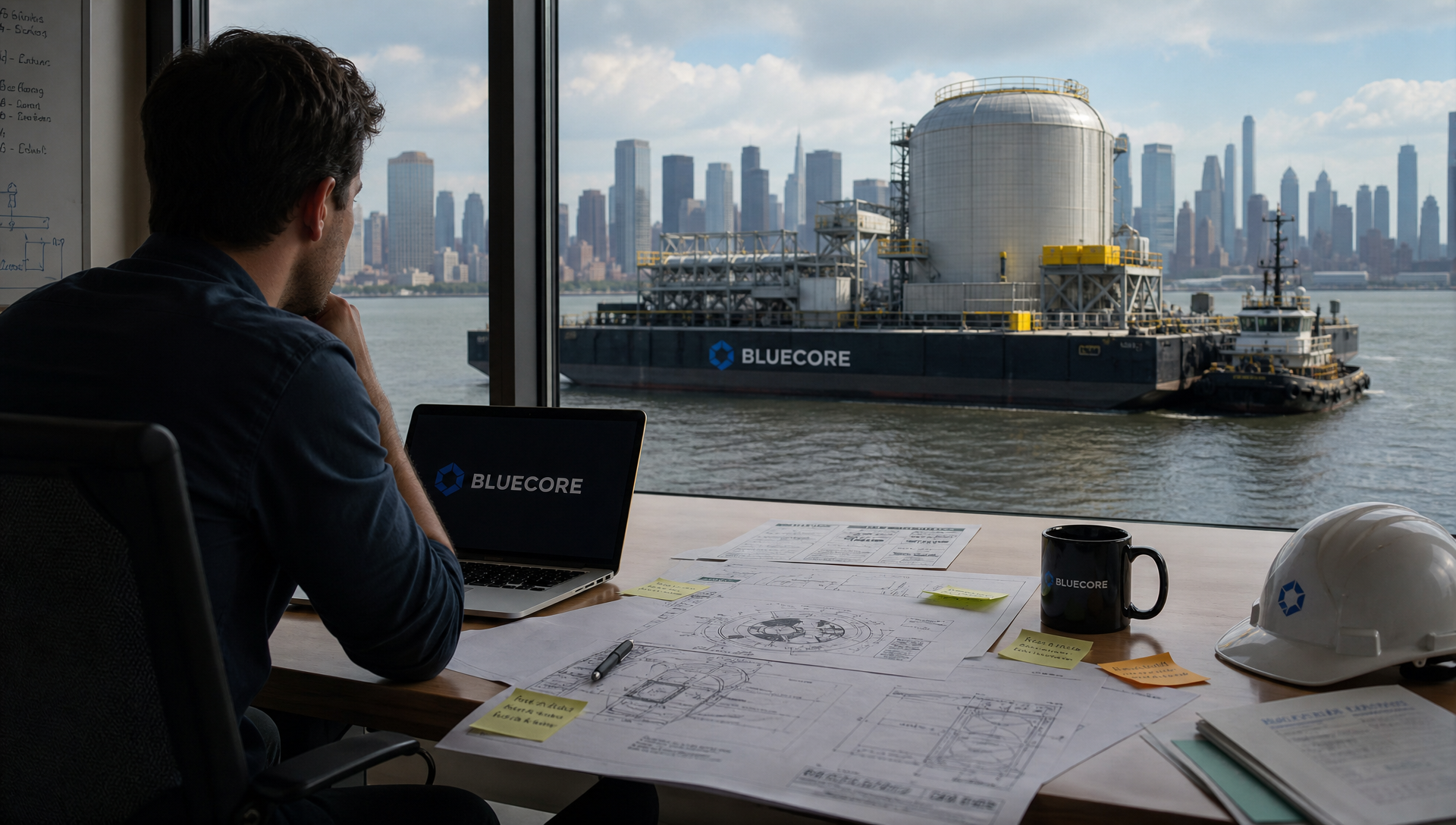
That is exactly what Bluecore Energy is trying to make real. On July 21, 2026, the Long Beach-based startup emerged from stealth with a bold announcement: it had raised approximately $10 million in an oversubscribed pre-seed round to develop small modular, water-cooled nuclear reactors designed to operate aboard floating energy barges. The round was led by Slauson & Co., with participation from Harlem Capital, Precursor Ventures, Visible Hands VC, Karman Ventures, Capital Factory, Ripple co-founder Chris Larsen, and angels who are former leaders at Tesla, Uber, Amazon, and Google.
The reaction online was immediate. Part fascination. Part alarm. Part “wait, is this actually legal?” And honestly, all three reactions make perfect sense. Because this story hits every nerve at once – nuclear fear, AI energy panic, climate politics, port safety, and a founder pitching delivery of nuclear power “as fast as an Amazon order.”
So let’s unpack exactly what is happening, what has actually been built, what has not, and why this story might just be one of the most important – and most controversial – startup announcements of 2026.
The Big Idea: A Nuclear Plant You Can Float Anywhere
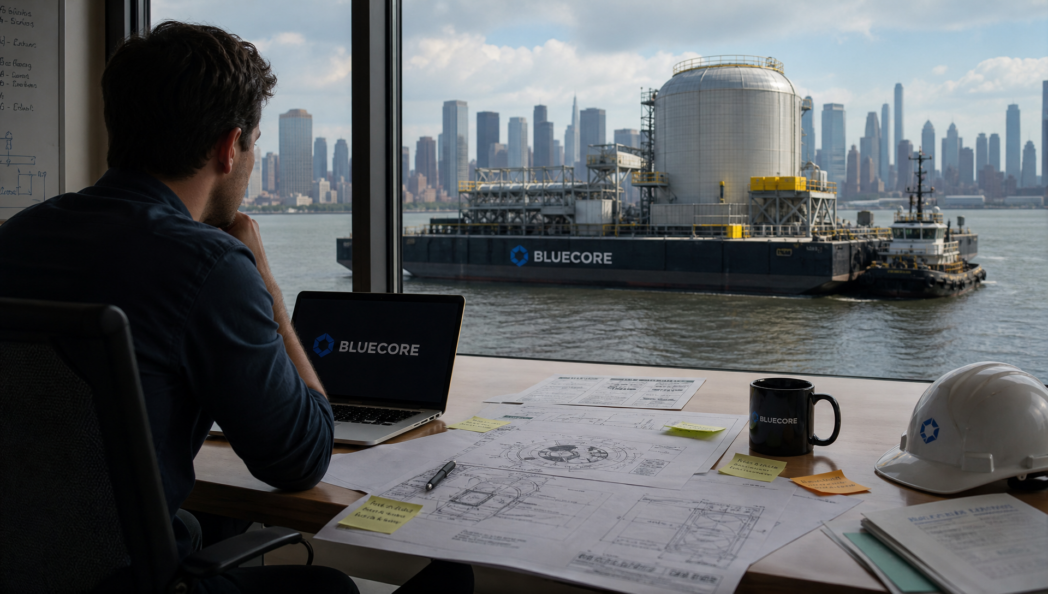
At its core, Bluecore Energy’s concept is almost elegant in its simplicity. Instead of building a power plant in a fixed location and then waiting years for grid infrastructure to connect it to wherever the power is actually needed, you put the reactor on a barge. Then you float it to wherever the demand is.
The company describes its product as a compact 10 MWe (megawatt electric) water-cooled reactor on a barge – modular, scalable, and zero-emission. Ten megawatts sounds modest, but Bluecore claims it is enough to power the equivalent of roughly 15,000 homes. String multiple units together and you can serve a major port, a large data center campus, or a critical piece of infrastructure that is struggling with energy supply.
The target markets read like a who’s who of the most urgent energy problems of our time:
- Ports undergoing massive electrification of cranes, trucks, and harbor vessels
- Data centers guzzling electricity to power AI workloads
- Critical infrastructure that cannot afford blackouts
- Utilities facing grid congestion and capacity shortfalls
- Offshore infrastructure far from the land-based grid
- Energy-constrained communities with limited or unreliable power access
- And eventually – cargo ship propulsion
The pitch from CEO Kofi Asante is direct and memorable: the system is designed to bring power to demand in a matter of days, not years.
Who Is Behind This?
Kofi Asante, Bluecore’s founder and CEO, quit his job in January 2026 to build the company – just months before its public debut. The idea was born partly from his own experience working with Port of Long Beach leadership on zero-emission infrastructure and ships. He has worked on deep-tech launch teams spanning ground, air, maritime, and nuclear domains, including stints at Uber Advanced Technology Group, Uber Freight, Elroy Air, and an electric tugboat program at the Port of Long Beach itself, according to AfroTech.
Asante is also being recognized as the first Black founder of a U.S. nuclear energy company – a milestone that adds a significant cultural and business dimension to the story beyond the technology itself.
But the team around him is what gives the company’s claims some weight. Bluecore’s leadership includes:
- Kwadwo Adutwum, a nuclear core design lead with experience at multiple light-water reactor companies
- Megan Moyette, Licensing and Safety Lead – a 13-year U.S. Navy nuclear submarine officer who operated maritime reactors at sea
- Andrew Phillips, Controls Lead – eight years at SpaceX across Falcon, Dragon, and Starship programs, plus maritime controls experience
- Jonathan Kyle, Ph.D., Thermal, Mechanical and Software Lead – experience at Blue Origin, Radiant, and Amazon
- William Zimmer, Quality and Supply Chain Lead – background at Toyota, Northrop Grumman aerospace manufacturing, and electric maritime vessels
The company also says its broader team includes former U.S. Navy nuclear submarine officers and a licensing advisor who has certified multiple operating reactors with the U.S. Nuclear Regulatory Commission.
This is not a group of dreamers sketching ideas on napkins. These are people who have worked on real systems, in real high-stakes environments.
What Has Actually Been Built – and What Has Not
Here is where the story demands honesty, because there is an important difference between a concept and a working nuclear plant.
Bluecore says it has secured and delivered its first barge to its Port of Long Beach headquarters, making it – by its own description – the first small modular reactor company to establish headquarters inside a major U.S. port. The company is also testing system components and has delivered an electric test reactor to the port.
That electric test reactor is significant, but it is important to understand what it is. It appears to be a non-nuclear or electrically heated test system used for engineering validation – not a fueled nuclear reactor. Bluecore has not announced a licensed operating nuclear reactor on a barge. There is no NRC construction permit, no operating license, and no design certification confirmed as of July 23, 2026. A check of the NRC’s advanced-reactor pre-application page – which lists many active vendors including Blue Energy, Last Energy, Radiant, X-energy, and TerraPower – does not include Bluecore.
No commercial customer, offtake contract, deployment date, reactor vendor partner, fuel supplier, or ship-classification approval has been confirmed in public materials. And $10 million, while meaningful as a pre-seed raise, is a very small number relative to what it actually costs to license, manufacture, fuel, certify, insure, and deploy a commercial nuclear power plant.
So this is real – but it is also very, very early.
“Nuclear Energy at Sea Is Not a New Idea”
Asante’s most confident public statement is worth taking seriously: “Nuclear energy at sea is not a new idea.” And he is absolutely right.
The United States has already done this. The MH-1A Sturgis, a former World War II Liberty Ship converted in the 1960s, became the world’s first floating nuclear power plant and generated electricity in the Panama Canal Zone from 1968 to 1976. The U.S. Army Corps of Engineers completed its full decommissioning and dismantling as recently as 2019 – a process that illustrates one of the long-tail challenges for floating nuclear concepts: eventual decommissioning, radioactive waste handling, and specialized environmental protection.
Russia has gone even further. The Akademik Lomonosov is a fully operational floating nuclear power plant, using a KLT-40S floating pressurized water reactor with 32 MWe of reference unit power. It achieved its first grid connection on December 19, 2019 and entered commercial operation on May 22, 2020.
Floating nuclear power plants can exist. They do exist. Bluecore’s challenge is to make one that is commercially viable, safe, and acceptable in a dense U.S. port environment – and that is a very different challenge.
The AI Energy Crisis Makes This Story Explode
One of the biggest reasons the Bluecore story is landing so hard right now is timing. The world has a massive and growing electricity problem, and artificial intelligence is a huge part of it.
The International Energy Agency reports that global data center electricity consumption reached approximately 415 TWh in 2024, accounting for around 1.5% of global electricity demand – and is projected to more than double to roughly 945 TWh by 2030. U.S. data centers alone account for nearly half of all U.S. electricity demand growth between now and the end of the decade.
A June 2026 Lawrence Berkeley National Laboratory update estimates that U.S. data centers could account for 11.8% of total U.S. electricity use by 2030, with some scenarios pushing that figure as high as 15.3%.
The IEA also notes that nuclear power could play a significant role in meeting U.S. data center electricity demand after 2030, when the first small modular reactors are expected to come online – and that technology companies have plans to finance more than 20 GW of SMRs to date.
Into this context steps Bluecore, saying: we can bring a clean, 24/7, grid-independent power source directly to wherever the demand is, faster than you can expand the grid. The pitch lands differently when data center operators are genuinely scrambling for power and utility queues stretch years into the future.
Why the Port of Long Beach Is the Perfect Launchpad
Bluecore’s choice of headquarters is no accident. The Port of Long Beach is one of the busiest cargo ports in the United States and is deep in the middle of a major electrification push. The port’s CEO, Dr. Noel Hacegaba, is quoted in Bluecore’s press release saying the port’s 2050 vision involves growing electrification and a zero-emissions transition that will require hundreds of megawatts of energy.
The San Pedro Bay Ports Clean Air Action Plan, which covers both the Port of Long Beach and the Port of Los Angeles, has long targeted reductions in port-related air pollution and public health risks while supporting continued port operations and trade.
A zero-emission floating nuclear plant offering dense, reliable, carbon-free power directly at the dock is – at least conceptually – exactly what a port in transition needs. The politics, however, are considerably more complicated.
The Questions Nobody Can Ignore
Any honest telling of the Bluecore story has to sit with the uncomfortable questions, because they are not small ones.
What if the barge gets hit? A nuclear barge operating in a busy commercial port faces real risk from ship collisions, storms, fire, and grounding. Bluecore describes a defense-in-depth approach with five barriers – fuel core, cladding, reactor vessel, steel containment, and water shield – plus passive safety systems and diverse shutdown mechanisms. But the full safety case and detailed accident analysis have not been published.
What about terrorism or sabotage? The IAEA has explicitly identified physical protection, cybersecurity, and insider-threat challenges as key issues for floating nuclear plants. A high-profile nuclear barge in a major commercial harbor is, by its nature, a visible and potentially attractive target.
Who actually regulates this? The U.S. Nuclear Regulatory Commission says it can license maritime nuclear reactors today under existing regulations, and in 2026, the NRC and the U.S. Coast Guard established a new memorandum of understanding to coordinate oversight of civilian maritime nuclear projects – replacing a 1973 agreement that dated back to the Atomic Energy Commission. But a floating nuclear reactor still sits at the intersection of nuclear regulation, maritime law, port authority rules, emergency planning, environmental review, and homeland security. That is an extraordinarily complex regulatory path. Environmental reviews for new commercial nuclear facilities currently take roughly 24 to 36 months for the NRC’s process alone.
The IAEA has noted that floating nuclear power plants bring real potential benefits – mobility, shipyard construction, service to remote coastal communities – but also significant challenges related to regulation, safety, security, and legal frameworks.
Where does the spent fuel go? Bluecore says its reactor is designed to be fueled once for years of operation, but public materials do not yet specify fuel type, enrichment levels, refueling logistics, spent-fuel storage, transport, or final disposal strategy.
Will the community accept it? The communities around the Port of Long Beach and Port of Los Angeles already carry a heavy environmental burden from freight-related pollution. A zero-emission power source could offer genuine relief. But the word “nuclear” in a dense urban coastal community will not go unchallenged.
Bluecore Is Not Alone
It is worth noting that Bluecore is entering a space that is already getting crowded. CORE POWER announced a feasibility study with BWXT in June 2026 to assess integrating BWXT’s mPower SMR – a 195 MWe Generation III+ integral pressurized-water design – into floating nuclear power plants built in and deployed from shipyards. Prodigy Clean Energy is developing Transportable Nuclear Power Plants ranging from 1 MW to gigawatt scale, designed for both marine and land-based deployment. Danish company Seaborg, now operating as Saltfoss Energy, has been developing a compact molten-salt reactor power barge concept. And Blue Energy – a separate company, not to be confused with Bluecore – secured $45 million to develop prefabricated nuclear plants using shipyard manufacturing and has had active NRC pre-application engagement since March 2025.
The race is real. The need is real. And the finish line is still very far away for everyone in it.
The Bottom Line
Bluecore Energy’s announcement is genuinely exciting and genuinely early. There is a barge. There is a test reactor. There is a serious team. There is real investor backing from credible names. There is a founder with a compelling story and a clear vision.
But there is no licensed nuclear reactor on a barge. There is no NRC permit. There is no commercial customer. And $10 million – while a strong signal of early confidence – is a long way from what it takes to bring a floating nuclear power plant to commercial operation.
What Bluecore has done is something arguably harder than any of those next steps: it has made the conversation feel urgent and real. In a world where AI is straining the grid, ports are trying to go green, and the energy transition is colliding with the very real limits of where the grid can reach, the idea of a floating nuclear power plant you can float into position in days rather than years is not science fiction. It has been done before – in the Panama Canal, and right now in the Arctic.
The question is not whether the concept can work. History says it can. The question is whether Bluecore Energy can navigate one of the most complex regulatory, engineering, safety, financial, and political labyrinths in the history of clean energy startups – and come out the other side with a product that ports, communities, and regulators are willing to accept.
That is a very big question. And the fact that so many people are asking it is exactly why this story is going to keep spreading.
Frequently Asked Questions
Has Bluecore Energy actually built a working nuclear reactor?
No. Bluecore has delivered a barge and an electric test reactor to the Port of Long Beach for engineering validation, but this is not a fueled nuclear reactor. There is currently no NRC license, permit, or design certification confirmed for the company.
Is floating nuclear power a new idea?
No. The U.S. operated the MH-1A Sturgis floating nuclear plant in the Panama Canal Zone from 1968 to 1976, and Russia’s Akademik Lomonosov has been in commercial operation since 2020.
How much power can Bluecore’s reactor generate?
The company describes a compact 10 MWe water-cooled reactor per barge, which it claims can power roughly 15,000 homes, with multiple units able to be combined for larger loads.
Who regulates floating nuclear reactors in the United States?
The Nuclear Regulatory Commission oversees nuclear licensing, while the U.S. Coast Guard oversees maritime safety. In 2026, the two agencies signed a new memorandum of understanding to coordinate oversight of civilian maritime nuclear projects.
Why is there so much interest in floating nuclear power right now?
Surging electricity demand from AI and data centers, combined with slow grid expansion timelines, has made fast-to-deploy, carbon-free power sources like floating nuclear reactors increasingly attractive to ports, utilities, and tech companies.
Is Bluecore Energy the only company working on this concept?
No. Competitors and peers include CORE POWER and BWXT, Prodigy Clean Energy, Seaborg (Saltfoss Energy), and Blue Energy, all pursuing different approaches to floating or shipyard-built nuclear power plants.