
Estimated reading time: 11 minutes
Key Takeaways
- Savi Security launched an app to protect families from AI voice cloning scams and virtual kidnapping schemes.
- The founders built the company after their own mother nearly fell victim to an AI-powered fake kidnapping scam.
- Imposter scams cost consumers $3.5 billion in 2025 alone, nearly triple the 2020 figure.
- Savi’s standout feature, “Savi On-Call,” lets users silently add the app to a live call to detect scams in real time.
- Savi launched with a $7 million seed round led by Acrew Capital.
- Simple habits like hanging up and calling back or using a family code word remain some of the strongest defenses available today.
Table of contents
- Key Takeaways
- The Nightmare That Started It All
- This Is Not a Rare Fluke – It Is a Growing Crisis
- Meet Savi: The App Built to Be Your Panic Firewall
- Scamwise: The Free Tool That Built the Brain Behind the App
- The Founders Behind the Mission
- How Does Savi Stack Up Against the Competition?
- What About Privacy?
- The Regulatory Backdrop
- What Every Family Should Do Right Now
- The Bigger Picture
- Frequently Asked Questions
Imagine your phone rings. The caller ID shows your daughter’s name. You pick up, and you hear her voice – panicked, screaming, crying. A man gets on the line and tells you she has been kidnapped. He knows which Walmart she shops at. He demands $1,200 or she dies.
Your heart stops. Your hands shake. You are about to do whatever it takes.
But here is the terrifying truth: your daughter is perfectly safe at home. The voice you heard was not hers. It was built by artificial intelligence, trained on a few seconds of audio pulled from her social media. And scammers just almost took your money and your peace of mind in under two minutes.
This is not a movie plot. This is happening right now, to real families, all across the United States. And a new startup called Savi Security wants to be the app that stops it.
The Nightmare That Started It All
The story behind Savi Security is as chilling as it gets. According to a TechCrunch report from July 7, 2026, brothers Patrick and Ryan Coughlin founded the company after their own mother became the target of an AI-powered fake kidnapping scam.
The call came in on her daughter’s caller ID. On the other end, she heard what she believed was her daughter’s voice, filled with fear and distress. Then a man took over. He told her that her daughter had been kidnapped and that he would kill her in the parking lot of a nearby Walmart – a Walmart her daughter actually visited regularly – unless she paid $1,200 immediately.
Thankfully, the mother kept her head just long enough to call her daughter directly. Her daughter picked up, safe and confused. The entire call had been a sophisticated AI-powered scam. The phone number was spoofed. The voice was cloned. The location detail was researched. And the panic was entirely manufactured.
Patrick Coughlin later described the incident as proof that tactics once aimed at governments and Fortune 500 companies are now cheap enough to use against everyday families. That moment became the founding mission of Savi Security, a Los Angeles-based consumer safety startup built to fight back.
This Is Not a Rare Fluke – It Is a Growing Crisis
Before we talk about what Savi is building, it is worth understanding just how massive and real this threat has become.
The Federal Trade Commission (FTC) first warned the public in March 2023 that scammers can clone a loved one’s voice using only a short audio clip found online. A few seconds from a TikTok video, an Instagram Live, or even a voice note is enough. The FTC’s advice is blunt and urgent: do not trust the voice alone. Hang up and call the person back on a number you already know.
The FBI went further in December 2024, warning that criminals are using generative AI to commit fraud at a larger scale than ever before, making schemes far more believable. Specifically, the FBI called out AI-generated vocal cloning as a tool criminals use to impersonate loved ones in crisis and demand immediate financial help or ransom. They noted that AI removes the spelling mistakes and awkward language that once helped people spot fake messages.
Then in December 2025, the FBI issued another alert, this time about virtual kidnapping scams using altered proof-of-life photos and videos pulled from social media. Criminals contact families claiming to have kidnapped their loved one, send seemingly real images to back it up, demand ransom immediately, and threaten violence if anyone contacts the police.
The financial damage is staggering. The FTC reported on June 15, 2026 that consumers lost $3.5 billion to imposter scams in 2025 alone – nearly triple the amount reported in 2020. Imposter scams were the single most reported fraud category of 2025, appearing in nearly one out of every three fraud reports filed.
Zoom out even further and the picture gets darker. Total fraud losses across all categories reached approximately $16 billion in 2025, the highest on record and roughly 25% above 2024 figures. For context, consumers had already lost more than $12.5 billion to fraud in 2024, with imposter scams accounting for $2.95 billion of that total.
Research from McAfee adds another layer of fear. Their 2023 AI voice cloning report found that many people regularly share voice recordings online and that just a few seconds of audio from Instagram Live, TikTok, or voice messages can give fraudsters everything they need to create a convincing clone. U.S. respondents were among the most likely to say they had personally experienced an AI voice scam or knew someone who had.
Consumer Reports echoed those fears in their own AI voice cloning report, warning that voice-cloning tools are supercharging impersonation scams and that ordinary consumers cannot reasonably avoid having their voices recorded and posted online. The risk is not something individuals can simply opt out of.
Meet Savi: The App Built to Be Your Panic Firewall
On July 7, 2026, Savi Security launched its app on both iOS and Android, and simultaneously announced a $7 million seed funding round led by Acrew Capital, with participation from Magnify Ventures, TTCER, and Resolute Ventures. The funding will accelerate development of Savi’s AI-native security platform and its behavioral AI technology for screening calls, messages, and digital communications.
Acrew Capital partner Lauren Kolodny put it plainly in Savi’s launch announcement: governments and enterprises have been investing in cyber defense for years, but consumers have “missed out on innovation.” People now need a new generation of protections built specifically for AI-powered threats.
Savi describes itself as an always-on family scam protection layer. Here is what the app can actually do:
- Text Message Protection automatically routes scam and spam texts to junk before they ever reach your inbox. This feature is currently available on iPhone only, as Android’s platform-level restrictions prevent Savi from supporting text filtering there.
- Voicemail Screening steps in when unknown callers try to reach you. Savi takes the message, identifies the caller, and flags any suspected scam attempts so you can review them without ever picking up.
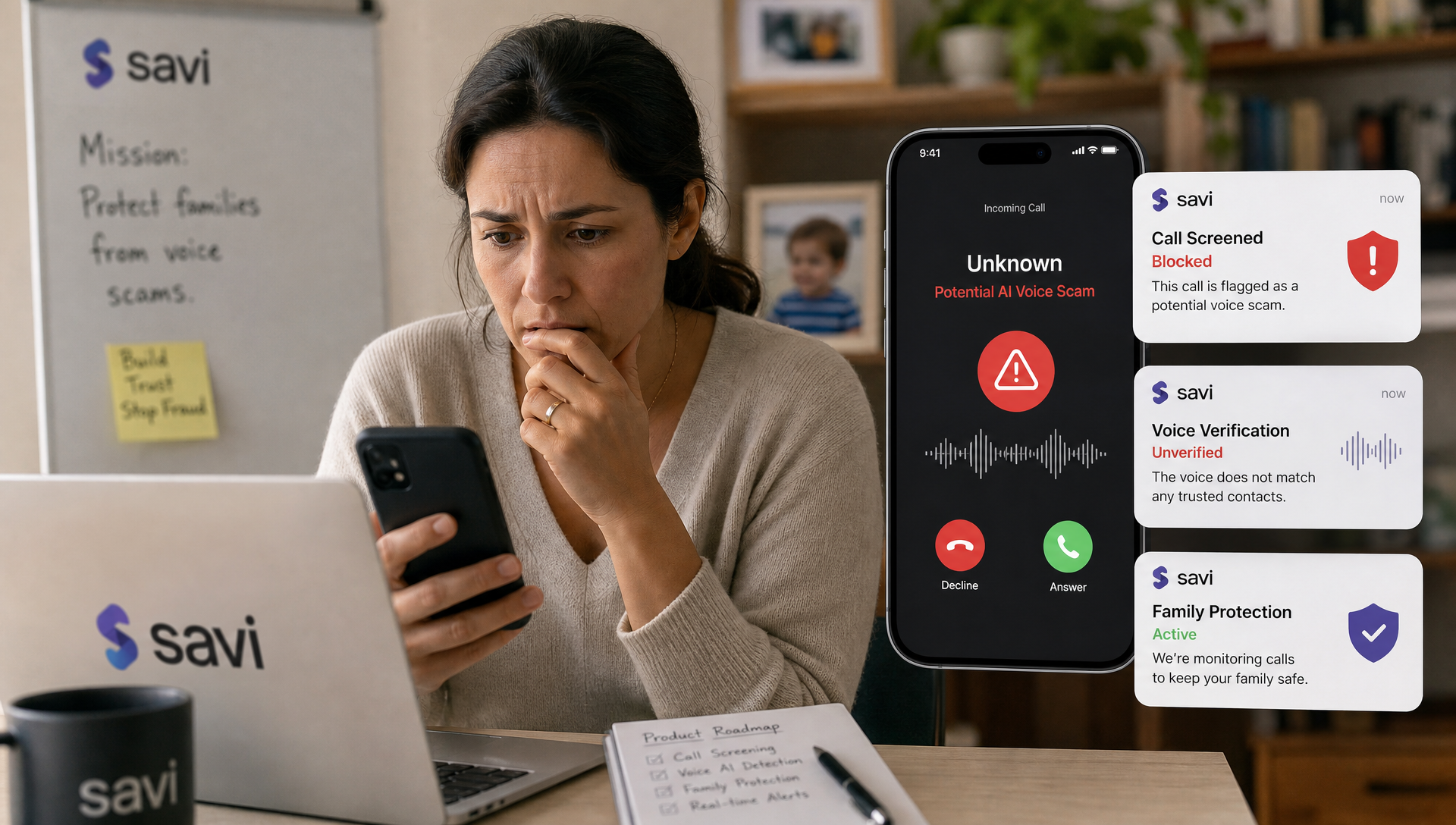
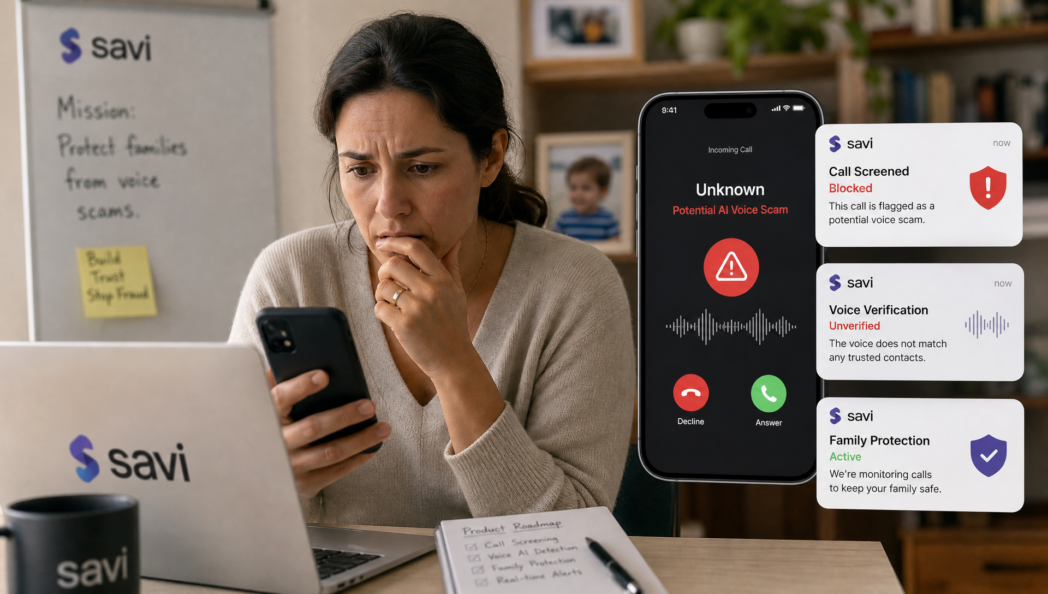
- Live Call Monitoring – or “Savi On-Call” – is the feature that makes the startup genuinely stand out. Users can silently add Savi to a live call already in progress. Savi listens in real time, detects scam patterns, and alerts the user during the actual conversation. This is the feature that could have helped the Coughlin brothers’ mother in the exact moment she needed it most.
- Scamwise is a free scam checker where users can submit suspicious messages, links, images, emails, phone numbers, or situations and receive an instant verdict. Before the app launched, Savi used Scamwise to gather real-world data and train its AI detection model.
- Proactive Call Screening is an upcoming feature expected to arrive in fall 2026. It will screen unknown callers before the call even reaches you.
- Family Coverage means one plan protects unlimited family members, including parents, partners, children, and other dependents – all under a single subscription.
Scamwise: The Free Tool That Built the Brain Behind the App
One of the most interesting parts of Savi’s story is how they built their detection capability before they even had a paid product. According to TechCrunch, Savi launched Scamwise roughly four months before the app launch. In that short window, it received 50,000 submissions and was growing by about 10,000 new submissions every week. By the time the app launched, Scamwise had crossed 100,000 total submissions.
The company’s press release confirmed that more than half of those submissions were identified as scams, including fake e-commerce websites, government impersonation schemes, and banking and finance fraud. That real-world dataset gave Savi’s AI model something most startups can only dream of at launch: actual threat intelligence from actual victims.
TechCrunch also reported that Savi was primarily using Google’s Gemini model at the time of launch, while building on an AI gateway system that allows it to plug in other models as needed, including tools built specifically for voice detection.
Scamwise is free and will remain free, available both inside the app and on the web.
The Founders Behind the Mission
Patrick and Ryan Coughlin are not first-time founders stumbling into a hot trend. They bring deeply relevant experience to a deeply personal mission.
Patrick’s background is in national security and enterprise cyber defense. Before founding Savi, he worked at TruSTAR, Splunk, Cisco, and Booz Allen Hamilton – organizations that sit at the intersection of government intelligence and corporate cybersecurity. Ryan is an AI and machine learning product leader who built consumer and platform products at Apple, Spotify, JW Player, and Sounder.
Together, they bring exactly the combination the problem demands: one brother who spent his career defending institutions from nation-state cyber threats, and one who spent his career making consumer technology feel effortless. Savi was founded in 2025 and the app is currently available in the United States on most major carriers, including AT&T, Verizon, and T-Mobile, as long as the carrier supports conditional call forwarding.
Pricing is accessible. Savi offers a family plan at $7.99 per month with a 7-day free trial, or $62.99 per year – which works out to $5.25 per month – with a 14-day free trial. The plan covers unlimited family members and includes voicemail screening, live call monitoring, suspicious message checks, and support through email, chat, and a one-on-one setup call.
How Does Savi Stack Up Against the Competition?
Savi is not operating in an empty market. Other companies are also applying AI to scam detection, and it is worth knowing who the players are.
Malwarebytes Scam Guard offers AI-powered scam detection that can analyze suspicious texts, emails, websites, ads, and messages. Truecaller’s AI Call Scanner claims to detect in real time whether a caller’s voice is human or AI-generated. Aura’s Call Protection bundles AI-powered spam call and message protection inside a broader family digital safety and identity protection product.
What sets Savi apart, according to TechCrunch, is the combination of family-wide coverage and live call monitoring during an active scam conversation. Malwarebytes and Aura are broader security suites. Truecaller leans heavily into call identification. Savi’s specific positioning is around crisis-call intervention – being there in the exact moment of panic before someone wires money, sends gift cards, or transfers cryptocurrency.
What About Privacy?
It is a fair and important question. An app that listens to your calls and reads your messages requires a high level of trust.
Savi’s FAQ states that the company collects only the minimum information needed, always with user permission, and that its AI providers are vetted for security and privacy. Crucially, Savi says its AI providers are contractually prohibited from using your data to train their own models.
For family accounts, Savi is clear that a “Guardian” – the account holder who covers other family members – does not see a family member’s voicemail transcripts, audio, text messages, call logs, or contacts. The Guardian only sees that the person joined the account and set up their protection. That is an important privacy boundary, though it is worth noting that independent third-party verification of these claims has not yet been published at the time of this writing.
The Regulatory Backdrop: Laws Are Moving, But Not Fast Enough
Lawmakers and regulators have started taking this threat seriously, but the gap between policy and real-time consumer harm remains wide.
The FCC declared in February 2024 that AI-generated voices in robocalls are illegal under the Telephone Consumer Protection Act. That ruling was partly driven by fears that AI voice cloning could be weaponized for scams, extortion, and even voter deception.
The FTC’s government and business impersonation rule went into effect in April 2024, giving the agency sharper tools against scammers pretending to be government agencies or companies. The FTC has also proposed extending those protections to cover impersonation of individuals and has run a Voice Cloning Challenge to encourage new tools and policies.
But as TechCrunch noted, regulation does not help the parent who is on the phone right now, shaking, hearing what sounds like their child screaming. Many scam calls come from spoofed numbers and overseas actors, and by the time any authority could intervene, the money is already gone. That real-time gap is exactly where Savi is planting its flag.
What Every Family Should Do Right Now
Whether you download Savi or not, the FTC and FBI have published concrete steps that every family should take today. These cost nothing and could save everything.
- Do not trust the voice alone. AI can clone your loved one’s voice using audio from their social media. A familiar voice is no longer proof of anything. (FTC)
- Hang up and call the person back directly using a number you already have saved. If they don’t answer, call another trusted family member immediately. (FTC)
- Create a family code word. Pick a word or phrase that only your family knows. In any emergency call, ask for it. The FBI specifically recommends this for AI-enabled fraud and virtual kidnapping scenarios. (FBI)
- Treat urgent secrecy as a major red flag. Scammers will tell you not to call anyone, not to tell the police, and to act immediately. That pressure is the scam. (FBI)
- Be suspicious of ransom demands via gift cards, cryptocurrency, wire transfers, or payment apps. These methods are extremely hard to reverse, and that is exactly why scammers prefer them. (FTC)
- Report it. File a report with the FTC at ReportFraud.ftc.gov and with the FBI’s Internet Crime Complaint Center at IC3.gov, especially if the scam involved cyber-enabled extortion, virtual kidnapping threats, or AI-generated voices. (FTC)
The Bigger Picture
Savi Security’s launch is not just a startup story. It is a signal that we have crossed a threshold where our oldest and most trusted instincts – recognizing the voice of someone we love, trusting the caller ID we see – can no longer be taken at face value.
AI voice cloning has transformed the classic “grandparent scam” into something far more cinematic and far more dangerous. The scammer who once fumbled through a vague story about a car accident now has a weapon that sounds, cries, and screams exactly like your child. The technology to do this is cheap, fast, and widely available.
Two brothers whose mother was nearly victimized decided to build the firewall that families never knew they needed. With $7 million in seed funding, a free scam-checking tool already processing tens of thousands of real-world threats, and a live-call monitoring feature that can intervene in the worst possible moment, Savi is making a compelling case that consumer-grade AI security is no longer a luxury.
Our caller ID can lie. Our ears can be fooled. And for the first time, there might be an app in your pocket that catches the scam before your panic does.
Frequently Asked Questions
What is Savi Security and what does its app do?
Savi Security is a consumer safety startup that launched an app designed to protect families from AI-powered scams, including voice cloning and virtual kidnapping schemes. It offers text message protection, voicemail screening, live call monitoring, and a free scam-checking tool called Scamwise.
How does AI voice cloning scam work?
Scammers use just a few seconds of audio pulled from social media, such as TikTok or Instagram Live, to train an AI model that can replicate a person’s voice. They then call a family member, often spoofing the victim’s caller ID, and use the cloned voice to fake a crisis and demand urgent payment.
What is “Savi On-Call” and how does it help during a scam?
Savi On-Call is a live call monitoring feature that lets users silently add Savi to a call already in progress. The AI listens in real time, detects scam patterns, and alerts the user during the actual conversation, which could help someone recognize a scam before sending money.
How much does Savi cost?
Savi offers a family plan at $7.99 per month with a 7-day free trial, or $62.99 per year, which works out to $5.25 per month, with a 14-day free trial. One plan covers unlimited family members.
Is Savi available on Android and iPhone?
Yes, Savi is available on both iOS and Android. However, text message protection is currently limited to iPhone only, due to platform-level restrictions on Android that prevent text filtering.
What should I do if I receive a suspicious call claiming a family member is kidnapped?
The FTC and FBI recommend not trusting the voice alone, hanging up, and calling the person back directly using a number you already have saved. Using a pre-established family code word and treating demands for secrecy as a red flag are also strongly recommended.
How much money have Americans lost to imposter scams?
According to the FTC, consumers lost $3.5 billion to imposter scams in 2025 alone, nearly triple the amount reported in 2020. Total fraud losses across all categories reached approximately $16 billion in 2025.