
Estimated reading time: 9 minutes
Key Takeaways
- Acti is a Singapore-based startup that just launched an “agentic keyboard” for iOS and Android, promising to turn every text field into an action layer.
- The keyboard’s flagship feature, the Acti Bar, lets you type a request, hold the button, and get results or completed actions without ever leaving your app.
- Founder Young Wang previously grew Facemoji Keyboard to over 300 million daily active users, giving this launch serious pedigree.
- Acti closed a $5.3 million seed round led by BITKRAFT Ventures and runs on Google’s Gemini models.
- The keyboard requires “Allow Full Access” on iOS and a system warning on Android, raising real privacy and trust questions despite Acti’s no-keylog claims.
- Community reaction is split — some see it as the future of human-computer interaction, others find it unnecessary and unsettling.
Table of contents
- Key Takeaways
- What Exactly Is Acti?
- How Does It Actually Work?
- Who Built This, and Where Did the Money Come From?
- The Part That Is Kinda Terrifying
- The Community Is Already Divided
- Where You Can Get It Right Now
- The Bigger Picture: What This Means for the Future of AI on Mobile
- Frequently Asked Questions
Imagine this: you’re texting a friend, they ask where you should eat tonight, and instead of flipping over to Google Maps, switching to Yelp, copying a link, jumping back to your messages, and pasting it in – you just type what you want, hold down a button on your keyboard, and the answer drops right into the conversation. No app switching. No interruption. Just your keyboard, doing the thing.
That is exactly what a Singapore-based startup called Acti is promising. And this week, the tech world is buzzing because Acti just launched what it calls an “agentic keyboard” for both iOS and Android – and it could change the way you interact with your phone forever. Or, depending on how you feel about AI sitting inside the most private surface on your device, it could be the creepiest thing to happen to smartphones in years.
Either way, it is very hard to look away.
What Exactly Is Acti?
At its most basic, Acti is a replacement keyboard for your smartphone. But calling it just a keyboard is like calling a Tesla just a car.
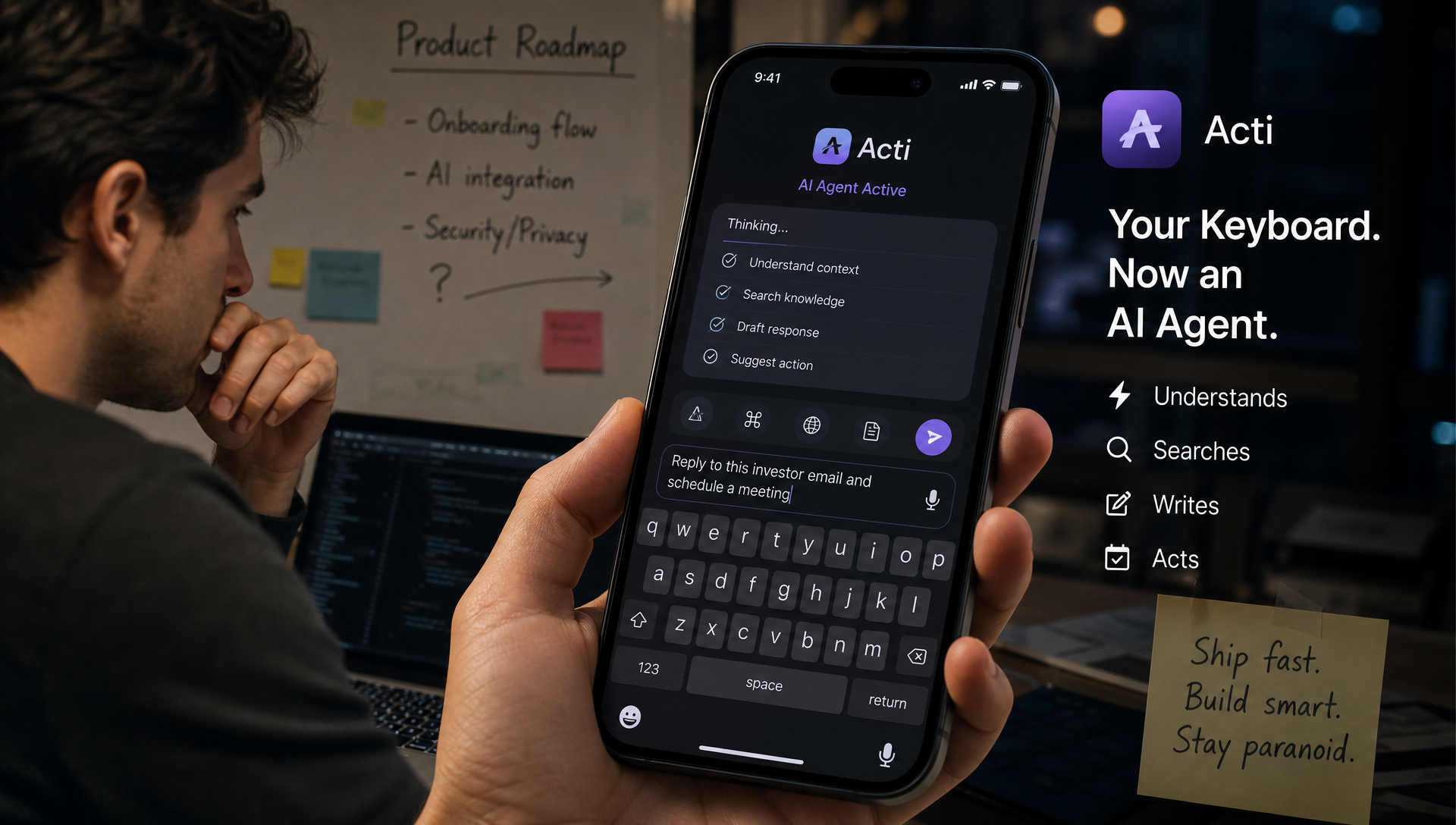
According to TechCrunch’s launch coverage on June 30, 2026, Acti wants to turn the smartphone keyboard from a passive typing tool into a full AI execution layer. That means it can search, summarize, translate, create meeting links, pull documents, check live information, and run workflows – all directly inside text fields, across every app on your phone.
The slogan says it all:
“Press to type. Hold to act.”
Instead of opening ChatGPT, Google, Calendar, Notion, or Maps as separate apps, Acti lets you type what you want inside any app, hold the keyboard, and have the AI bring back a result or take an action – right there, right then, without you ever leaving the app you were already using.
This is what makes it different from every other so-called “AI keyboard” that has come before it. Most AI keyboards are built around text transformation: fix this sentence, change the tone, translate this paragraph. Acti’s distinction is execution. The keyboard is not just helping you write – it is actually doing things. Connecting to outside tools. Running workflows. Taking actions on your behalf. As Acti’s own website puts it, the goal is to turn every text field on your phone into an action layer.
How Does It Actually Work?
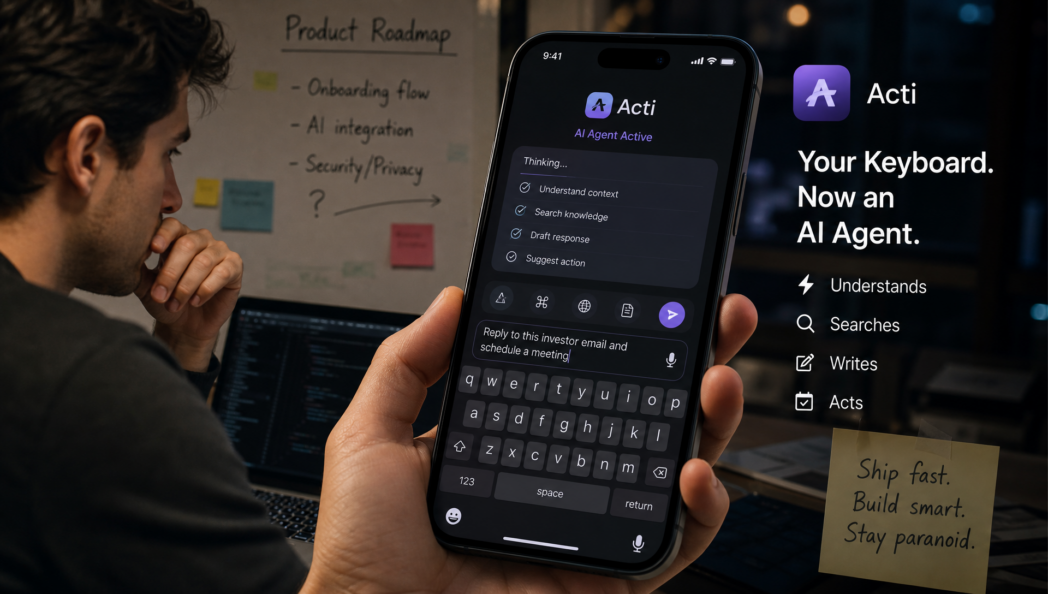
The main feature is something Acti calls the Acti Bar – a modified spacebar/action bar at the bottom of the keyboard. You type what you want, long-press the Acti Bar, and Acti returns a result, a link, or a completed action right where you are.
Acti’s own site uses vivid examples: summoning Italian restaurant recommendations in San Francisco, sharing a location link with a friend, or dropping live World Cup schedules into a group chat. All without leaving the conversation.
But it goes deeper than that. Acti also includes Skill Keys, where individual keyboard keys are turned into reusable shortcuts for specific actions. According to TechCrunch, built-in examples include long-pressing “T” to instantly translate a message and long-pressing “C” to create and share a Google Meet link. The app’s store listings also mention actions like pulling up Notion docs, accessing LinkedIn profiles, checking Google Calendar, looking up live sports schedules, and finding nearby restaurants.
And for power users, there is the Skill Builder – a tool that lets you describe a custom workflow in plain language, connect apps or APIs, save it as a reusable Skill, and even share it publicly in Acti’s Skill Hub community. Think of it like building your own shortcuts, except you explain what you want in normal words and the AI figures out the steps.
As the team explains on Reddit, the strongest way to think about Acti is as the Zapier or Apple Shortcuts layer for mobile typing – with the keyboard itself as the trigger surface. The keyboard is one of the only UI surfaces that travels with you across every single app: messaging, email, notes, browsers, social media, and work tools. If you can put an AI agent there, you essentially have an AI that follows you everywhere on your phone.
Who Built This, and Where Did the Money Come From?
The founder and CEO of Acti is Young Wang, and his background is what makes this story even more interesting. Before starting Acti, Wang spent around a decade at Baidu and worked on growing Facemoji Keyboard, which TechCrunch reports reached over 300 million daily active users. This is not a first-time founder throwing something at the wall. This is someone who has built keyboard products at a scale most people can barely imagine.
Wang is joined by CTO Mike Sun, who was the founding technical lead behind Baidu’s cloud-photo platform Yike Album, and CSO Junbo Yang, who previously worked at HashKey Capital leading consumer investments. Together, they form a team with deep roots in both consumer mobile and emerging technology investment.
On the funding side, Acti has closed a $5.3 million seed round, led by BITKRAFT Ventures. According to TechCrunch, BITKRAFT’s Jonathan Huang backed the company because he believes the team has a real shot at “owning the next phase of human-computer interaction.” That is a big statement, and the kind that makes investors – and reporters – pay attention.
TNGlobal reported that Acti plans to use the funding for engineering and AI hiring, building deeper on-device intelligence, and growing the Skill ecosystem and developer community. For a startup with an early-stage seed round, those are smart and focused bets.
Under the hood, TechCrunch confirmed that Acti runs on Google’s Gemini models, chosen by Wang for their intelligence, speed, reliability, multilingual performance, and cost efficiency. Acti’s website also links to Google’s AI startup program, suggesting a close relationship with Google’s ecosystem.
The Part That Is Kinda Terrifying
Here is where the story gets complicated. And here is why it is spreading so fast.
Keyboards are among the most sensitive surfaces on a smartphone. Everything passes through them – passwords, private messages, health information, financial details, your 3 a.m. thoughts that you delete before sending. Apple’s own developer documentation explicitly warns that keyboards handle highly sensitive user data, and says open-access keyboards require special user permission because network access can enable server-supported features. Apple says enabling open access “shouldn’t be done lightly.”
And yet, Acti’s AI Skills require exactly that: Apple’s “Allow Full Access” setting. On Android, the system shows a warning when enabling Acti as an input method. These are not obscure developer technicalities – they are visible, blunt alerts that your phone throws at you when you try to set this keyboard up.
So what is Acti’s answer to the obvious “are you reading everything I type?” question?
According to Acti’s privacy policy, the keyboard does not maintain a remote keylog and does not collect, store, or transmit typed content to Acti’s servers for storage or training. Text is only sent when the user actively triggers a Skill, and only the inputs that specific Skill is configured to read. TechCrunch also reported that Acti claims users’ personal context stays on-device by default and that private messages and conversations are not accessed or stored unless the user explicitly invokes a feature that requires external processing.
That is a strong claim. But it is still a claim. And the tension between “this company says it doesn’t keylog” and “this keyboard literally needs full network access to work” is exactly the kind of uncomfortable gap that makes people uneasy – and makes this story go viral.
There are also other risk angles worth knowing about. When users connect tools like Gmail, Slack, Notion, or Google Calendar, Acti Skills can read or act on those services within the permissions granted. Acti’s own terms of service warn users that AI output may be wrong, incomplete, biased, or outdated, and that when a Skill uses a connected tool, the AI might misread intent, choose the wrong recipient, or include incorrect content. The terms also specifically tell users to review AI-suggested actions before they are sent or saved – especially for irreversible operations like sending a message, deleting a record, or sharing a file.
That last point deserves a moment of reflection. The keyboard might be the worst possible place to put a “send first, think later” AI agent. Irreversible actions triggered by an AI from the surface where you’re having your most casual, fast-paced conversations? That is a risk most users will not think about until something goes wrong.
The Community Is Already Divided
When Acti’s founder posted about the product on Reddit, describing how he built it after getting frustrated by constantly switching between Slack, WhatsApp, Notion, Calendly, and Maps while trying to hold conversations, the reactions split almost immediately.
- On one side: people who said the keyboard layer makes perfect sense, because that is literally where intent begins before it becomes a task or a message.
- On the other side: people who said they do not want to explain things to their keyboard, and that opening Maps or Calendar is already faster and more trustworthy for most things.
That split – “this is genius” versus “this is horrifying and unnecessary” – is exactly the kind of energy that drives shares, comments, and TikTok reactions. And it is exactly why this story is landing as hard as it is this week.
Digital Trends framed the product as turning the keyboard into an AI assistant that lives inside it so users never have to switch apps. The Indian Express noted the open question of whether average consumers will actually want agents directly inside their keyboard rather than in a dedicated app or system assistant. Those are fair questions that nobody has fully answered yet.
Where You Can Get It Right Now
Acti is available today on both platforms. On iOS, it is listed as “Acti: Agentic Keyboard” in the Productivity category, free to download, requiring iOS 17.0 or later. On Android via Google Play, the app already shows 100,000 or more downloads, was updated on June 23, 2026, and is marked as having in-app purchases. Acti also hit Product Hunt with a Number 1 Day Rank and 423 points, which for a brand-new keyboard app is a strong early signal.
As for pricing, Acti currently appears to be free to use, operating on an internal credit system to manage AI usage. TechCrunch reported that the company plans to introduce subscriptions offering more advanced AI models, higher usage limits, and premium features in the future.
The Bigger Picture: What This Means for the Future of AI on Mobile
If Acti’s bet pays off, it could represent something genuinely significant – not just a clever app, but a shift in where AI lives on your phone. Right now, AI on mobile mostly means opening a separate app: ChatGPT, Gemini, Perplexity, or whatever assistant is built into your phone. You stop what you’re doing, open the tool, ask your question, copy the answer, go back to your app, and paste it in. That is friction. That is interruption. That is the exact workflow Acti is trying to kill.
As Acti’s founder Young Wang told TechCrunch, text is no longer just something people type – it is a carrier of intent that can be translated into action. The keyboard is where that intent first appears, and that is exactly where the AI should live.
But the risks are real. Apple and Google own the operating systems and control the defaults. If agentic keyboards become the next big thing, it is entirely possible that Gboard, Apple’s native keyboard, or Samsung’s keyboard simply absorbs this idea and leaves third-party players like Acti fighting for scraps. As Apple’s developer documentation makes clear, platform owners hold enormous power over what custom keyboards can and cannot do. That is a structural risk that no amount of seed funding fully solves.
And then there is the consumer trust question. Convincing people to hand the keys to their keyboard – truly the most intimate layer of their phone – to an AI agent is not a small ask. Acti’s privacy claims are clear and seem well thought through. But in an era where data privacy is front of mind for millions of users, “trust us, we don’t keylog” may not be enough for mainstream adoption. Security researchers, independent audits, and time will tell that story.
For startups operating in the fundraising space, stories like Acti’s are a powerful reminder of how fast the AI landscape is moving and how quickly new interaction paradigms can attract serious investor attention. A $5.3 million seed round led by a respected venture firm for a keyboard app – even a very clever one – reflects just how hungry investors are for the next interface shift in AI. Whether it is through a chat window, a voice assistant, or now a keyboard, the race to own how humans interact with AI in their daily lives is accelerating at a speed that is both thrilling and a little dizzying.
The keyboard has always been where your thoughts become words. Now, one startup wants it to be where your thoughts become actions.
Whether that excites you or unsettles you probably says a lot about where you think AI should – and shouldn’t – go next.
Frequently Asked Questions
What is Acti’s “agentic keyboard”?
Acti is a replacement smartphone keyboard for iOS and Android that lets you type a request, hold down a button called the Acti Bar, and have an AI agent search, summarize, translate, or complete actions directly inside any app – without switching apps.
Does Acti read and store everything I type?
According to Acti’s privacy policy, no. The company says it does not maintain a remote keylog and does not collect or store typed content for training. Text is only sent to Acti’s systems when a user actively triggers a Skill.
Why does Acti need “Allow Full Access” on iOS?
Apple requires custom keyboards to request open access if they need network connectivity for server-supported features. Since Acti’s AI Skills rely on live data and outside tools, it needs this permission to function.
What are Skill Keys and the Skill Builder?
Skill Keys turn individual keyboard keys into shortcuts for specific actions, like translating text or creating a meeting link. The Skill Builder lets users describe custom workflows in plain language and save them as reusable Skills, which can be shared in Acti’s Skill Hub community.
Who founded Acti and who is backing it financially?
Acti was founded by Young Wang, a former Baidu executive who helped grow Facemoji Keyboard to over 300 million daily active users. The company raised a $5.3 million seed round led by BITKRAFT Ventures.
Is Acti free to use?
Yes, Acti is currently free and operates on an internal credit system for AI usage. The company has stated it plans to introduce paid subscriptions offering advanced models and higher usage limits in the future.