
Estimated reading time: 12 minutes
Key Takeaways
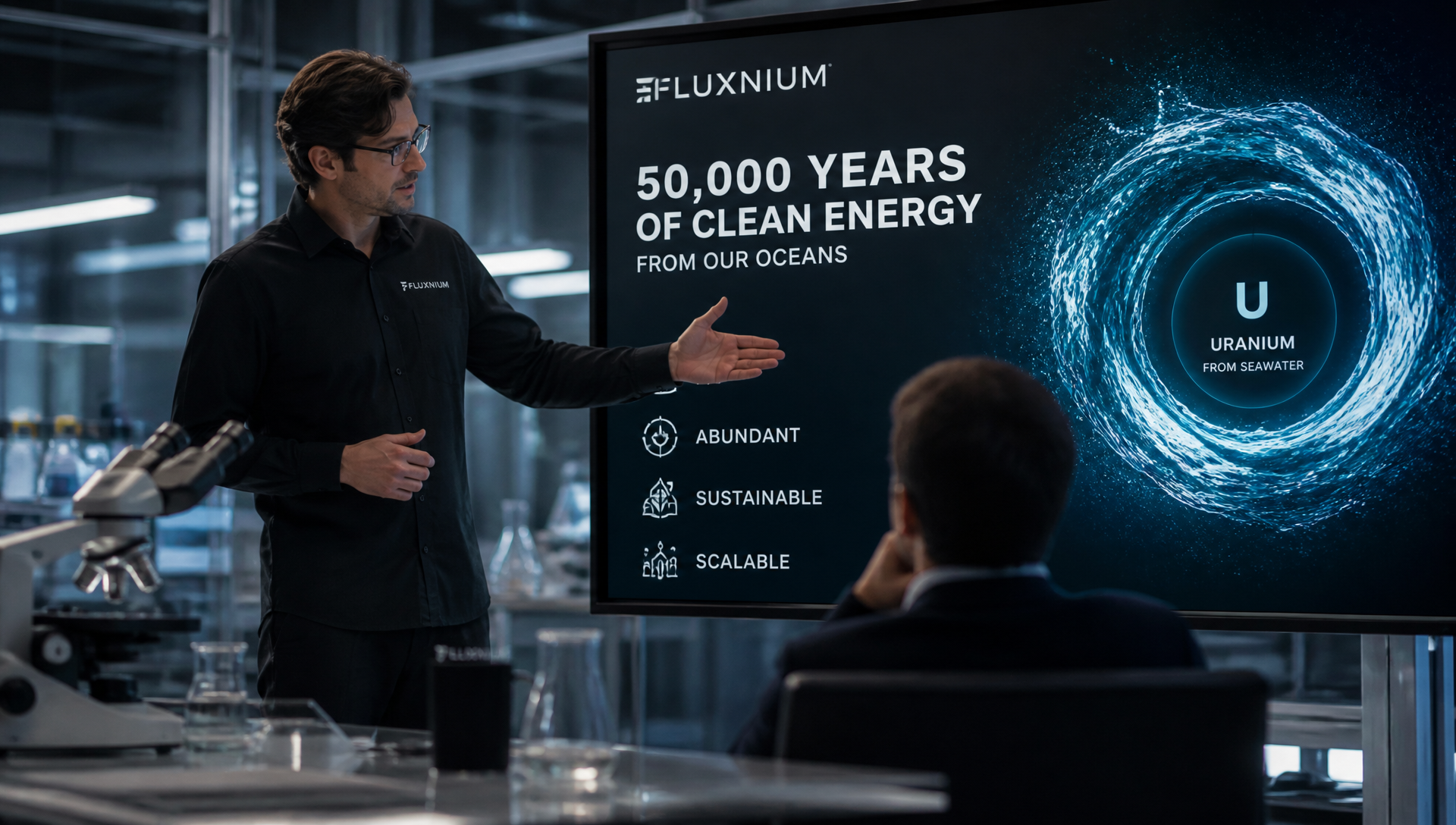
- Fluxnium claims it can extract enough uranium from seawater to power the world for 50,000 years.
- The startup closed a $7 million seed round backed by Congruent Ventures, Active Impact Investments, and Constellation Energy.
- The technology uses specially engineered polymer fibers deployed offshore to passively adsorb dissolved uranium from ocean currents.
- The underlying science is real and has been validated in national lab field tests, but commercial-scale cost validation is still missing.
- Cost, dilution, selectivity, biofouling, and offshore logistics remain major unsolved challenges.
- Fluxnium is not alone – competitors like SuperCritical Materials and Chinese researchers are racing toward the same goal.
Table of contents
- Key Takeaways
- The Big Announcement: Fluxnium Comes Out of Stealth
- So What Does Fluxnium Actually Do?
- Where Does “50,000 Years” Come From?
- Why This Matters Right Now
- The Science Is Real – But So Are the Challenges
- What About the Environment?
- Fluxnium Is Not Alone in This Race
- What Is Real, What Is Hype
- The Bottom Line
- Frequently Asked Questions
What if the answer to one of humanity’s biggest energy challenges had been hiding in the ocean the entire time? That is exactly what clean tech startup Fluxnium wants you to believe. The company emerged from stealth in September 2026 with a bold, eyebrow-raising claim: it has found a way to tap into a supply of nuclear fuel so vast it could theoretically power the world for 50,000 years. The announcement sent shockwaves through the clean energy world, sparking equal parts excitement and healthy skepticism. So what is really going on here? Is this a genuine breakthrough, a clever piece of startup storytelling, or something in between? Let’s dig in.
The Big Announcement: Fluxnium Comes Out of Stealth
On September 16, 2026, TechCrunch published an exclusive revealing that Fluxnium had just closed a $7 million seed round and was ready to tell the world what it had been building. The round was led by Congruent Ventures, with participation from Active Impact Investments and, perhaps most notably, Constellation Energy – the largest operator of nuclear facilities in the United States.
The funding and the backers alone signal that this is not just a wild science experiment. Real money from serious players in the energy world has landed on this bet. An SEC Form D filing confirms that Fluxnium, Inc. sold $6,999,998 in equity in an exempt offering, with the first sale dated May 5, 2026. The filing identifies the company as a Delaware corporation incorporated in 2026, headquartered in Santa Monica, California, with CEO Jeff Green signing the filing on May 11, 2026. Also listed as related persons are James AC McDermott and Kevin Kopczynski.
Jeff Green is not a first-time founder fumbling around with science fair ideas. Public bios connect him to a string of notable ventures including Stamps.com, NanoH2O, Rusheen Capital Management, Moleaer, Avnos, Carbon Ridge, and 1PointFive, giving him a track record in building real, technically ambitious companies.
So What Does Fluxnium Actually Do?
Here is where it gets genuinely fascinating. Fluxnium is not building a new type of nuclear reactor. It is not working on nuclear fusion. It is not enriching uranium. What it is doing is arguably more unusual: it is trying to fish uranium out of the ocean.
The world’s oceans contain an estimated 4 to 4.5 billion metric tons of dissolved uranium, spread throughout seawater at an incredibly dilute concentration of about 3.3 parts per billion, or roughly 3 milligrams per ton of seawater. That uranium has been sitting there for millions of years, swept off rocks and land by rivers and rain, slowly building up in the seas. ORNL and IAEA-linked research describes the ocean’s uranium resource as roughly 1,000 times larger than all known terrestrial uranium deposits combined.
Fluxnium’s approach, as reported by TechCrunch, uses specially engineered polymer fibers that are braided into long lines and deployed offshore, suspended from buoys in a setup described as similar to offshore seaweed farming. These fibers are designed to chemically attract and capture dissolved uranium as ocean currents wash past them. After roughly 30 to 60 days in the water, the lines are recovered, brought onshore, and processed so the uranium can be separated out, purified, and sold into the conventional nuclear fuel supply chain as yellowcake – the standard form of uranium concentrate used at the start of the nuclear fuel cycle.
According to Congruent Ventures’ portfolio page, the company’s adsorbent fiber technology was developed in partnership with a leading U.S. national laboratory, and the goal is to match conventional uranium mining costs while completely avoiding radioactive mine tailings – one of the most politically and environmentally contentious aspects of traditional uranium mining.
Where Does “50,000 Years” Come From?
The headline number is dramatic, but is it made up? Not entirely. Here is the math behind it.
The world’s nuclear power reactors currently require nearly 69,000 tonnes of uranium per year, according to the World Nuclear Association. If you divide the estimated 4.0 to 4.5 billion tonnes of uranium dissolved in the oceans by that annual consumption figure, you get somewhere between 58,000 and 65,000 years worth of fuel at today’s reactor fleet size. Rounding down to “50,000 years” is, therefore, directionally honest as a simplified headline claim.
But – and this is a very big but – the World Nuclear Association explicitly notes that seawater uranium is not currently considered an ore reserve. A resource existing in the ocean is a very different thing from a resource that can be commercially extracted at competitive prices. The number tells you how much uranium is theoretically there. It says nothing about whether getting it out will ever be cheap enough to matter.
Why This Matters Right Now
The timing of Fluxnium’s emergence is not accidental. The nuclear energy landscape is shifting fast, and fuel supply security is moving up the agenda rapidly.
The U.S. Department of Energy has set targets to add 35 GW of new nuclear capacity by 2035, reach 15 GW per year by 2040, and add roughly 200 GW of new nuclear capacity by 2050 to meet future demand and net-zero climate goals. More nuclear plants mean more demand for uranium – and right now, the U.S. is deeply dependent on foreign suppliers to meet that demand.
The numbers from the EIA’s 2025 Uranium Marketing Annual Report make for sobering reading. U.S. civilian reactor owners purchased 46.9 million pounds of uranium equivalent in 2025 at a weighted-average price of $58.46 per pound. Of all uranium delivered in 2025, only 7% was of U.S. origin. Major foreign sources included Canada, Kazakhstan, Australia, Uzbekistan, and Namibia. Even more striking: 77% of enrichment services purchased by U.S. civilian operators in 2025 were foreign-origin, including 26% from Russia.
At the same time, global uranium mine production in 2024 reached about 60,213 tonnes, covering roughly 90% of world reactor demand, with the largest producing countries being Kazakhstan, Canada, Namibia, Australia, Uzbekistan, Russia, and China. The concentration of supply in a handful of countries is exactly the kind of geopolitical vulnerability that makes a domestic, ocean-based uranium source look attractive to policymakers, utilities, and investors alike.
That is why Constellation Energy’s participation in the seed round is so telling. As the operator of the largest fleet of nuclear facilities in the U.S., Constellation has a very direct stake in where its fuel comes from and what it costs.
The Science Is Real – But So Are the Challenges
Here is what makes Fluxnium’s story genuinely compelling rather than pure fantasy: the underlying science is not new, and it works in the lab. Researchers at U.S. national laboratories including ORNL and PNNL, as well as universities and institutes in Japan and China, have been studying uranium extraction from seawater for decades.
ORNL reported in 2016 that advanced adsorbent fibers achieved between 5.00 and 6.56 grams of uranium per kilogram of adsorbent after 56 days of seawater exposure – among the highest adsorption capacities reported at the time. PNNL separately reported that a braid of polyethylene fibers tested in natural seawater conditions held 5.2 grams of uranium per kilogram of adsorbent after 49 days. These are not theoretical numbers – they come from real ocean exposure tests.
But knowing the science works in a controlled setting is a long way from building a commercial business around it. The challenges are formidable.
Cost has historically been the wall. A 2015 review published in Energy Economics found that uranium-from-seawater cost estimates at the time ranged from roughly $400 to $1,000 per kilogram of uranium – several times higher than contemporary market prices for mined uranium. ORNL’s own 2016 estimates placed costs at roughly $370 to $860 per kilogram, compared to a spot market price that has typically ranged between $80 and $160 per kilogram in recent years. TechCrunch reported that the DOE lab demonstration Fluxnium built on had extraction costs above $200 per pound, and that Fluxnium claims improvements to fiber surface area have meaningfully improved economics – but no independent, third-party validation of those claims has been made public yet.
Extreme dilution is a fundamental physics problem. With uranium at just 3.3 parts per billion in seawater, enormous volumes of water must contact the adsorbent material. IAEA-linked research notes that roughly 330,000 tonnes of seawater must be processed for every kilogram of uranium recovered – which is why passive exposure to ocean currents is favored over actively pumping seawater through a system.
Selectivity is another complication. The leading class of adsorbent materials, known as amidoxime-based fibers, also strongly bind vanadium and other metals dissolved in seawater. ORNL noted that this reduces uranium capacity and adds processing costs – and that older approaches sometimes required harsh acid processing to remove vanadium, which damages the fibers and creates problematic waste streams. ORNL’s more recent bio-inspired H₂BHT material work aimed specifically to improve selectivity for uranium over vanadium.
Biofouling – the accumulation of marine organisms on submerged surfaces – is a serious practical problem for any offshore deployment. Research compiled in chemical review literature identifies biofouling as a major challenge that can block contact between seawater and binding sites on the adsorbent, degrading performance over time. PNNL researchers suggested that deploying fibers below the photic zone could reduce some of these effects.
Offshore operations at commercial scale would require durable lines, buoys, ships or automated recovery systems, storm survivability engineering, chemical processing facilities, worker safety infrastructure, and permits for large-scale marine installations – all of which add cost and complexity beyond the chemistry itself.
What About the Environment?
One of Fluxnium’s most appealing talking points is the absence of traditional uranium mine tailings. Conventional uranium mining leaves behind radioactive waste rock and processing residues that can contaminate soil and groundwater for generations – a source of ongoing controversy in communities near mine sites. Congruent Ventures highlights that Fluxnium’s approach involves no mine and therefore no radioactive tailings, which would remove one of the most contested aspects of the nuclear fuel chain.
But “no mine tailings” does not mean no environmental footprint at all. Large offshore arrays could affect marine navigation, fisheries, local ecosystems, and ocean space. The processing steps involve chemical elution and metal separation. And crucially, Fluxnium’s technology addresses only the upstream fuel supply side of nuclear power. It does nothing to solve the spent fuel problem.
As the NRC notes, spent nuclear fuel is currently stored in pools and dry casks at reactor sites across the U.S., and no federal waste repository or commercial reprocessing facility is currently licensed in the country. The full nuclear fuel cycle, as described by the NRC, includes uranium recovery, conversion, enrichment, fuel fabrication, reactor use, storage, and final disposition of high-level radioactive waste. Fluxnium’s technology operates only at the very first step of that chain.
On a more cautiously positive note, PNNL toxicity testing on 68 adsorbent materials found no toxicity in standard assays, with PNNL concluding that preliminary evidence suggested seawater uranium extraction could potentially be performed with minimal impact on marine fauna – while also noting that other environmental effects would still need careful study.
Fluxnium Is Not Alone in This Race
One of the most intriguing subplots in this story is that Fluxnium is not the only startup racing to commercialize seawater uranium extraction using national lab-developed technology.
In July 2026, just weeks before Fluxnium’s public launch, Austin-based SuperCritical Materials announced that it had secured an exclusive license from Battelle Memorial Institute for patented uranium adsorbent technology originally developed by PNNL and research partners. SuperCritical is also aiming to industrialize seawater uranium extraction using national-lab chemistry.
Both Fluxnium and SuperCritical point to DOE and national-lab origins for their technology, but it is not yet publicly clear whether these are distinct patent families, separate lab technologies, or potentially competing claims to overlapping intellectual property. This is one of the most important unanswered questions hanging over the entire space.
Meanwhile, TechRadar reported in February 2026 that Chinese researchers had demonstrated kilogram-scale seawater uranium extraction under marine conditions – though public data on efficiency, energy costs, and economics were not disclosed, and the challenge of making extraction commercially viable remains very much open.
The race to turn ocean uranium from a scientific curiosity into a fundable startup – and eventually a real fuel supply – appears to be accelerating fast.
What Is Real, What Is Hype
To be fair to Fluxnium, several core claims in the story hold up under scrutiny:
- There really is a staggering amount of uranium dissolved in the ocean – roughly 4 to 4.5 billion metric tonnes.
- The “50,000 years” framing is broadly plausible at current global consumption rates.
- Polymer adsorbents genuinely do extract uranium from real seawater in field tests, as ORNL and PNNL data confirm.
- A domestic uranium source would be strategically significant given the U.S.’s current heavy reliance on foreign suppliers.
- The SEC filing confirms real money has changed hands.
But “found a way” is premature language if it implies commercial proof. No independent validation of Fluxnium’s claimed cost improvements or industrial-scale performance has been made public. “Did we solve energy?” is far too broad a question – even if Fluxnium’s technology works perfectly, it addresses only one upstream input into nuclear power, while questions of reactor construction costs, licensing timelines, waste disposal, enrichment capacity, grid integration, and public acceptance remain entirely untouched. And the DOE’s own ambitious nuclear capacity targets underscore just how much infrastructure and investment remains to be built before the nuclear renaissance becomes a reality.
The Bottom Line
Fluxnium is a genuinely interesting early-stage startup working on a real scientific problem with real backing from credible investors. The ocean really does contain enough dissolved uranium to power nuclear reactors for tens of thousands of years. The lab science to extract it really does work. And the geopolitical case for a domestic, mine-free uranium source is stronger today than it has ever been.
But commercializing this technology means solving some very hard problems – cost, durability, selectivity, marine logistics, permitting, and scaling – that have resisted solution for decades. Fluxnium has $7 million, a promising approach, and a compelling story. What it does not yet have is publicly verified proof that it can extract uranium from seawater cheaply enough to compete with conventional mining.
So no – energy is not solved. But if Fluxnium, or one of its competitors, can crack the cost equation and make ocean uranium genuinely economical, it could fundamentally change the ceiling on nuclear fuel supply for generations to come. And that, even with all the caveats, is a story very much worth watching.
Frequently Asked Questions
What is Fluxnium and what does it actually do?
Fluxnium is a clean tech startup that extracts dissolved uranium from seawater using specially engineered polymer fibers deployed offshore, rather than mining uranium from the ground.
Is the “50,000 years of nuclear fuel” claim accurate?
The math is directionally reasonable – dividing the estimated 4 to 4.5 billion tonnes of oceanic uranium by current global annual consumption yields roughly 58,000 to 65,000 years. However, this is a theoretical resource figure, not a proven commercially extractable reserve.
Has this technology been proven to work?
The core chemistry has been validated in real seawater field tests by national laboratories like ORNL and PNNL. However, no independent, third-party validation of Fluxnium’s specific cost improvements or commercial-scale performance has been made public.
Why is cost such a big issue for seawater uranium extraction?
Historical estimates put seawater uranium extraction costs several times higher than conventional mined uranium, largely due to the extreme dilution of uranium in seawater and the vast volumes of water that must be processed.
Does Fluxnium’s approach create radioactive waste like traditional mining?
Fluxnium’s method avoids the radioactive mine tailings associated with conventional uranium mining. However, it does not address the separate issue of spent nuclear fuel disposal from reactors.
Is Fluxnium the only company pursuing this technology?
No. Competitors such as SuperCritical Materials have licensed similar national-lab technology, and researchers in China have also demonstrated kilogram-scale seawater uranium extraction.