
Estimated reading time: 9 minutes
Key Takeaways
- Helion Energy raised $465 million in a Series G round on June 4, 2026, reaching a $15.5 billion post-money valuation.
- Microsoft has signed the world’s first fusion energy power purchase agreement, targeting 50 MW of clean electricity from Helion by 2028.
- Sam Altman, CEO of OpenAI, is one of Helion’s largest personal backers, having invested over $384 million in the company across multiple rounds.
- Helion’s prototype machine, Polaris, has already achieved plasma temperatures of 150 million degrees Celsius – ten times hotter than the core of the sun.
- Construction has physically begun at the Orion plant site in Malaga, Washington – but serious scientific questions about the timeline and technology remain.
- Microsoft’s own emissions rose 23.4% above its 2020 baseline, driven by AI expansion – making the stakes of this bet very real.
Table of contents
- What Just Happened: A $465M Bet on Fusion Energy
- The AI Energy Problem Nobody Wants to Talk About
- The Deal That Shocked the Energy World
- Sam Altman: The Man Betting Big on a Mini Sun
- What Is Helion Actually Building?
- The Part Where Scientists Pump the Brakes
- So – Is the Energy Crisis Over?
- Frequently Asked Questions
A fusion startup backed by Sam Altman just raised $465 million. Microsoft has already signed up as its first customer. And the plant they want to power? It doesn’t exist yet.
Welcome to the most exciting – and most debated – energy story in tech right now.
On June 4, 2026, Helion Energy announced a $465 million Series G funding round, valuing the Washington-based fusion startup at a jaw-dropping $15.5 billion post-money. The round was led by Thrive Capital and brings Helion’s total funding to approximately $1.5 billion. The goal? Build the world’s first fusion power plant and sell clean electricity to Microsoft to help power its AI data centers.
If that sentence didn’t make your head spin a little, read it again. Because what Helion is attempting – and what Microsoft is betting on – is nothing short of recreating the power of the sun on Earth, in a building in Washington state, in time to help run the AI revolution.
Is this the beginning of a new energy era? Or is it the most expensive science experiment in tech history? Let’s break it all down.
What Just Happened: A $465M Bet on Fusion Energy
On June 4, 2026, Helion officially announced its Series G round, led by Thrive Capital. The round pulled in a remarkable lineup of new investors, including Alta Park Capital, Anti Fund, BoxGroup, Lux Capital, Peak XV Partners, and Ford Motor Company Executive Chairman Bill Ford. Existing backers like Lightspeed Venture Partners, SoftBank Vision Fund 2, Capricorn Technology Impact Funds, Mithril Capital, Dustin Moskovitz through Good Ventures Foundation, and a university endowment fund also participated.
The valuation is what makes even seasoned investors do a double-take. At $15.5 billion post-money, Helion has nearly tripled its valuation from its January 2025 Series F, when it raised $425 million at roughly $5.4 billion. As Kitco News reported, this leap in value reflects rising investor demand for clean, reliable electricity to power AI-focused data centers.
Helion says the fresh capital will go toward accelerating commercial fusion deployment, scaling U.S. fusion manufacturing capacity, and delivering on its promise of “clean, reliable, affordable always-on electricity at scale.” That last phrase is key – because it speaks directly to one of the biggest problems facing the tech world right now.
The AI Energy Problem Nobody Wants to Talk About
Here’s the uncomfortable truth lurking behind every ChatGPT query, every AI image generated, and every cloud-based service we use every day: all of it burns enormous amounts of electricity.
AI data centers run around the clock. They cannot afford to go offline. They need power that is not just clean, but firm – meaning it doesn’t stop when the sun goes down or the wind dies down. Solar and wind, as wonderful as they are, don’t always fit that bill.
And the numbers are staggering. Microsoft’s own 2025 Environmental Sustainability Report revealed that total company emissions were up 23.4% versus its 2020 baseline, largely driven by AI and cloud expansion. Energy use had increased by a breathtaking 168% over the same period.
Microsoft has a 2030 carbon-negative goal. But the AI boom is pulling it in the opposite direction – fast. That tension is exactly why Microsoft made a move that nobody in the energy industry had seen before.
The Deal That Shocked the Energy World
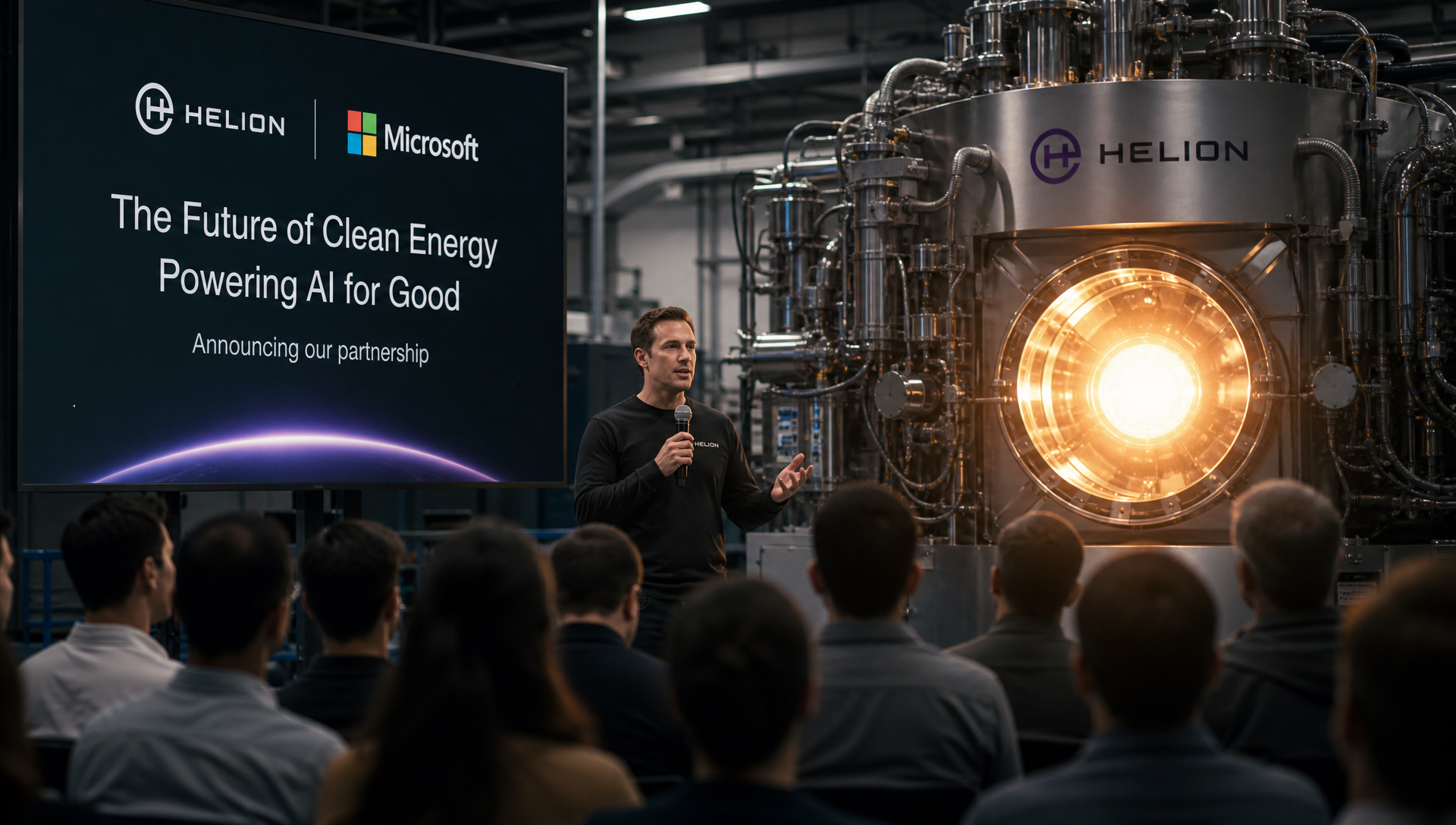
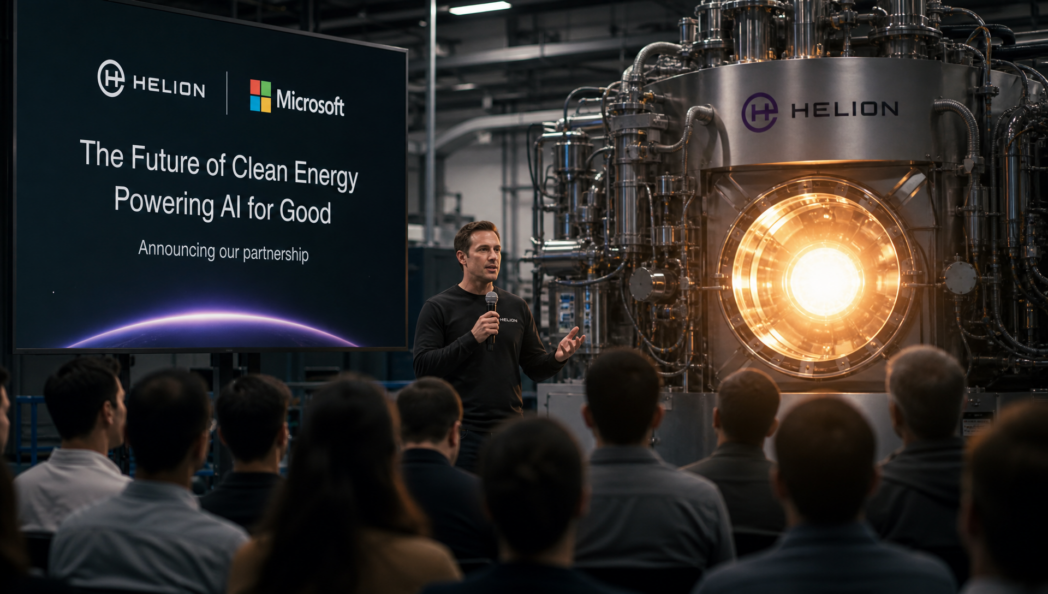
In May 2023, Helion announced what it called the world’s first fusion energy power purchase agreement. Microsoft agreed to buy electricity from Helion’s first fusion power plant, with Constellation serving as the power marketer and managing transmission.
The targets were aggressive from day one: the plant would be online by 2028, delivering 50 megawatts or greater of clean electricity after a one-year ramp-up period. Microsoft President Brad Smith said the deal could help advance Microsoft’s long-term clean energy goals and bring more clean power to the grid faster.
As Axios reported, Microsoft planned to use the electricity to power its data centers – tying the story directly to AI’s ravenous appetite for power.
And critically, this is not a handshake deal. According to GeekWire, Helion’s Microsoft agreement includes financial penalties if Helion fails to start generating electricity on schedule. That’s a level of accountability that turns this from a feel-good partnership announcement into a real commercial deadline with real consequences.
Sam Altman: The Man Betting Big on a Mini Sun
You cannot tell this story without talking about Sam Altman.
The CEO of OpenAI – the company behind ChatGPT – has been one of Helion’s most prominent backers for years. According to TIME, Altman first invested approximately $9.5 million in Helion around 2015. He later put another $375 million into the company in 2021, making Helion one of his largest personal investments.
Then things got even more interesting. In March 2026, Altman stepped down from Helion’s board as OpenAI and Helion began exploring working together “at significant scale,” according to Reuters via Investing.com. Axios separately reported that OpenAI was in advanced talks to buy electricity from Helion – potentially securing a guaranteed portion of Helion’s production.
Think about what that means for a moment. The CEO of the world’s most talked-about AI company is also a massive personal investor in a fusion startup that could sell clean power to AI companies – including his own. It’s a triangle that sparks both excitement and eyebrows. The conflict-of-interest optics are real, and they’re already part of the public conversation.
But the bigger picture is harder to ignore: the people most deeply involved in building the AI revolution are also the ones most urgently trying to solve the energy problem it creates.
What Is Helion Actually Building?
Let’s get into the science – in plain English.
Fusion is the process that powers the sun. Hydrogen atoms are forced together under extreme heat and pressure, fusing to form helium and releasing enormous amounts of energy. For decades, scientists have dreamed of recreating this process on Earth to produce virtually limitless clean power. The joke in the field has long been that fusion is “always 30 years away.”
Helion is trying to prove that joke wrong.
Polaris: The Prototype Pushing Boundaries
Before Orion – the actual power plant – comes Polaris, Helion’s seventh-generation fusion machine. This is where the real physics is being tested. At 19 meters long, with over 50 megajoules of bank energy, 15+ tesla peak magnetic fields, and around 3,800 diagnostics, Polaris is a serious piece of engineering.
In February 2026, Helion announced that Polaris had achieved measurable deuterium-tritium fusion and reached plasma temperatures of 150 million degrees Celsius – exceeding its earlier stated benchmark of 100 million degrees. That is ten times hotter than the core of the sun. For context, those are the temperatures required to make fusion happen.
Orion: The World’s First (Proposed) Fusion Power Plant
Orion is the machine Helion wants to plug into the power grid. Located in Malaga, Chelan County, Washington, it is designed to deliver fusion electricity to Microsoft under the terms of the 2023 PPA, targeting 50 MW of clean electricity with initial operations beginning in 2028.
Helion’s timeline for Orion is detailed and already in motion. The company describes a path from the Microsoft PPA in 2023, community engagement in 2024, environmental review and permit approval in 2025, site construction beginning in 2025, and generator building construction beginning in 2026. In July 2025, Helion confirmed that it had begun initial earthwork and construction at the Malaga site after completing environmental review and receiving local approvals.
Dirt is actually being moved. That part is real.
How Helion’s Fusion Approach Is Different
Helion is not building a tokamak – the giant donut-shaped machine most commonly associated with fusion research, including the massive international ITER project. Instead, Helion uses a pulsed, magneto-inertial fusion approach based on field-reversed configuration plasmas.
In simple terms: Helion forms two balls of plasma, accelerates them toward each other at around 1 million miles per hour, merges them, and compresses them using magnetic fields until fusion occurs. The really clever part – Helion’s claimed big differentiator – is direct electricity recovery. Rather than using fusion heat to boil water and spin a steam turbine like a traditional power plant, Helion’s system captures electricity directly through electromagnetic induction as the plasma expands back outward. The company compares it to regenerative braking in an electric car.
For fuel, Helion plans to use deuterium and helium-3. Deuterium can be extracted from ordinary water. Helium-3 is far scarcer, but Helion says it plans to produce it internally through side reactions in its own fuel cycle and then recycle it – a process it describes on its Polaris page.
The Part Where Scientists Pump the Brakes
Here is where the story gets more complicated – and more honest.
No fusion company in history has ever delivered commercial electricity to the power grid. Not once. Helion’s own FAQ page acknowledges this directly: fusion reactions have been achieved many times, but no one has built a commercial fusion power plant that produces reliable electricity for the grid.
Helion’s 2028 commercial target is one of the most aggressive timelines in the entire fusion industry. Scientific American has reported that some physicists believe Helion’s promises may be outrunning what the technology has actually proved.
There are several specific concerns experts have raised:
- Transparency: Helion publishes relatively little peer-reviewed data about its plasma performance. Scientific American quoted Oak Ridge fusion expert Troy Carter saying that without more published data, it is hard to fully evaluate where Helion stands. GeekWire has noted that Helion is more tight-lipped than many competitors, with critics warning that missed deadlines could damage the credibility of the entire fusion sector.
- Physics challenges: Scientific American also reported technical concerns about whether Helion’s field-reversed configuration plasmas can remain stable enough during the high-speed merging and compression process, whether the helium-3 breeding and recycling strategy can work at commercial scale, and whether direct electricity recovery can be demonstrated at the required efficiency level.
- A specific physics argument: A group at the Max Planck Institute, led by Karl Lackner, formally challenged a key assumption in Helion’s approach – the idea that ions can remain much hotter than electrons during the pulse, which Helion relies upon to improve efficiency. The Max Planck group argued that ordinary collisional power transfer makes this more demanding than Helion’s analysis suggests, according to Scientific American.
None of this means Helion will fail. But it does mean that a $15.5 billion valuation for a company that has not yet delivered a single commercial watt of electricity is a remarkable act of faith – or a remarkable act of ambition, depending on how you look at it.
So – Is the Energy Crisis Over?
Not quite. Not yet.
What this story really tells us is something both thrilling and a little bit sobering: AI’s power demand has become so enormous that some of the biggest companies in the world are making billion-dollar bets on technology that has never been commercially proven – simply because they are running out of other options fast enough.
Microsoft needs clean, always-on power at scale. Wind and solar cannot always provide firm baseload power. Traditional nuclear takes too long to build. And so Microsoft is buying electricity from a fusion plant that doesn’t exist yet, from a company valued at $15.5 billion that has not yet sold a single watt to the grid.
That is not a criticism. It may actually be the most rational thing to do given the stakes. If fusion works – and Helion delivers Orion on schedule and on spec – it could become a landmark moment in energy history. The kind of thing written into textbooks. If it doesn’t, it becomes a cautionary tale about what happens when the pressure to solve a crisis becomes so intense that the normal rules of evidence and patience get compressed.
Helion has real engineers, real milestones, real construction underway, and real investors who have put real money on the line with eyes wide open. The Series G announcement is not a dream – it is a funded, scheduled, contractually penalized commercial attempt to do something humanity has never done before.
The next few years will tell us whether the mini sun is real – or whether the energy crisis just got a very expensive story to tell.
Either way, we’ll be watching every single step.
Frequently Asked Questions
What is Helion Energy and what does it do?
Helion Energy is a Washington-based fusion startup that is attempting to build the world’s first commercial fusion power plant. It uses a pulsed, magneto-inertial fusion approach to fuse plasma at extreme temperatures, aiming to generate clean, firm electricity that can be sold to the grid around the clock.
Why did Microsoft sign a deal with a fusion company?
Microsoft’s AI and cloud operations require enormous amounts of always-on, clean electricity. Solar and wind power are intermittent, and traditional nuclear takes years to build. Helion’s fusion power, if delivered, would offer firm baseload power that aligns with Microsoft’s 2030 carbon-negative goal – which is why Microsoft signed the world’s first fusion power purchase agreement with Helion in 2023.
What is the difference between Polaris and Orion?
Polaris is Helion’s seventh-generation prototype fusion machine, currently being used to test and validate the physics of their approach. Orion is the planned commercial power plant – the machine that would actually connect to the grid and deliver electricity to Microsoft. Polaris must prove the technology before Orion can operate.
Has fusion power ever been used commercially before?
No. As of the time of writing, no fusion company has ever delivered commercial electricity to a power grid. Fusion reactions have been achieved in laboratory and experimental settings, but a commercial power plant producing reliable electricity has never been built. Helion’s Orion, if completed, would be a genuine first in human history.
What are the biggest risks to Helion’s plan?
The main risks include unresolved physics challenges around plasma stability, the scalability of helium-3 breeding and recycling, and whether direct electricity recovery can work at commercial efficiency. There are also concerns about a lack of peer-reviewed published data, and the 2028 deadline is widely considered one of the most aggressive timelines in the fusion industry.
What happens if Helion misses its 2028 deadline?
According to GeekWire, Helion’s power purchase agreement with Microsoft includes financial penalties if Helion fails to begin generating electricity on schedule. This means there are real commercial and financial consequences for missing the target – not just reputational ones.
Why is Sam Altman involved with both OpenAI and Helion?
Sam Altman is the CEO of OpenAI and has been a major personal investor in Helion since around 2015. His logic is that AI creates enormous energy demand, and fusion could provide a clean, scalable solution to that problem. He stepped down from Helion’s board in March 2026 as the two companies began exploring a potential electricity supply partnership – a situation that has raised conflict-of-interest questions that are already part of public discussion.