
Estimated reading time: 8 minutes
Key Takeaways
- Whisper-filled offices are becoming reality as voice interaction replaces traditional typing and communication methods.
- Advanced technologies like SilentWhisper and EMG wearables can detect ultra-quiet speech and even silent muscle movements.
- AI meeting assistants are raising serious privacy concerns and legal challenges around consent and surveillance.
- Shadow AI poses risks when employees use unauthorized tools that record confidential conversations.
- The future depends on whether companies prioritize transparency and privacy or allow invasive monitoring practices.
Table of contents
- Key Takeaways
- What Exactly Is the Whisper-Filled Office?
- The Magic Technology Behind the Murmurs
- Changing How We Work and Talk Every Day
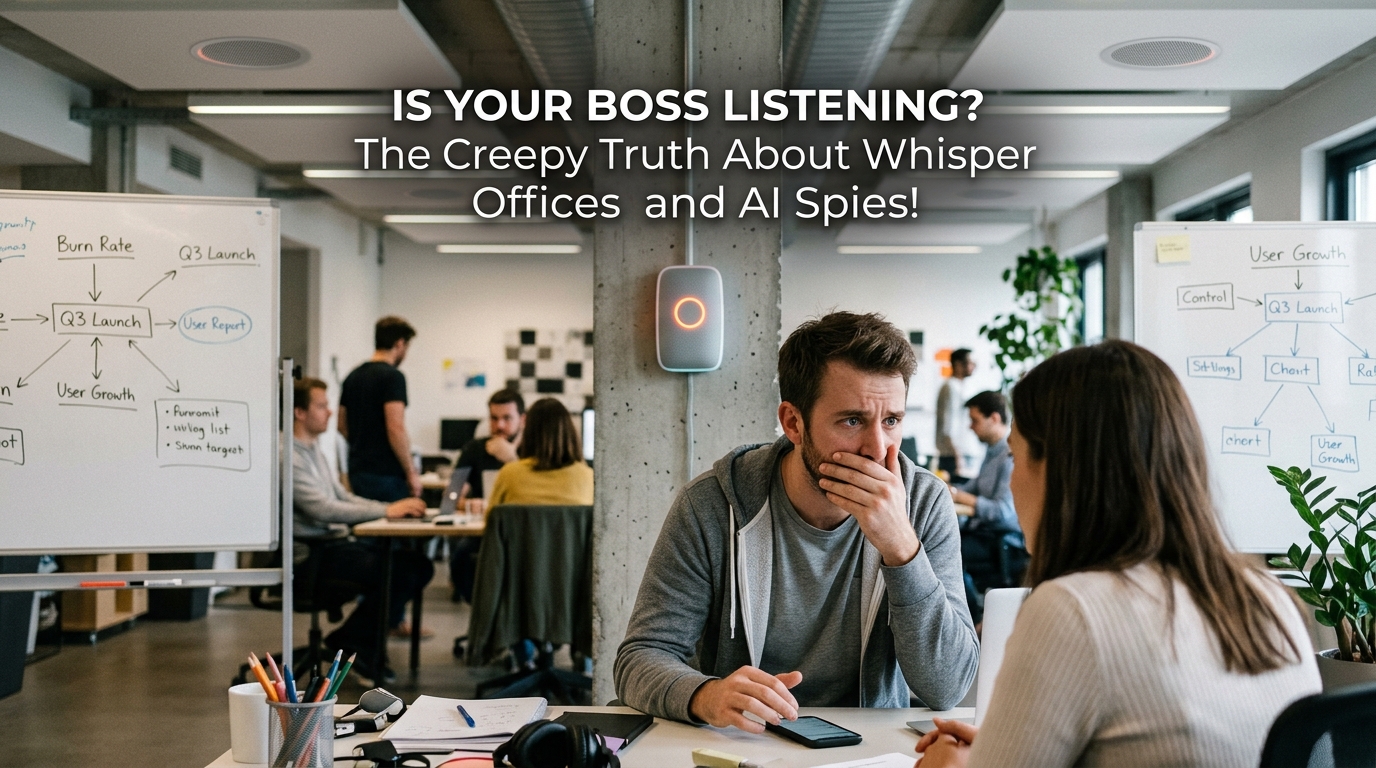
- The Creepy Truth: Is Your Boss Listening?
- The Law, Rules, and Massive Privacy Trouble
- Why Are We So Scared?
- Two Futures: The Best Case vs. The Worst Case
- Bringing It Back to Building Great Startups
- Frequently Asked Questions
The typical office soundtrack of keyboard clicks and loud conversations is fading away. In its place, a new acoustic reality is emerging: the whisper-filled workplace. Voice-first computing is no longer just about barking commands at Alexa or Siri. It’s becoming deeply integrated into professional tools, transforming how we communicate, collaborate, and yes, potentially how our every word gets monitored.
What Exactly Is the Whisper-Filled Office?
The traditional office environment has always been defined by its sounds. But futurists and AI experts are painting a radically different picture of tomorrow’s workplace. Instead of typing emails and shouting across open-plan layouts, professionals will spend their days whispering to intelligent machines.
This transformation centers on voice becoming the primary interface for work. Offices will be redesigned around constant low-level murmuring rather than the familiar cacophony of keyboard clatter and conference calls.
Here’s what defines this emerging workplace:
Voice-Centric Workflows: Rather than typing lengthy emails or documentation, professionals will quietly instruct their AI assistants. Commands like “Draft an update to the venture capital client” or “File a bug with these details” become routine whispered instructions replacing manual data entry.
Ambient AI: The new generation of assistants doesn’t just respond to queries. These “agentic” systems proactively observe meetings, capture context, and take autonomous action. They write documents, message colleagues, and schedule follow-ups based entirely on overheard conversations.
A Brand New Soundscape: The office acoustic environment transforms completely. Instead of ringing phones and animated discussions, the dominant sound becomes brief whispered prompts to machines, punctuated by occasional quiet exchanges between colleagues sharing AI-generated insights.
This represents a fundamental evolution beyond consumer voice assistants into serious enterprise applications. Your calendar, project management tools, and communication platforms all become voice-first interfaces.
The Magic Technology Behind the Murmurs
Making whisper-filled offices functional requires sophisticated technological advances. Voice recognition is evolving beyond “speak clearly into your phone” toward understanding barely audible communication in complex acoustic environments.
Catching the Quietest Whispers
Systems like SilentWhisper represent breakthrough achievements in ultra-quiet speech recognition. This technology can understand whispered speech at just 45 to 50 decibels using standard microphones by analyzing subtle phonetic patterns that persist even when vocal pitch disappears.
Wearables and Silent Speech
Perhaps most remarkably, emerging technologies enable completely silent communication. Devices like SilentWear use EMG (electromyography) sensors to detect tiny muscle movements in your throat and face, allowing you to “speak” commands without making any audible sound whatsoever.
These wearable systems consume minimal power, enabling all-day usage for silent AI interaction. Imagine giving complex instructions to your computer while sitting in a library or during a presentation, with zero audible output.
Always-Listening Chips
Supporting this ecosystem requires ultra-low-power speech recognition systems that can continuously monitor for wake words without draining batteries. These specialized processors enable ambient devices to patiently wait for whispered activation commands throughout your workspace.
Acoustic Office Design and Directional Mics
Managing dozens of people whispering simultaneously requires sophisticated audio engineering. Beamforming and directional microphones focus exclusively on the speaker directly in front of them, filtering out adjacent conversations.
Physical office spaces will undergo acoustic transformations: sound-absorbing materials, strategic desk arrangements, micro-booth configurations, and potentially AI-driven sound masking that generates targeted background noise to prevent eavesdropping.
Keeping Your Privacy Safe
With microphones proliferating throughout workspaces, privacy becomes paramount. Researchers are developing privacy-aware systems that process audio locally rather than transmitting to cloud servers.
Emerging privacy protections include hardware off-switches, on-device processing, differential privacy techniques, and systems that actively scramble background conversations before analysis to protect non-consenting bystanders.
Changing How We Work and Talk Every Day
The whisper-filled office fundamentally transforms daily professional routines and interpersonal dynamics.
Your New Daily Routine
Your workday begins differently. Instead of checking email, you whisper: “Catch me up on yesterday’s venture capital meetings and draft my status update.”
During team meetings, human-to-human conversation might diminish as participants quietly instruct their AI agents: “Note this down – the client wants to target healthcare in Q3. Update the roadmap.”
Post-meeting, your AI instantly distributes summaries, creates tasks, and coordinates with colleagues’ assistants without manual intervention. Collaboration increasingly happens assistant-to-assistant, with humans delegating coordination to their AI proxies.
The Weird New Etiquette
Novel social norms emerge around this technology. Is it rude to whisper instructions to your AI while a colleague is speaking? Does this signal inattention or efficient multitasking?
Recording consent becomes formalized. Standard meeting warnings announce AI presence: “This call is being recorded by an AI assistant.” Visual indicators like recording lights become ubiquitous on video platforms and in conference rooms.
Difficult conversations raise questions about delegation appropriateness. Using an AI intermediary for sensitive feedback might be perceived as cowardly or disrespectful. Meanwhile, assistant-to-assistant (A2A) protocols enable your AI to negotiate directly with colleagues’ AIs, creating new channels for workplace interaction.
The Creepy Truth: Is Your Boss Listening?
The concept of “AI Spies” isn’t hyperbolic scaremongering. It represents genuine risks already materializing in workplaces.
Meeting Assistants as Spies
Contemporary AI meeting tools join calls, record conversations, generate transcripts, and store data on vendor servers. Terms of service often permit vendors to retain and analyze this data for model training purposes.
More concerning, employees frequently add these AI bots to meetings without organizational approval. This means highly confidential discussions about startup fundraising strategies or trade secrets get transmitted to third-party servers completely outside IT oversight.
Legal consequences are emerging. Lawsuits invoking strict wiretap statutes claim AI vendors function as unauthorized third-party interceptors, recording conversations without proper consent.
In a whisper-filled office with continuous ambient listening, surveillance capabilities multiply exponentially. Even if managers don’t monitor live conversations, they can search transcript archives for specific phrases, review AI-generated behavioral summaries, and evaluate performance based on automated analysis of your spoken words.
The Danger of Shadow AI
“Shadow AI” occurs when employees deploy personal AI tools without IT authorization. Legal experts warn this practice violates confidentiality obligations, exposes trade secrets, and breaches regulatory requirements across heavily regulated industries.
The threat operates bidirectionally. Your colleague might use unauthorized AI that surreptitiously records you. Conversely, management might deploy monitoring systems leveraging voice data without transparent disclosure.
The Law, Rules, and Massive Privacy Trouble
Always-listening workplaces collide forcefully with existing legal frameworks designed to protect conversational privacy.
Recording Rules in the US
American recording consent laws vary dramatically by jurisdiction. States like California and Illinois require all-party consent, meaning every conversation participant must explicitly agree to recording.
Multi-state calls create complex compliance scenarios where the strictest applicable law typically governs. Legal analysis confirms AI note-takers function identically to traditional recording devices under these statutes.
Ambient office microphones raise particularly thorny questions. If devices continuously listen, what happens when they inadvertently capture conversations from non-consenting bystanders? This scenario presents enormous legal exposure.
Data Rules in the EU and Beyond
European GDPR regulations impose stringent requirements on voice data processing. When audio data enables personal identification, organizations need legitimate processing grounds, robust security measures, and strict access limitations.
Europe’s strong worker privacy protections mean regulators scrutinize AI meeting tools intensively. Healthcare contexts add another compliance layer, with HIPAA requiring Business Associate Agreements before AI vendors can process protected health information.
Bosses Monitoring Workers
Employment attorneys caution that AI assistants quickly transform into workplace surveillance infrastructure. These systems track participation metrics, perform sentiment analysis, and correlate voice data with productivity scores.
Recognizing these risks, some major organizations and universities have prohibited unauthorized AI bots from sensitive meetings entirely.
Why Are We So Scared?
Despite technological sophistication, many professionals remain deeply hesitant to trust AI with authentic work conversations. Concerns center on data destination and transcript accuracy—fears that AI-generated errors become permanently embedded in professional records.
For IT security professionals, AI notetakers represent overwhelming challenges. Some describe them as “the bane of my existence” due to endless legal and privacy complications.
Research into always-listening devices reveals persistent user anxiety. People constantly wonder about continuous monitoring, accidental recordings, and vendor data practices. Without careful implementation, whisper-filled offices feel like constantly surveilled environments where AI becomes menacing rather than helpful.
Two Futures: The Best Case vs. The Worst Case
The whisper-filled office trajectory bifurcates into dramatically different outcomes.
In the optimistic scenario, organizations implement transparent AI policies with clear disclosure about recording practices. They deploy on-device processing and visible recording indicators. AI eliminates administrative drudgery and enhances accessibility for individuals who struggle with traditional input methods. The whispered soundscape feels like ambient assistance rather than intrusive surveillance.
In the dystopian scenario, employers weaponize whisper-office technology for comprehensive employee monitoring. Systems generate behavioral scores based on meeting sentiment, mine conversations for dissatisfaction indicators, and maintain extensive voice archives. Workers experience constant anxiety, hesitant to speak candidly. The workplace becomes a cold, algorithmic environment governed by inscrutable machine judgment.
Bringing It Back to Building Great Startups
AI’s inexorable rise reshapes professional landscapes across every dimension. Whether preparing for whisper-filled offices or leveraging intelligent systems for startup fundraising, the technological foundation beneath business operations is fundamentally shifting.
At HeyEveryone.io, we believe AI should function as an empowering tool rather than invasive surveillance. Our platform uses advanced AI to solve critical fundraising challenges—analyzing investor databases, identifying perfect matches for your startup, and crafting highly personalized outreach that mirrors your authentic voice.
We deliver 10x higher reply rates at just $2 per investor contact, handling the heavy computational lifting so founders can focus on building transformative businesses. As voice interfaces and ambient AI reshape workplaces, demanding transparency, privacy, and human dignity becomes increasingly critical.
Technology will continue transforming how we work. As directional microphones and silent speech wearables become commonplace, let’s ensure we champion implementations that respect individual privacy while enhancing professional capabilities.
Frequently Asked Questions
What exactly is a whisper-filled office?
A whisper-filled office is a workplace where voice interaction becomes the primary interface for computing and communication. Instead of typing or loud conversations, employees spend their day quietly speaking commands to AI assistants and whispering to colleagues, creating a fundamentally different acoustic environment optimized for voice-first workflows.
How does technology recognize whispered speech?
Advanced systems like SilentWhisper can understand whispered speech at 45-50 decibels using standard microphones by analyzing subtle phonetic patterns that persist even when vocal pitch disappears. More sophisticated wearable devices use EMG sensors to detect muscle movements, enabling completely silent “speech” through throat and facial muscle activity detection.
Are AI meeting assistants legal?
Legality depends heavily on jurisdiction and implementation. In US states with all-party consent laws (like California and Illinois), every participant must explicitly agree to recording. Under GDPR in Europe, organizations need legitimate processing grounds and robust security measures. Many organizations face lawsuits for deploying AI assistants without proper consent protocols.
What is Shadow AI in the workplace?
Shadow AI occurs when employees use personal AI tools without organizational IT approval or oversight. This practice creates serious risks including confidentiality breaches, trade secret exposure, regulatory violations, and legal liability, particularly when these unauthorized tools record and transmit sensitive business conversations to third-party servers.
Can my employer monitor my whispered conversations with AI?
Potentially yes. Even if managers don’t monitor conversations in real-time, transcript archives enable searching for specific phrases, reviewing AI behavioral summaries, and evaluating performance based on automated analysis. The legal boundaries around this surveillance vary by jurisdiction and employment context, but the technical capability exists in most AI assistant implementations.
How can whisper-office privacy be protected?
Privacy protection requires multiple layers: transparent disclosure policies, hardware off-switches, on-device processing instead of cloud transmission, directional microphones that filter adjacent conversations, acoustic office design that prevents eavesdropping, and systems that actively scramble background conversations before analysis to protect non-consenting bystanders.