
Estimated reading time: 8 minutes
Key Takeaways
- Blake Resnick, a former Thiel Fellow, founded Brinc to revolutionize public safety with autonomous drones.
- The Guardian drone can fly at 60 mph, stay airborne for 62 minutes, and features thermal imaging and 4K cameras.
- It includes Starlink satellite connectivity, making it the first public-safety quadcopter with unlimited range capabilities.
- Automated charging nests enable battery swaps and can deliver life-saving medical supplies like AEDs and Narcan.
- The Guardian aims to replace expensive, noisy police helicopters with a faster, cheaper, quieter alternative.
- Brinc is valued at nearly 500 million dollars and targets a 6-8 billion dollar market opportunity.
- Privacy concerns, FAA regulations, and surveillance debates remain significant challenges to widespread adoption.
Table of contents
- Key Takeaways
- Meet the Brain Behind the Machine
- Enter the Guardian Drone
- Space Internet: The Starlink Magic
- The Magic Charging Nest
- Helicopter vs. Drone: The Big Fight
- The Older Siblings: Lemur and Responder
- Taking on the Giant: The Battle with DJI
- The Dark Side: Privacy, Rules, and Fears
- The Future is Flying
- Frequently Asked Questions
Have you ever looked up at the night sky and seen a police helicopter? They are very big and very loud. They shake the windows of your house. They wake up your dogs. They use a lot of fuel and cost a huge amount of money. But what if those giant, noisy machines were gone forever? A former Thiel fellow’s startup just launched a drone it says can replace police helicopters, and it could change emergency response as we know it.
This is not a story about a toy drone you buy at the store. This is a story about a super machine—a smart flying robot that could change how police officers and firefighters do their jobs forever. Imagine a world where emergency help arrives in just seconds. Imagine a world where a robot drops life-saving medicine right into your hands before an ambulance even gets there. This is not the future. This is happening right now.
Meet the Brain Behind the Machine
The genius behind this amazing new tool is a young man named Blake Resnick. He is the founder and CEO of a startup called Brinc, a public-safety drone company based right here in the United States.
Blake Resnick is not your average boss. When he was younger, he left his classes at Northwestern University to become a Thiel Fellow—a smart student who gets a special grant to leave school and build amazing things. Before he even started Brinc, Resnick worked at some of the coolest and biggest tech companies in the world, including Tesla, DJI, and the famous car company McLaren.
But why did he decide to build drones? The story is actually very sad, but it inspired a great idea. In 2017, a terrible mass shooting happened at the Route 91 Harvest Festival in Las Vegas. Blake Resnick lived in Las Vegas. He watched the tragedy unfold and wanted to help. After the event, he talked with SWAT teams and police officers. He learned that they did not have a fast and safe way to see what was happening inside dangerous places. They desperately needed “eyes and ears” to understand the danger without putting more human lives at risk. This sad event is what motivated him to start Brinc.
Resnick had a huge dream. He wanted to make the police helicopter obsolete. He wanted to bring all emergency response times down to under one single minute. To do this, he wanted to place smart drones in nests around cities so they could fly out to emergencies instantly.
To build this dream, Resnick needed money. And he did a fantastic job finding it. He got early investment support from very smart people, including Sam Altman, who is the co-founder of OpenAI. Thanks to all this support, recent funding rounds have valued Brinc at nearly 500 million dollars.
Enter the Guardian Drone
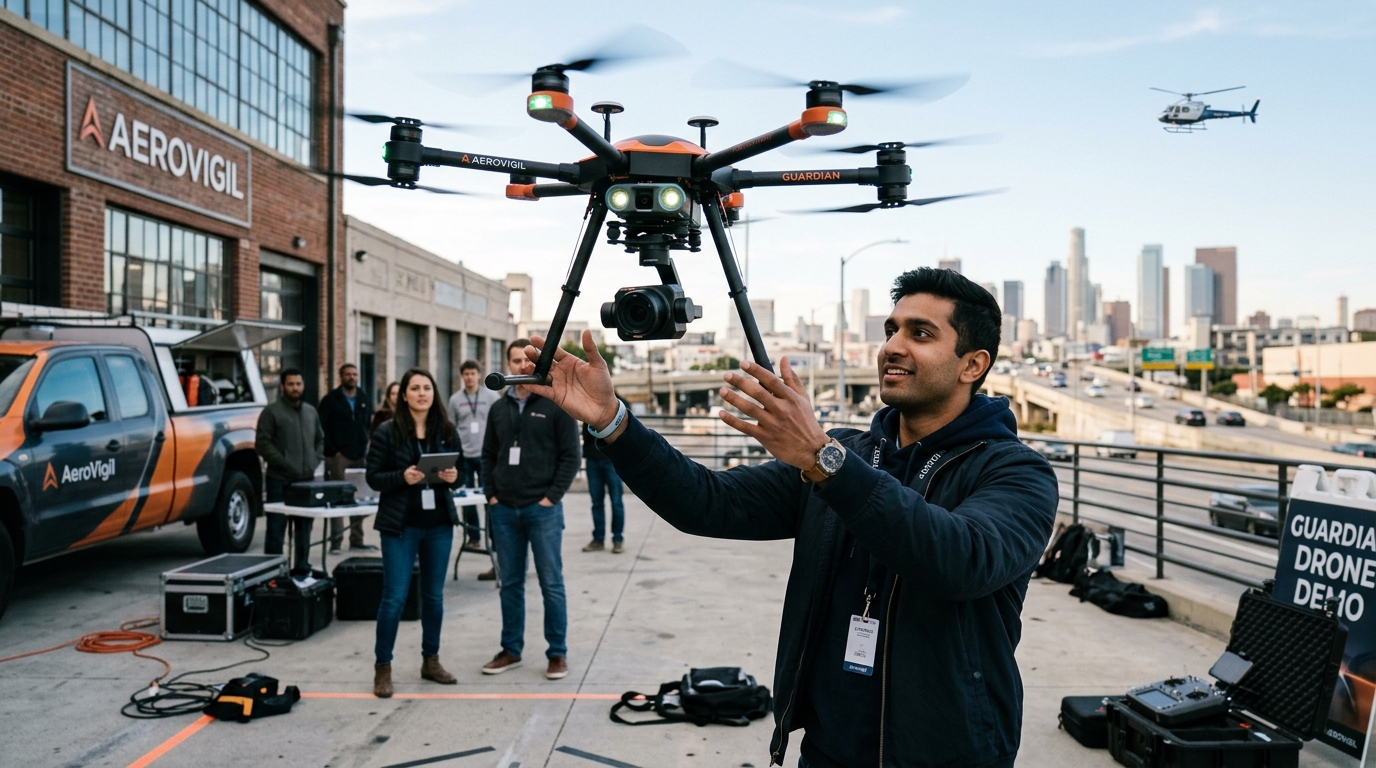
Now, let us talk about the star of the show. Brinc has officially launched its newest product, the Guardian drone. The company is very proud of it. In fact, they market the Guardian as “the closest thing to a police helicopter replacement that the drone industry has ever produced” and they call it the “world’s most capable 911 response drone.”
What makes it so special? Let us look at its super powers.
- Speed: The Guardian can fly at speeds up to 60 miles per hour. That means it can zip across a city as fast as a car driving on the highway.
- Endurance: It can fly for up to 62 minutes on just one single battery.
- Thermal imaging: The drone has a special thermal imaging camera. This means it can see body heat. If a person is lost in the woods at night, the drone can spot their body heat glowing in the dark.
- High-resolution cameras: It also carries two extra 4K cameras that can zoom in very far. The company says these cameras have such high resolution that they can read a car license plate from a very high altitude.
But the Guardian does more than just look. It can speak and light up the dark. The drone has a high-intensity spotlight onboard and features a very loud speaker. This speaker is described as being louder than an actual police siren! Police can use it to shout commands, give evacuation orders, or talk to someone to help calm them down during a scary emergency.
Space Internet: The Starlink Magic
Here is a feature that sounds like it is from a science fiction movie. Have you ever tried to use your phone, but you had no cell service? Drones can lose their connection too. But the Guardian has a secret weapon. It includes a Starlink satellite internet panel integrated directly into its airframe.
Brinc claims that this makes the Guardian the first public-safety quadcopter to ever have Starlink built in. Because it talks to space satellites, the company argues this gives the drone connectivity essentially anywhere. It is not limited by local cellular coverage. This gives the drone “unlimited range anywhere in the world” as long as aviation rules and power allow it.
The Magic Charging Nest
Most drones need a human to plug them in when their battery dies. The Guardian does not. Brinc offers a special rooftop “charging nest” for it. This is a robotic docking station. When the drone lands, the nest performs a fully automated battery swap, which the company has shown in its marketing videos. The drone is ready to fly again in no time!
But this nest is not just a charger. It is also a medical delivery box. The nest can be pre-loaded with critical supplies:
- An AED (a machine that helps restart a stopped heart)
- Flotation devices for people drowning
- Narcan (medicine used to stop drug overdoses)
The big idea is for the drone to grab these items and deliver them immediately at an emergency scene, potentially way before human responders can arrive.
The long-term dream is to have dense urban coverage. Imagine putting these nests on the roofs of police and fire stations everywhere. This would allow near-instant drone dispatch to many 911 calls.
Helicopter vs. Drone: The Big Fight
So, why do they call it a true replacement for a police helicopter? Let us look at how they compare.
They share a lot of the same jobs. Both can provide aerial surveillance and situational awareness. The drone can loiter over a scene for about an hour, which is highly competitive with many manned helicopter missions, especially when you think about the cost. In search and rescue operations, the drone uses its thermal cameras, speaker, and spotlight to direct crowds just like a helicopter would.
Speed is another big factor. With nests on rooftops across a city, a Guardian drone could theoretically reach an incident within a minute or two. Helicopters take much longer to get their engines started and fly to the scene. And helicopters usually do not deliver small packages like an AED or Narcan directly to the ground during routine urban calls. The Guardian can.
But the biggest difference of all is the price tag. Helicopters cost millions of dollars to purchase. On top of that, they cost thousands of dollars per hour to operate because you have to pay for fuel, pilots, maintenance, and insurance. The nest-based drones are dramatically cheaper to buy and run.
Let us not forget the noise. Helicopters are extremely loud and draw lots of complaints from angry neighbors. Electric drones are much quieter, making them less annoying to the community.
Because they are so much cheaper, a city could deploy dozens of nests and drones to cover huge areas, instead of just buying one or two helicopters. Plus, helicopters need human crews on shift. Drones can sit in their nests 24/7. They can launch autonomously or semi-autonomously when triggered by a 911 call or a gunshot detection system.
The Older Siblings: Lemur and Responder
Brinc did not just start with the Guardian. Before this new super drone, they launched drones like the Lemur and the Responder. These were designed for indoor tactical use and 911 response. In the Los Angeles area, local reporting has covered Brinc “Responder” drones being deployed as first-response tools.
In one example, a suburb like Hawthorne worked with Brinc to test drones that respond rapidly to 911 calls. These drones use nests stored across the city. When an emergency happens, the drones are dispatched automatically by dispatchers to arrive before officers or firefighters. They provide live video, audio, and even make public announcements.
These programs love to brag about being American-made hardware. They also feature cool integrations with systems like ShotSpotter, which is a technology that detects the sound of gunshots, and public warning systems.
Taking on the Giant: The Battle with DJI
Blake Resnick has a very bold vision for his company. He explicitly frames his goal as becoming the “DJI of the West”. He wants Brinc to be the dominant non-Chinese drone supplier for public safety.
He estimates this is a massive 6 billion to 8 billion dollar opportunity. Why? Because across the United States and abroad, there are roughly 20,000 police departments, 30,000 fire departments, and 80,000 police and fire stations. If just half of them host a 911 response drone in a rooftop nest, that is a gigantic market.
Historically, DJI held an “unofficial monopoly” in U.S. public-safety drones. Many departments still use them for everyday tasks. But things have changed. During the Trump era, the U.S. government put bans and restrictions on Chinese drones because of national security concerns. The government was worried about data being stolen. Congress has even debated broader bans, pushing agencies to look for American or allied suppliers.
Brinc is strongly marketing itself into this open space. To help speed things up, Brinc has partnered with the National League of Cities. Together, they are helping municipalities scale “drone as first responder” initiatives. This builds contacts with local governments that may eventually purchase the Guardian.
The Dark Side: Privacy, Rules, and Fears
But hold on a second. This all sounds amazing, but there are some real problems and fears to talk about. Replacing helicopters with drones is not perfectly simple.
First, there are physical limits. Drones are more sensitive to high winds, heavy rain, and icing than large helicopters. Their payload capacity is also much lower, meaning they cannot carry personnel like an injured person to the hospital.
Second, there are very strict aviation rules. In the U.S., a group called the FAA sets the laws for the sky. Under FAA Part 107 rules, drone pilots must usually keep the drone within visual line of sight. Flying further away is called BVLOS. Approvals for routine BVLOS public-safety operations are still emerging. They are usually only given case-by-case. The success of the Guardian will depend on how quickly regulators allow these autonomous flights.
Then, there is the giant issue of privacy and surveillance. Civil liberties groups are very worried. They criticize drone programs for turning routine 911 responses into aerial video surveillance of innocent neighborhoods. With long-zoom and thermal cameras, people worry about how long the video footage is kept. They worry about the video being used for general intelligence gathering or tracking individuals over time.
There is also a fear about the militarization of policing. Equipping drones with loudspeakers, sirens, bright spotlights, and powerful optics can make people feel like they are living in a military zone. This is especially true in already over-policed communities. On the flip side, police argue that drones let them avoid sending officers into danger. This could actually reduce lethal confrontations.
Because of all these fears, transparency and governance are super important. Advocacy organizations are pushing for clear public policies on drone use. They want strict rules on data retention and no-fly zones. They also want local ordinances requiring public hearings before these drone programs can expand. By partnering with the National League of Cities, Brinc is trying to position itself as a friendly helper to navigate these tricky rules, not just a company selling hardware.
Finally, data security is a huge topic. U.S. anxieties about Chinese-made drones center on potential data exfiltration and foreign influence. Brinc strongly markets its domestic manufacturing and control as the perfect solution to keep American data safe.
The Future is Flying
What we are watching is a massive technological shift. The world is moving away from single, crewed, very expensive helicopters. Instead, we are moving toward many, distributed, semi-autonomous, cheaper nodes. It is an “internet of aircraft” model for emergency response.
Brinc’s business model is brilliant. They are pushing a “drones-as-infrastructure” or “drones-as-a-service” idea. Cities do not just buy a drone. They buy an entire network of nests, integration with 911, and ongoing support.
The company has so much leverage right now. They benefit from national security concerns about Chinese drones. They benefit from cities wanting faster emergency response times. They also benefit from the pressure cities face to cut costs while still maintaining great aerial capabilities.
Of course, the ethical pressure points will remain. Widespread deployment of persistent aerial sensors over cities will keep raising surveillance and equity questions. Civil liberties groups will keep fighting to make sure the technology is used fairly.
But one thing is completely certain. The sky above our cities is about to change. A former Thiel fellow’s startup just launched a drone it says can replace police helicopters, and it is bringing a thrilling new chapter to the world of public safety. So, the next time you hear a loud siren or look up for a helicopter, keep your eyes peeled. You might just spot a super-fast, quiet Guardian drone racing across the clouds to save the day!
Frequently Asked Questions
What is the Guardian drone?
The Guardian is an advanced public-safety drone created by Brinc. It can fly at 60 mph, stay airborne for 62 minutes, and features thermal imaging, 4K cameras, Starlink connectivity, a spotlight, and a loud speaker. It is designed to replace traditional police helicopters.
Who founded Brinc?
Brinc was founded by Blake Resnick, a former Thiel Fellow who left Northwestern University to build technology solutions for public safety after witnessing the 2017 Las Vegas mass shooting.
How does the charging nest work?
The charging nest is a robotic rooftop docking station that performs fully automated battery swaps when the Guardian lands. It can also store and deliver critical medical supplies like AEDs, Narcan, and flotation devices directly to emergency scenes.
Why is Starlink connectivity important?
Starlink satellite internet gives the Guardian connectivity anywhere, regardless of local cellular coverage. This allows the drone to operate with unlimited range anywhere in the world, as long as aviation rules and power permit.
How much is Brinc worth?
Recent funding rounds have valued Brinc at nearly 500 million dollars, with early investment support from notable figures including Sam Altman, co-founder of OpenAI.
What are the main advantages over police helicopters?
Guardian drones are dramatically cheaper to purchase and operate, much quieter, faster to deploy from rooftop nests, and can deliver medical supplies. Cities can deploy dozens of drones for the cost of one helicopter, providing broader coverage.
What are the privacy concerns with these drones?
Civil liberties groups worry about persistent aerial surveillance, long-zoom and thermal camera capabilities, data retention policies, and the potential for tracking individuals. There are also concerns about the militarization of policing and the need for strict governance and transparency rules.
Why is Brinc competing with DJI?
DJI historically dominated U.S. public-safety drones, but national security concerns about Chinese technology have created opportunities for American suppliers. Resnick aims to make Brinc the “DJI of the West” and capture the 6-8 billion dollar public safety drone market.
Can the Guardian operate autonomously?
The Guardian can launch autonomously or semi-autonomously from its charging nest when triggered by a 911 call or gunshot detection system. However, full autonomous operation depends on evolving FAA regulations regarding beyond visual line of sight flights.
What is the market opportunity for these drones?
Resnick estimates a 6-8 billion dollar opportunity, with approximately 20,000 police departments, 30,000 fire departments, and 80,000 police and fire stations across the United States. If just half host a 911 response drone, it represents a massive market for Brinc.