
Estimated reading time: 12 minutes
Key Takeaways
- China has successfully completed invasive and wireless brain-computer interface trials on paralyzed patients, making it the second country after the US to achieve this milestone.
- Over 50 clinical trials for flexible, implantable BCIs were reported in China by mid-2025, targeting motor control, language decoding, and stroke rehabilitation.
- The Chinese government released a strategic roadmap aiming to build a globally competitive BCI industry by 2030.
- China’s BCI industry was worth approximately US$446 million in 2024 and is projected to grow at 20% annually.
- Chinese companies hold more than half of all global BCI invention patents.
- The technology raises significant ethical concerns about workplace surveillance and privacy.
- China’s manufacturing capabilities and centralized system give it unique advantages in scaling BCI technology.
Table of contents
- Key Takeaways
- The “Miracle” in Shanghai
- The Science is Moving Fast
- The Master Plan: World Domination by 2030
- The Business of Brains
- Who Are the Players?
- The “Brain” Computer and the Chip War
- The Good, The Bad, and The Scary
- China vs. The USA: Who is Winning?
- Reality Check: Can They Read Your Mind?
- Frequently Asked Questions
Imagine sitting in a chair, completely still. You are looking at a computer screen. Without lifting a finger, without speaking a word, and without even blinking, you open an app. You start typing a message to your friend. You move a chess piece across a digital board. You are doing all of this just by thinking about it.
It sounds like a movie about the distant future. It sounds like science fiction. But it is not fiction. It is happening right now, and the country leading the charge might surprise you.
China is racing ahead in brain-computer interface (BCI) technology — basically connecting human brains directly to computers. This could mean future tech that lets people control devices or even communicate just by thinking.
The “Miracle” in Shanghai
Let’s start with the human side of this story. It is easy to get lost in talk about wires and codes, but the real impact is on people.
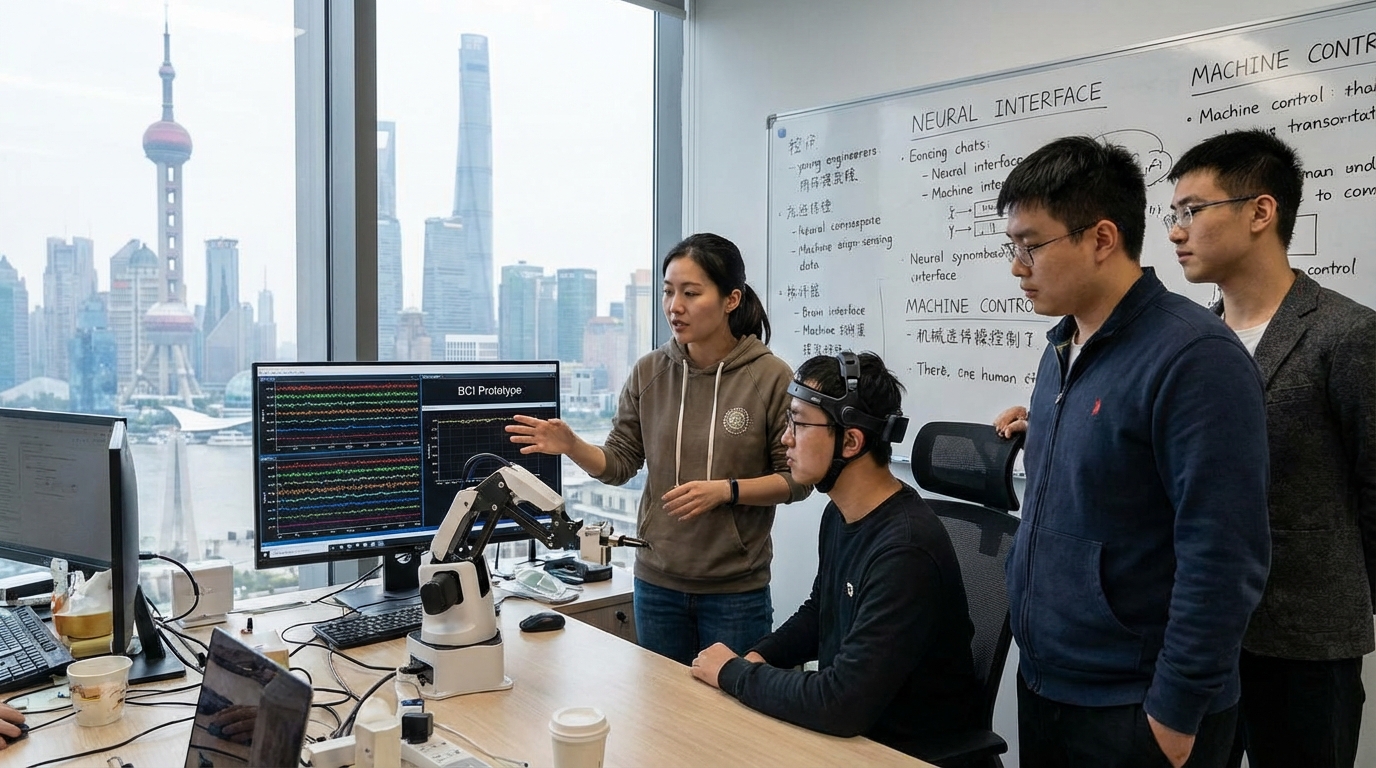
In March 2025, a team of doctors and scientists in Shanghai did something incredible. They worked with a 37-year-old man who had lost the use of all four of his limbs. He could not move his arms or legs. For many people in his position, interacting with the world is incredibly difficult.
The team, from the Chinese Academy of Sciences’ Center for Excellence in Brain Science and Intelligence Technology (CEBSIT) and Huashan Hospital, performed a surgery. They implanted a device directly into his brain. This is what experts call an “invasive BCI.” It means they actually go inside the skull to get the best possible signal.
The results were stunning. By June 2025, just a few months later, this man was doing things he hadn’t done in years. He could play chess and racing video games, move a cursor on a screen, and even type messages using only his thoughts. The device was stable. There were no infections. It just worked.
This achievement made China the second country in the world, right after the United States (specifically Elon Musk’s Neuralink), to successfully run this kind of invasive trial on a human being.
But they didn’t stop there.
Wires sticking out of a head can be dangerous and prone to infection. The “holy grail” of this tech is to make it wireless. Chinese researchers have now completed the country’s first fully implanted, wireless BCI trial on a paralyzed patient. This system allows the patient to control external devices without any clunky headgear or wires. Again, this puts them in a very exclusive club—only the second time in history this has been done wirelessly, with Neuralink being the first.
The Science is Moving Fast
The speed at which this is happening is breathtaking. It is not just one or two experiments. It is a whole wave of innovation.
By the middle of 2025, there were over 50 clinical trials reported in China for flexible, implantable BCIs. These trials aren’t just for fun; they are trying to fix serious medical problems. They are looking at motor control (helping people move), language decoding (helping people speak), spinal cord reconstruction, and stroke rehabilitation.
The scientists are also getting very creative with how they put these devices into the brain. You see, the brain is soft, like jelly. Putting hard metal electrodes into it can cause damage over time.
So, researchers are testing new methods on animals. One fascinating experiment involved a “lantern-inspired” device. They inserted a small tool into a rat’s brain. Once it was deep inside a specific fluid-filled space called the ventricle, the device opened up like a Chinese lantern. This allowed the sensors to press gently against the walls of the brain to pick up signals from deep areas, like the memory center (the hippocampus).
The result? It had long-term stability and could predict if the rat decided to turn left or right with up to 98% accuracy.
Mind-to-Mind Communication?
If that isn’t wild enough for you, let’s look at “telepathy.”
A Chinese team has proposed something called an electromagnetic brain-computer metasurface (EBCM). That is a mouthful, but the idea is simple and thrilling. They set up a system where two people could wirelessly transmit text to each other using brain signals.
The system tracks brain waves (specifically a signal called P300) to pick letters. It then sends those letters wirelessly to the other person. It is essentially “mind-to-mind” communication via brain signals.
They are also working on decoding speech. In 2025, work was done on non-invasive Chinese speech decoding. This uses a helmet that scans magnetic fields (MEG) to figure out what someone is saying or imagining saying. They use a smart algorithm that looks at both text and sound patterns to decode “inner speech.”
So, the basic story is absolutely true: China has functioning brain-computer implants in people, experiments that look like mind reading, and they are moving fast.
The Master Plan: World Domination by 2030
In many places, science happens because a company decides to make a product, or a university gets a grant. In China, things often happen because the government sets a massive goal.
BCI is no longer just a science project in China. It is a named strategic industry with a central-government roadmap.
In 2025, seven powerful ministries—including the Ministry of Industry and Information Technology—released a document. It was called the “Implementation Plan for Promoting Innovation and Development of the BCI Industry.” This is a blueprint for how China intends to win this race.
The timeline is aggressive:
- By 2027: They want key BCI technologies to move out of the lab and into real hospitals and demo sites.
- By 2030: They want to build a “globally competitive” BCI industry. They want to be the world leaders.
The plan is very detailed. It lists 17 concrete actions. They aren’t just hoping for the best; they are planning to:
- Develop ultra-low-power chips that can go inside the brain.
- Create algorithms that can decode brain signals in real-time.
- Mass-manufacture non-invasive BCIs (like headsets) for everyday people.
- Create the rules and standards that the rest of the world might have to follow.
To make this happen, they are pouring money into it. At the 2025 Shenzhen BCI & Human-Computer Interaction Expo, it was announced that there is an 11.6 billion yuan (that is about US$165 million) brain science fund. This money is there to help companies grow from tiny startups to massive corporations.
We have seen this movie before. China did the same thing with solar panels, electric vehicles, and batteries. They used state support to build huge industries very quickly. Now, they are doing it for the brain.
The Business of Brains
So, how much is this industry actually worth?
The numbers are climbing fast. In 2024, China’s BCI industry was worth RMB 3.2 billion (about US$446 million). That was a jump of 18.8% from the year before.
By 2027, experts think this will grow to RMB 5.58 billion (about US$778 million). That is a steady growth of 20% every single year. Some people are looking even further ahead, predicting that by 2040, the market could be worth tens of billions of US dollars.
Right now, most of this money comes from “non-invasive” tech. These are things like headbands that help you meditate or focus. In 2024, these devices made up 82% of the market.
But the invasive stuff—the chips that go inside the brain—is expected to grow fast. As doctors get better at using them to treat paralysis and disease, invasive tech could make up 25% of the market by 2027.
China is also filing patents like crazy. A patent is like a claim of ownership on an invention. By 2024, China had 2,276 BCI-related patents. In fact, Chinese companies accounted for more than half of all BCI invention patent filings globally.
This means China isn’t just using the technology; they are trying to own the intellectual property rights to it.
Who Are the Players?
You might know Neuralink, but you should probably start learning the names of the Chinese competitors.
There is NeuroXess, which is working on flexible implants. There is BrainCo, a company that makes wearables for focus and attention. BrainCo has raised about 2 billion yuan (US$287 million) and is reportedly planning to go public on the stock market in Hong Kong.
Another big name is StairMed Technology. They are based in Shanghai and just raised 350 million yuan (US$48 million) in early 2025 to build implantable systems.
It’s not just startups. Big universities like Tsinghua and Fudan University are deeply involved. This combination of hungry startups and powerful research universities is a recipe for rapid progress.
The “Brain” Computer and the Chip War
We cannot talk about tech today without talking about chips. The US and China are already in a fierce competition over who makes the best AI chips. Now, that battle is moving to BCI.
Chinese researchers recently unveiled something called BI Explorer 1 (BIE-1). It is a brain-inspired AI server that is about the size of a mini-fridge.
This machine is a beast. It has 1,152 homegrown CPU cores and massive storage. But the most amazing part is that it uses 90% less power than typical AI computers. You could plug it into a standard wall outlet in your house.
Why does this matter? Because the Chinese government wants to make sure they can build ultra-low-power implantable chips without needing help from the US. They want to break their reliance on Western suppliers.
This is about sovereignty. It is about making sure that if the brain is the next frontier, China has the keys to the castle.
The Good, The Bad, and The Scary
Tech is a tool. A hammer can build a house, or it can break a window. BCI is the same. It has amazing potential for good, but it also opens doors to things that make people uncomfortable.
The Good: Healing the Broken
For people with medical conditions, this tech is a miracle.
We already mentioned the man playing chess. But researchers want to go further. They want to help people control robotic limbs, wheelchairs, and smart homes just by thinking.
They are looking at using BCI for stroke rehabilitation and even spinal cord reconstruction. Imagine bypassing a broken spine so signals from the brain can reach the legs again. They are also looking at using it to treat depression and manage pain.
The Scary: Watching Your Thoughts
Here is where the “Black Mirror” vibes start. The Chinese plan is very open about using this tech for things that are not medical.
The government roadmap encourages using wearable headbands in places like mines, transportation, and factories. Why? To monitor driver drowsiness and fatigue.
On the surface, this sounds safe. If a truck driver is falling asleep, the helmet knows and wakes them up. That saves lives.
But it also means the boss knows exactly what is happening inside the worker’s head. Are they focused? Are they stressed? Are they working hard enough?
Education is another target. Companies like BrainCo already sell headbands to schools to monitor student attention. Imagine a classroom where the teacher has a dashboard showing exactly which kids are paying attention and which ones are daydreaming.
The plan even envisions mass-produced consumer BCIs. Imagine playing a video game where the controller is your mind, or meditating with an app that adjusts the music based on your brain waves.
The Military Angle
While the documents focus on civilian use, experts know that this tech has a dual purpose.
If you can use a BCI to help a paralyzed person control a robotic arm, you can use the same tech to help a soldier control a drone swarm. If you can monitor a truck driver for fatigue, you can monitor a fighter pilot for stress.
Analysts note that China treats BCI just like 5G or AI—it is a strategic asset. It is reasonable to assume this is another frontier of competition between great powers.
China vs. The USA: Who is Winning?
So, who is actually ahead?
The US has a head start. Companies like Neuralink and Synchron have been pushing boundaries for years. The US has deep pockets and a history of innovation.
However, China has some distinct advantages:
- Manufacturing: China is the world’s factory. They can build sensors, chips, and wearables faster and cheaper than almost anyone else.
- Patients: China has a large population and a centralized medical system. This can make it easier to find patients for clinical trials and gather data.
- Coordination: As we saw with the government plan, when China decides to move, the whole system moves together. Funding, laws, and manufacturing all line up.
A common view among experts is this: The US might be ahead at the very bleeding edge of innovation right now, but China is building the massive industrial ecosystem that could win on scale and cost in the long run.
Reality Check: Can They Read Your Mind?
Before you panic and buy a tin foil hat, let’s be realistic about what “mind reading” actually means today.
Current technology cannot read your deep secrets. It cannot look into your brain and see your childhood memories or know your political beliefs. It works by recognizing specific patterns. It can see “motor actions” (like intending to move a hand left or right) and “states” (like being tired or excited).
However, the technology is getting better at decoding “inner speech.” As we saw with the EBCM work, it is possible to transmit simple text messages mind-to-mind.
So while they can’t read your diary yet, decoding meaningful pieces of your intentions is no longer just a theory. It is a reality that is rapidly improving.
The race for the brain is on. What started as medical experiments to help the disabled has turned into a global industrial competition.
China’s approach is clear: they want to be the leaders. They have the plan, they have the money, and they have the technology. From the man playing chess with his mind in Shanghai to the students wearing focus bands in classrooms, the future is arriving fast.
For startup founders and tech enthusiasts, this is a reminder of how quickly the world changes. Innovation doesn’t wait. Whether it is AI writing emails or chips reading brains, the tools of tomorrow are being built today. The only question left is: are we ready to plug in?
Frequently Asked Questions
What is brain-computer interface (BCI) technology?
BCI technology creates a direct communication pathway between the brain and external devices. It allows people to control computers, prosthetics, or other machines using only their thoughts, without physical movement.
How does China’s BCI technology compare to Neuralink?
China is currently the second country after the US (Neuralink) to successfully complete invasive and wireless BCI trials on humans. While the US may have a slight edge in bleeding-edge innovation, China has advantages in manufacturing scale, patient access, and centralized coordination.
Can BCI technology actually read minds?
Current BCI technology cannot read your thoughts or memories. It can only detect specific patterns related to motor actions (like intending to move) and states (like fatigue or focus). However, researchers are making progress in decoding “inner speech” for simple communication.
What are the main applications of BCI technology?
BCI has medical applications including helping paralyzed patients control devices, stroke rehabilitation, spinal cord reconstruction, and treating depression. Non-medical uses include monitoring worker fatigue, student attention, and potentially consumer applications like gaming or meditation.
When does China plan to dominate the BCI industry?
According to China’s government roadmap, they aim to move key BCI technologies from labs to hospitals by 2027 and build a globally competitive BCI industry by 2030. They have allocated significant funding and outlined 17 concrete actions to achieve this goal.
What are the privacy concerns with BCI technology?
BCI raises concerns about workplace surveillance (monitoring worker attention and fatigue), educational monitoring (tracking student focus), and potential misuse for military applications. The technology could allow unprecedented access to people’s mental states and intentions.
How much is China’s BCI industry worth?
In 2024, China’s BCI industry was valued at approximately US$446 million and is projected to grow to US$778 million by 2027, representing a 20% annual growth rate. Some experts predict the market could be worth tens of billions by 2040.