
Estimated reading time: 12 minutes
Key Takeaways
- Arcee AI, a 30-person startup, released Trinity Large—a 400 billion parameter open source LLM that competes with Meta’s Llama 4.
- The model is released under an Apache 2.0 license, making it truly open source with no commercial restrictions.
- Arcee trained the entire Trinity family for roughly $20 million—a fraction of what tech giants spend.
- The model uses Mixture-of-Experts (MoE) architecture for maximum efficiency and performance.
- This breakthrough proves that smart engineering can beat brute force in the AI race.
- For founders, this represents a new era of accessible, sovereign AI technology without dependence on Big Tech.
Table of contents
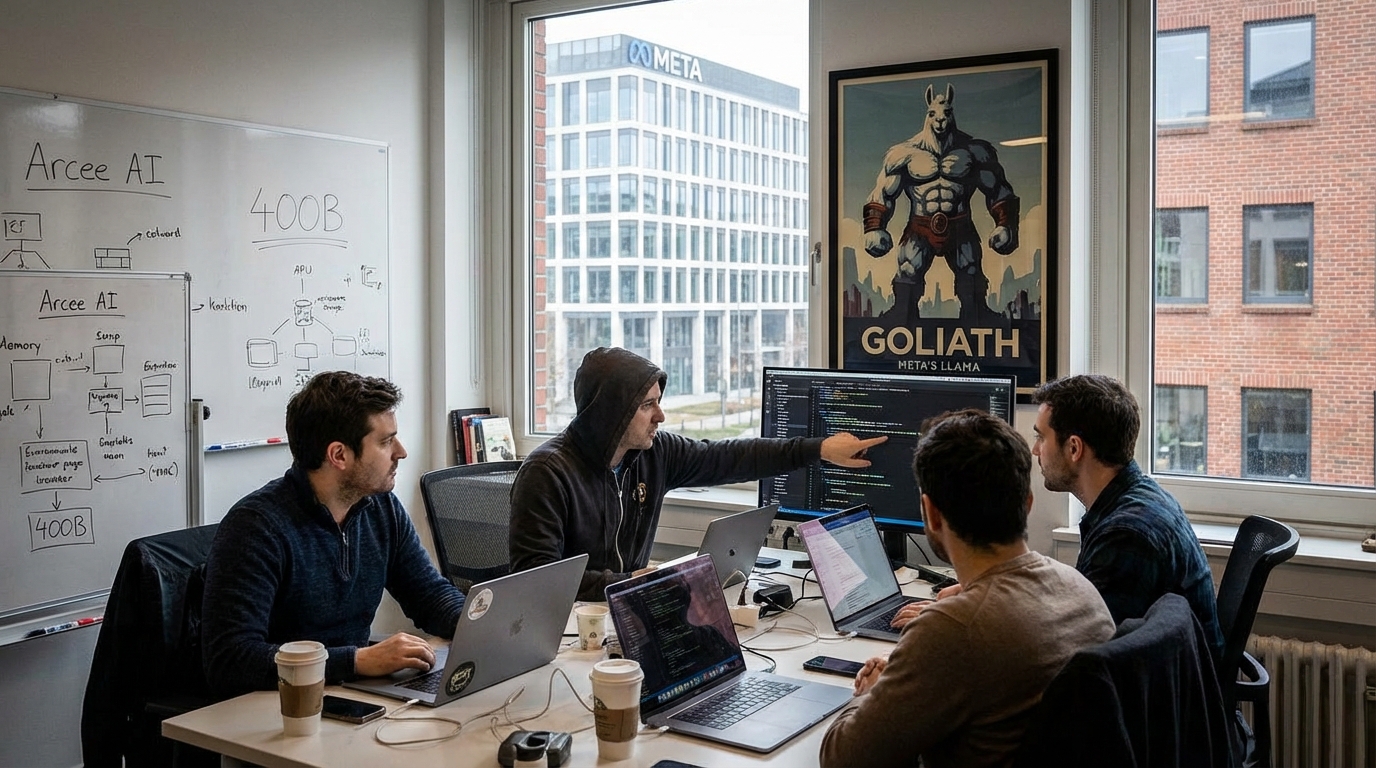
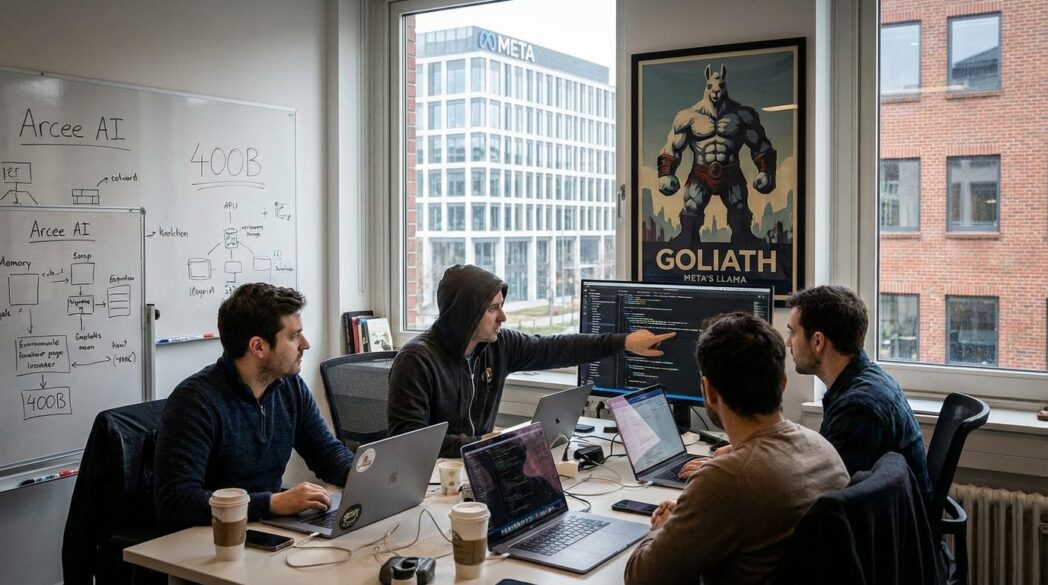
Imagine a battle. On one side, you have a giant—a titan of industry with billions of dollars, thousands of employees, and data centers the size of small cities. This is Meta, led by Mark Zuckerberg.
On the other side, you have a small room of people. Roughly 30 of them. They have a fraction of the money and a tiny fraction of the resources.
In the world of business and startup fundraising, the smart money is usually on the giant. But every once in a while, something incredible happens. The little guy wins.
This week, the technology world is buzzing with exactly that kind of story. The headline everyone is reading is that a tiny startup Arcee AI built a 400B-parameter open source LLM from scratch to best Meta’s Llama.
This isn’t just a technological breakthrough; it is a statement. It proves that in the age of AI, smart engineering can beat brute force. For the founders reading this—the ones who use HeyEveryone.io to automate their fundraising because they value efficiency over waste—this story is going to resonate deeply.
Let’s dive into the details of how a small team in Miami decided to take on the kings of Silicon Valley, and why they might just have won.
The Breaking News: What Just Happened?
On January 28, 2026, the AI landscape shifted beneath our feet. TechCrunch reported that Arcee AI, a startup with only about 30 employees, released a monster of an AI model called Trinity Large.
This isn’t a small toy model. This is a “frontier-grade” Large Language Model (LLM). It boasts a staggering 400 billion parameters. In the world of AI, parameters are somewhat like the brain cells of the model—the more you have, generally, the smarter the model is.
But here is the kicker: Arcee AI claims this model delivers performance that is competitive with, and in some cases better than, Meta’s Llama 4 Maverick 400B.
For years, Meta has been the undisputed champion of “open” AI models. But Arcee has done something Meta hasn’t. They released Trinity under an Apache 2.0 license.
Why does that matter? It means the model weights are permanently open and free to download. It means you can use it for commercial purposes with almost zero restrictions. It is true open source, unlike Llama’s custom license which comes with a lot of legal strings attached.
Arcee is positioning Trinity as a true alternative to the giants. They are standing up to Meta and other contenders like the Chinese model GLM-4.5, saying that open-weight AI belongs to everyone, not just the big corporations.
Who Are The Davids Behind This Goliath Tech?
So, who are these people? Who has the audacity to look at Meta and say, “We can do it better”?
Arcee AI was founded recently, in 2023. Their headquarters is listed in Miami, Florida. While huge tech companies have thousands of engineers working on a single button, Arcee has a team size of roughly 30 to 50 employees.
Their leadership is impressive but scrappy. The CEO is Mark McQuade, who previously worked at Hugging Face, a central hub for the open-source AI community. He knows this space inside and out.
The CTO is Lucas Atkins, the brain behind the model-building effort for Trinity.
When we look at their funding, it is modest compared to the billions raised by OpenAI or Anthropic. They raised a Series A of about $24 million on July 18, 2024. Their total capital raised sits around $29.5 million.
Here is the interesting twist: Arcee didn’t start out trying to build massive models. Originally, their thesis was “Small Language Models” (SLMs). They believed that companies wanted small, private, cost-efficient models. They built things like AFM-4.5B and tools like MergeKit to help people combine models.
But then, they pivoted. They decided to move up-market. They took their efficiency know-how and applied it to a massive scale. The result is the Trinity 400B—a shift from small tools to full-on frontier AI.
The Trinity Family: Under the Hood
When we say “Trinity,” we aren’t just talking about one robot. It is a whole family of models.
1. Trinity Large (400B) – The Heavy Hitter
This is the headline-grabber. It has 400 billion total parameters. However, Arcee used a clever technique called Mixture-of-Experts (MoE).
Imagine a classroom with 256 geniuses, but for any given question, only 4 of them are allowed to answer. This is how MoE works. Trinity has 256 experts, but only 4 are active per token. This means that while the model knows 400 billion things, it only uses about 13 billion parameters to process each word you type.
This is brilliant because it makes the model huge in knowledge but much cheaper and faster to run—similar to the cost of a much smaller model.
It was trained on about 17 trillion tokens of data. It can read and remember a massive amount of information at once—up to 256k tokens during training, and it supports up to 512k tokens when being used. That is enough to read multiple novels in one go.
There are three “flavors” of this model:
- Preview: Tuned for chatting and instructions.
- Base: The raw brain with minimal tuning.
- TrueBase: A “pure” version for researchers who want zero outside influence.
2. Trinity Mini (26B)
Released back in December 2025, this is a smaller, reasoning-focused model. It’s designed for coding and agents (AI bots that do tasks for you). It is very cheap to run, costing pennies per million tokens.
3. Trinity Nano (6B)
This is an experimental, tiny model. The goal here is to have a smart chat bot that can live on your laptop or even a phone—what they call “edge devices.”
The Showdown: Does It Really Beat Llama?
It is easy to make claims. It is harder to back them up. So, how does Trinity actually compare to Meta?
According to TechCrunch and Arcee’s reports, the Trinity Large base model is “largely holding its own and, in some cases, slightly besting” Meta’s Llama 4 Maverick 400B.
The areas where it excels include:
- Coding
- Math
- Common-sense reasoning
- General knowledge
It is also going toe-to-toe with GLM-4.5, the top-tier Chinese open model.
Now, we have to be fair reporters here. These benchmarks are currently coming from Arcee and their partners. We are waiting on the independent scoreboards to confirm everything. Also, the tests focus heavily on “reasoning” (thinking through problems), rather than safety or how many languages it speaks.
But the fact that a $29M startup is even in the same conversation as a trillion-dollar company is, frankly, astounding.
The “True” Open Source Rebellion
Why is everyone making such a big deal about the license?
When Meta releases Llama, they call it “open source.” But if you read the fine print, it is a custom license controlled by Meta. If you get too big, or if you use it in a way they don’t like, they can stop you. Many people in the coding world argue this isn’t real open source.
Arcee went the other way. They used Apache 2.0.
This is the gold standard of freedom. It means the weights (the brain of the AI) are permanently open. You can download them. You can put them on your own servers. You can build a product, sell it, and never owe Arcee a dime or an explanation.
This concept is called “Model Sovereignty.” It is the idea that companies and founders should own the technology they build on, rather than renting it from Big Tech.
For an indie developer or a startup founder, this is like being given the keys to a Ferrari and being told, “It’s yours. Do whatever you want with it.”
How Did They Afford This?
Training a model this big is usually shockingly expensive. We are talking hundreds of millions of dollars. How did Arcee do it with a fraction of that cash?
Efficiency.
The total training cost for the entire Trinity family (Large, Mini, and Nano) was about $20 million.
They spent nearly all their money on this gamble. The training took over six months. To do it, they partnered with a company called Prime Intellect.
Prime Intellect provided the “orchestration stack”—the software that manages the computers—and the hardware. They used 2,048 Nvidia Blackwell B300 GPUs for the big model. These are some of the most powerful AI chips on the planet.
By using the “Mixture-of-Experts” architecture we talked about earlier, they made sure that every dollar spent on computing power was used as efficiently as possible. They focused on “performance per parameter.” They didn’t just build big; they built smart.
What Does This Mean for You?
If you are a founder reading this, you might be thinking, “Cool story, but how does this help me raise money or build my business?”
The release of Trinity is a symbol of the current era of startups. It proves that the barrier to entry is crashing down.
1. Access to Intelligence: Previously, only giant corporations could afford “frontier” intelligence. Now, with Trinity being Apache 2.0, any startup can integrate world-class AI into their product without paying license fees to Meta or API fees to OpenAI.
2. Data Privacy: Because you can host this model yourself (if you have the hardware), you don’t have to send your sensitive customer data to a third party. This is huge for fintech and healthcare startups.
3. The Power of Efficiency: Arcee proves that you don’t need the most venture capital to win. You need the best strategy.
This connects directly to what we do here at HeyEveryone.io.
We understand that cold outreach is broken. Traditionally, you would need to hire a massive sales team (brute force) to research investors and send generic emails. That takes months and costs a fortune—just like training a traditional AI model.
But just as Arcee used smart engineering to beat Meta, HeyEveryone uses AI to beat the old way of fundraising. Our tool identifies the right investors for you. It crafts hyper-personalized emails based on their recent news and investment history. It automates the follow-ups.
We turn a process that used to take a team of people six months into something one founder can manage in minutes. We give you the “David” advantage in a world of Goliaths.
Arcee AI showed us that a 30-person team can outmaneuver a trillion-dollar company. With the right tools—like HeyEveryone for your fundraising—your startup can do the exact same thing in your industry.
The Future is Open
The release of Trinity Large is more than just a new product. It is a challenge.
It challenges the idea that AI must be closed and controlled by the few. It challenges the idea that you need billions of dollars to innovate.
Arcee plans to make money by offering hosting services and helping companies fine-tune these models, but the core technology is out there. Free. Forever.
This “David vs. Goliath” showdown in the open-source AI wars is just beginning. But one thing is for sure: the Davids are getting smarter, faster, and more dangerous every day.
For the indie developers and the founders working late nights to build something from nothing: Arcee AI just proved that anything is possible. Now, it’s your turn.
Frequently Asked Questions
What makes Trinity Large different from Meta’s Llama?
Trinity Large is released under an Apache 2.0 license, making it truly open source with no commercial restrictions, unlike Llama’s custom license. Additionally, Trinity uses a Mixture-of-Experts architecture for improved efficiency while maintaining competitive performance.
How much did it cost Arcee AI to train Trinity?
Arcee AI spent approximately $20 million to train the entire Trinity family of models, which is a fraction of what tech giants typically spend on similar projects. This was achieved through efficient engineering and strategic partnerships.
Can I use Trinity Large for commercial purposes?
Yes, absolutely. The Apache 2.0 license means you can download the model weights, use them commercially, modify them, and even sell products built on top of Trinity without owing Arcee AI anything or needing their permission.
What is Mixture-of-Experts (MoE) architecture?
MoE is a technique where the model has many “expert” sub-networks (256 in Trinity’s case), but only a few (4 per token) are activated for any given task. This makes the model incredibly efficient, providing the knowledge of a 400B parameter model while using only about 13B parameters per inference.
How does this affect the AI industry for startups?
Trinity’s release dramatically lowers the barrier to entry for startups wanting to use frontier-level AI. Instead of paying API fees or being locked into proprietary systems, startups can now access world-class AI technology for free, giving them true “model sovereignty” and competitive advantages against larger players.
This blog post was researched using the latest news from TechCrunch, Arcee AI documentation, and industry databases to bring you the most accurate updates in the world of venture capital and technology.