
Estimated reading time: 7 minutes
Key Takeaways
- Neko Health, co-founded by Spotify’s Daniel Ek, opened its first U.S. clinic in SoHo, Manhattan, with more than 25,000 New Yorkers on the waitlist.
- The $499 scan takes about one hour, is radiation-free, and includes a 50+ biomarker blood panel and a one-on-one clinician consultation.
- Neko raised a $700 million Series C in July 2026, backed by high-profile investors including Mark Zuckerberg and Priscilla Chan.
- Neko’s own data suggests about 1% of Swedish members had severe, potentially life-threatening conditions with no symptoms, but this is observational data with no control group.
- Doctors raise concerns about false positives, false reassurance, and the lack of evidence that scanning healthy people reduces mortality.
- Neko is best understood as a technology-driven annual physical, not a replacement for primary care or validated screening such as colonoscopies and mammograms.
Table of contents
What if you could walk into a sleek, futuristic clinic, spend one hour being scanned from head to toe, and walk out knowing more about your body than your doctor has ever told you? That is exactly the promise Neko Health is making to Americans, and tens of thousands of people are already lining up to take them up on it.
Neko Health’s full-body scan has officially arrived in the United States. The story has everything: a billionaire tech founder, cutting-edge sensors borrowed from the automotive industry, more than 25,000 New Yorkers on a waitlist before the doors even opened, and a medical debate about how we think about staying healthy. Is this the future of preventive medicine? Or is it an expensive anxiety machine dressed up in Scandinavian minimalism? Let’s dig in.
From Spotify to Your Bloodstream: Who Is Behind Neko Health?
Neko Health was co-founded by Daniel Ek, the same Daniel Ek who built Spotify into one of the most powerful music platforms on earth, and Hjalmar Nilsonne, who serves as Neko’s CEO. Ek, now Spotify’s executive chairman after stepping back from the CEO role on January 1, 2026, has poured his energy and his money into a very different kind of streaming service. This one streams data about your body rather than songs into your ears.
The company opened its first clinic in Stockholm in 2023 and has since expanded to the United Kingdom. Now it has taken the leap across the Atlantic. On September 24, 2026, Neko Health opened the doors to its first American clinic at 300 Lafayette Street in SoHo, Manhattan. The reception was extraordinary: more than 25,000 New Yorkers had already joined the waitlist before the clinic welcomed its first patient.
The company says it has already delivered scans to more than 100,000 members across Sweden and the U.K. It also reports that more than 350,000 people globally are either on waitlists or registered for upcoming scans.
Those are not the numbers of a niche wellness experiment. That is a startup with serious momentum and serious money behind it.
$700 Million and a Star-Studded Investor List
Let’s talk funding, because this is where the story gets truly jaw-dropping. In July 2026, Neko Health raised a $700 million Series C round to fuel its U.S. expansion and continue developing its proprietary technology. Fierce Healthcare reported that the round was co-led by Lightspeed Venture Partners and O.G. Venture Partners, with participation from:
- Atomico
- General Catalyst
- Lakestar
- Liberty City Ventures
- Positive Sum
- BDT & MSD
The investor list does not stop there. Among those backing Neko are Mark Zuckerberg, Priscilla Chan, Maria Sharapova, Claudia Schiffer, Thierry Henry, Tim Ferriss, will.i.am, Ari Emanuel, Danny Meyer, and Jimmy Iovine. When the founder of Facebook and a tennis Grand Slam champion are putting money into the same health startup, something culturally significant is happening.
This Series C follows an earlier $260 million Series B in January 2025, at a reported valuation of $1.8 billion, according to Axios. At that time, Axios noted that full-body scan startups had become popular with both venture capitalists and celebrities, but were already generating serious debate over cost and clinical effectiveness. That debate has only grown louder since.
This level of fundraising makes Neko one of the most heavily backed health-tech ventures in recent memory. It signals that the smart money, at least, believes preventive health technology is a space worth betting on in a very big way.
What Actually Happens Inside the Clinic?
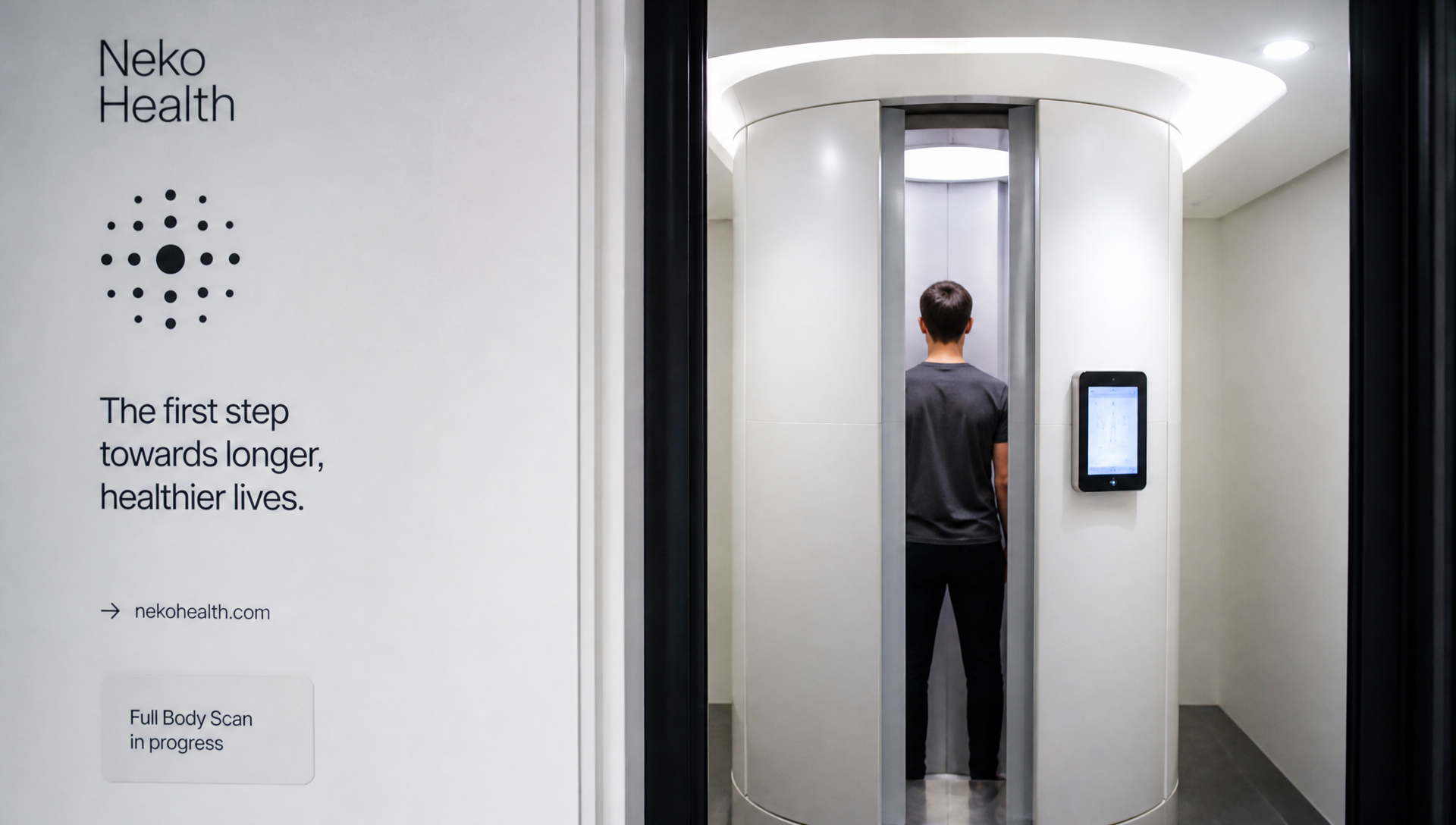
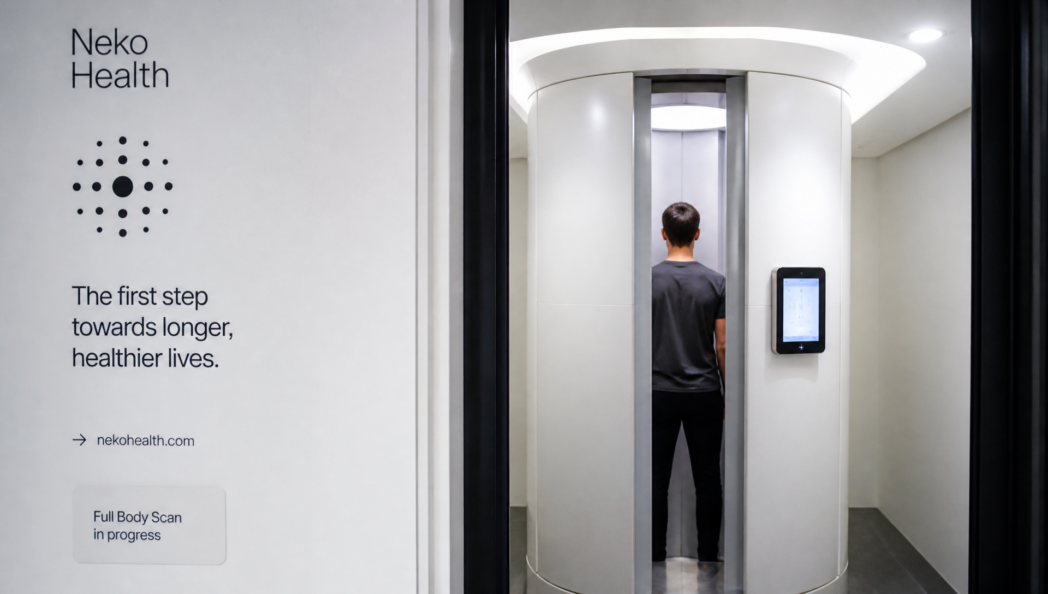
For $499 (the scan is HSA/FSA eligible according to Neko’s site) you get roughly one hour of comprehensive health assessment. Before you picture a claustrophobic MRI tube or a room full of radiation equipment, stop. Neko’s scan is entirely radiation-free, with no X-rays and no CT scan. Instead, it combines cameras, sensors, blood analysis, and clinical expertise.
Here is what the scan covers, according to Neko’s own health scan page:
- Skin and body imaging: Contactless imaging captures your skin and body. Moles are indexed and flagged, and a dermatologist reviews any concerning spots. Body composition and visceral fat context are also assessed.
- Heart and circulation: An ECG and cardiovascular assessment, blood pressure readings, circulation measurements, and microcirculation imaging at the feet all show how your heart and blood vessels are performing. A clinician interprets all cardiac and vascular signals together.
- Blood testing: An on-site blood lab tests more than 50 biomarkers covering heart health, metabolism, immunity, inflammation, and other markers. You get the results within the same visit.
- Other biometrics: Grip strength, eye pressure, vitals, and physical resilience markers round out the picture.
- Clinician consultation: Every scan ends with a one-on-one consultation with a clinician. If something needs a closer look, Neko says it can offer in-house follow-up including ultrasounds and echocardiograms, or prepare referrals for outside doctors.
- Wearables integration: Users can connect Apple Health or Health Connect data so clinicians can review sleep patterns, activity levels, recovery, and heart-rate trends alongside scan results.
The technology powering all of this is genuinely fascinating. Neko’s team has designed its own hardware and software in-house. One standout example: Neko’s technology page describes a laser vibrometry system that detects subtle mechanical motion from your heartbeat at a distance. The technology was originally adapted from the automotive industry, and it samples cardiac timing 4,000 times per second. Multi-wavelength imaging at the feet measures tissue oxygen levels and hemoglobin signals at different tissue depths. Blood samples are processed on-site using Abbott and Sysmex systems.
In 2026, Neko-linked researchers even published a paper in Scientific Reports presenting a contactless laser-vibrometry and deep-learning approach for estimating a key cardiac timing metric. This is not a company slapping a wellness brand on existing equipment. It is engineering new ways to look inside your body.
Two of Neko’s specific devices also carry FDA 510(k) clearances:
- The Derma-2 thermal imaging system (clearance K253911, granted May 20, 2026)
- The Spectrum-2 tissue-saturation oximeter (clearance K254129, granted May 22, 2026)
It is important to understand what 510(k) clearance means and what it does not mean. The FDA’s 510(k) program is a device market-clearance pathway confirming a device is substantially equivalent to an already-marketed predicate device. It does not prove that a consumer screening program reduces mortality or improves long-term health outcomes.
What Does the Data Actually Show?
Neko is refreshingly upfront that its published findings come from its own member data, not randomized controlled trials. Still, the numbers it has shared are thought-provoking.
In its first-year data story analyzing 2,707 people scanned in Stockholm across 2023, Neko reported the following:
- 78.5% had no health issues requiring further examination.
- 14.1% needed medical treatment and monitoring.
- 1% received what Neko described as a potentially life-saving intervention for serious conditions like cardiovascular disease, severe metabolic disease, or melanoma.
Neko explicitly noted this was not a scientific study with a control group.
By September 2026, Neko published a Year Three report covering 80,858 members and 92,002 scans. That report found that in Sweden in 2025:
- Around 4% of members aged 25 to 84 had a significant condition requiring medical treatment.
- About 2% had early warning signs that could become more serious.
- Roughly 1% of members aged 28 to 72 had severe, potentially life-threatening conditions detected despite having no symptoms at all, including invasive melanoma, severe arrhythmias, valve disease, and aortic aneurysms.
Read that last part again. People who felt completely fine. No symptoms. Walking around with hidden serious conditions. That is the core emotional hook of the Neko story, and it is genuinely powerful.
It is also, the company itself acknowledges, observational data from a self-selected group of people who chose to pay for the scan. There is no control group. The improvements Neko observed across seven cardiometabolic markers among returning members cannot be definitively attributed to the scan itself.
Members do seem to love the experience, though. Neko reports that 75% of members book and prepay for their next scan after their first appointment, and 80% book a third scan after their second. Whatever people are getting from this experience, they are coming back for more.
But Wait: What Do Doctors Think?
Here is where the story takes a sharp turn. The medical community is not cheering Neko’s U.S. arrival from the sidelines, and the skepticism is not simply “technology bad.” It runs deeper than that.
The core question scientists ask is not “Can a scan find something?” It is “Does scanning healthy people like this actually help them live longer or better?”
Those are very different questions. Here are the main concerns.
The false positive problem is real and well-documented. When you test many body systems in a healthy person, you dramatically increase the chance of finding something that looks concerning but turns out to be harmless, or at least clinically irrelevant. These findings can cascade into follow-up imaging, biopsies, specialist referrals, anxiety spirals, and unexpected medical bills. The FDA’s own guidance on full-body screening warns that abnormal findings may not be serious, normal findings may be inaccurate, and false leads can prompt unnecessary testing.
False reassurance is the flip side of the same coin. Expert coverage in Allure highlighted concern that people might skip validated screening tests, such as colonoscopies and mammograms with strong evidence behind them, after getting a commercial scan and feeling “cleared.”
The mortality question looms largest of all. Experts quoted by Allure pointed to an absence of conclusive evidence that commercial full-body scans improve outcomes at the population level, with mortality reduction being the gold standard scientists look for. A landmark 2019 Cochrane review of general health checks found that systematic health checks in adults have little or no effect on total mortality or cancer mortality, and probably little or no effect on cardiovascular mortality. The conclusion was stark: systematic offers of health checks are unlikely to be beneficial and may lead to unnecessary tests and treatments.
The American College of Radiology stated in 2023 that it does not believe there is sufficient evidence to recommend total-body screening for patients with no symptoms, risk factors, or family history suggesting underlying disease.
It is worth noting that Neko is genuinely different from MRI-heavy competitors like Prenuvo or Ezra. Neko does not use MRI or CT, and at $499 it is cheaper than most boutique scan competitors. Allure noted that Neko instead uses 2D cameras, thermal cameras, depth sensors, blood tests, and other health metrics. Some of the harshest criticism directed at whole-body MRI services does not map perfectly onto what Neko is doing. But the broader screening concerns still apply:
- False positives
- Overdiagnosis
- False reassurance
- Unnecessary follow-up costs
- The absence of long-term outcomes data
Neko’s own U.S. medical terms of service are telling. The company explicitly states that it:
- Is not a full-service medical practice
- Is not intended as a primary care provider
- Does not replace continued medical care
- Does not currently accept insurance
- Does not include treatment for any identified health issues
It also states that it does not guarantee results will be accurate, reliable, or complete.
The marketing says “catch disease before it catches you.” The legal framing says “preventive assessment plus referral.”
So What Is Neko Health, Really?
Think of it less as a sci-fi body scanner and more as a very ambitious, technology-driven annual physical. It is faster, more data-rich, and far more aesthetically pleasing than what most Americans experience in a standard doctor’s visit.
It does not replace a colonoscopy, a mammogram, a Pap test, a lung cancer CT for high-risk smokers, or primary care. But it does gather an impressive volume of health signals in a single hour, present them through a clinician consultation, and give health-conscious people a richer baseline to work from.
Neko plans to expand beyond its SoHo location to more New York City sites and Miami, with Washington, D.C. and San Francisco to follow. At $499 a visit, with an HSA/FSA option and more than 350,000 people already engaged globally, it is building something that looks less like a luxury product and more like a new category of consumer health infrastructure.
Whether that infrastructure will ultimately be proven to save lives at scale remains the open question, and probably the most important one. Neko may be an early glimpse of what consumer preventive medicine looks like when it is built by technologists rather than traditional healthcare systems. But it also stress-tests one of medicine’s oldest and most important warnings: more data is not always better care.
For now, 25,000 New Yorkers are waiting to find out what their bodies have been hiding. And the rest of us are watching very closely.
Frequently Asked Questions
How much does a Neko Health scan cost in the U.S.?
The scan costs $499 and is HSA/FSA eligible. Neko does not currently accept insurance.
How long does the scan take?
The comprehensive health assessment takes roughly one hour and ends with a one-on-one consultation with a clinician. Blood results are available within the same visit.
Does the Neko scan use radiation, MRI, or CT?
No. The scan is radiation-free, with no X-rays, no CT, and no MRI. It uses cameras, thermal imaging, depth sensors, laser vibrometry, an ECG, and an on-site blood lab instead.
Where is Neko Health’s first U.S. clinic?
It is at 300 Lafayette Street in SoHo, Manhattan, and opened on September 24, 2026. Neko plans to expand to more New York City sites and Miami, followed by Washington, D.C. and San Francisco.
Does FDA clearance mean the scan is proven to save lives?
No. Two Neko devices have FDA 510(k) clearance, but this pathway only confirms a device is substantially equivalent to an already-marketed device. It does not show that a screening program reduces mortality or improves long-term health outcomes.
Why are some doctors skeptical of full-body scans?
The main concerns are false positives that lead to unnecessary tests and anxiety, false reassurance that may cause people to skip proven screenings, and the lack of conclusive evidence that scanning healthy people reduces mortality.
Can Neko Health replace my primary care doctor or routine screenings?
No. Neko states it is not a primary care provider and does not replace continued medical care. It also does not replace validated screenings like colonoscopies, mammograms, and Pap tests.