
Estimated reading time: 9 minutes
Key Takeaways
- Slate Auto’s Blank Slate Truck starts at $24,950 – making it the most affordable new electric pickup in America by a wide margin.
- The truck is deliberately bare-bones: no touchscreen, no radio, no power windows – and Slate calls that a feature, not a flaw.
- A modular accessory ecosystem with 200+ options lets owners customise over time, including full SUV conversion kits.
- The company is backed by Jeff Bezos’ family office and has raised roughly $1.4 billion in total funding.
- More than 180,000 reservation holders have already signed up – but converting those into actual buyers is the real test ahead.
- Key risks include an uncertified range figure, undisclosed destination fees, and the ever-present challenge of EV startup execution at scale.
Table of contents
- What Exactly Is the Slate Truck?
- The Anti-Feature List: What Slate Deliberately Left Out
- The Customization Play: Build It How You Want It
- The Real Price: Read the Fine Print
- The Company Behind the Truck
- Skipping Dealerships, Partnering With RepairPal
- The Cybertruck Comparison: It Is Complicated
- The Demand Is Real: 180,000+ Reservations
- Open Questions: What Could Go Wrong?
- The Bottom Line
- Frequently Asked Questions
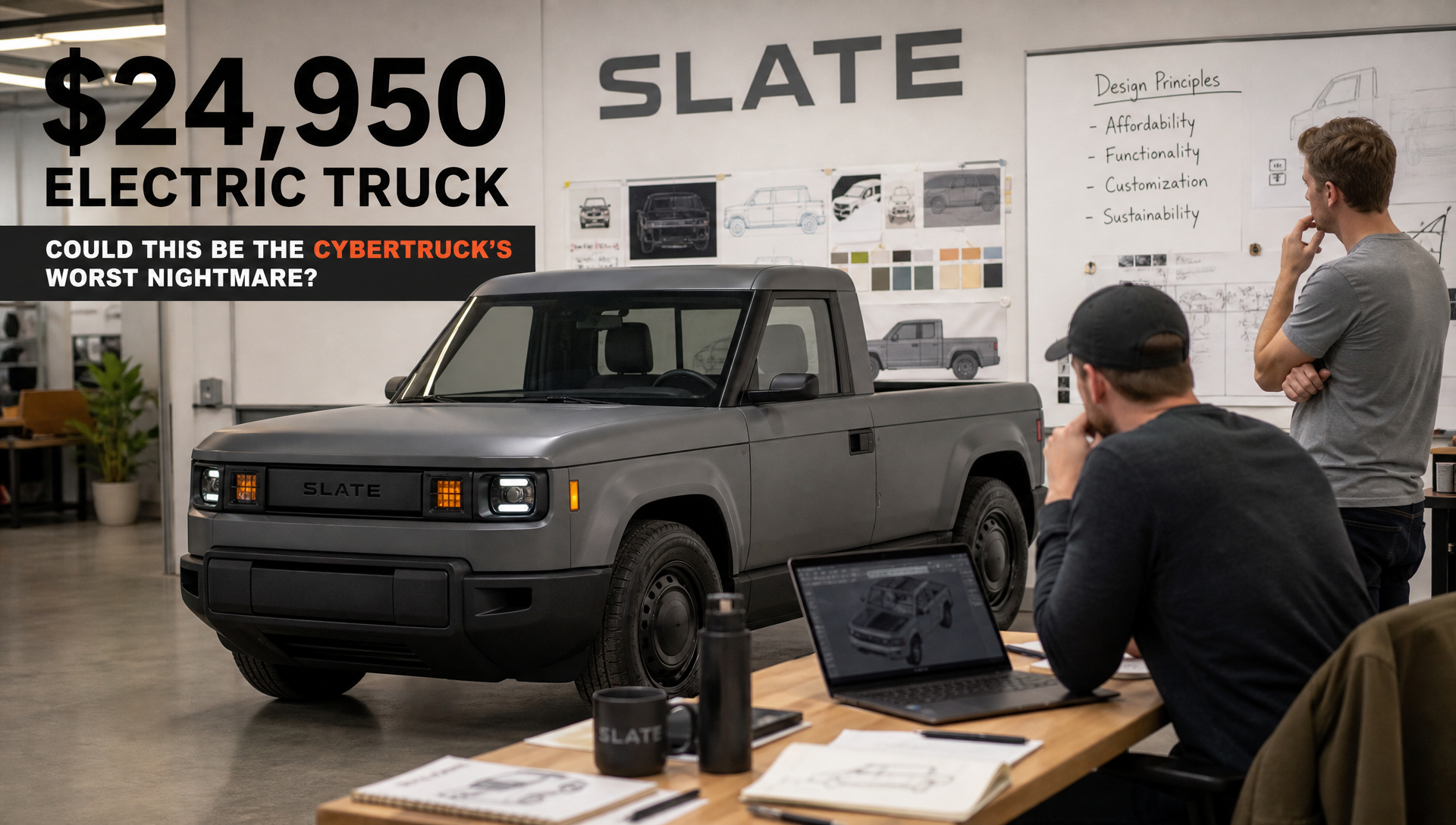
There is a new electric truck making waves across the internet right now, and it does not have a giant touchscreen. It does not come in flashy colors. It does not even have power windows. What it does have is a price tag of $24,950 – and that number alone is enough to make the entire electric vehicle industry stop and pay attention.
Meet the Slate Blank Slate Truck: a radically simple, bare-bones electric pickup from a Jeff Bezos-backed startup called Slate Auto. On June 24, 2026, the company officially opened preorders and revealed pricing that has sent shockwaves through the automotive world. In a market where most electric trucks cost as much as a modest home down payment, Slate is betting big that people are tired of paying for features they never asked for.
Could this scrappy little EV startup shake up the entire truck market? Could it make the Tesla Cybertruck look wildly overpriced? The internet is already arguing about it – and honestly, the debate is just getting started.
What Exactly Is the Slate Truck?
At its core, the Slate Truck is a two-door, two-seat compact electric pickup. It runs on a single rear motor producing 135 kW (roughly 181 horsepower) and 264 Nm (about 195 lb-ft) of torque. It carries a 65 kWh LFP battery pack (63 kWh usable) and is projected to deliver around 205 miles of range – though it is important to note that this is based on an approximation of the EPA test cycle and is not yet an official EPA-certified figure, according to Slate’s own fine print.
The truck goes from 0 to 60 mph in an estimated 8.0 seconds, tops out at 90 mph, and can haul a payload of 1,550 pounds while towing up to 2,000 pounds. The bed measures 60.5 inches long (or 80.7 inches with the tailgate dropped), and there is a 7.0 cubic foot frunk up front for extra storage.
According to Slate’s official announcement, the truck uses the North American Charging Standard (NACS), giving owners access to more than 29,000 Tesla Supercharger stalls across the country. Level 2 charging takes the battery from 20% to 100% in about 4 hours, and DC fast charging (rated at 120 kW) can take it from 20% to 80% in just 30 minutes.
And yes – the warranty is genuinely impressive for a startup: 10 years or 110,000 miles on the battery and powertrain, and 4 years or 50,000 miles on the rest of the vehicle.
The Anti-Feature List: What Slate Deliberately Left Out
Here is where things get really interesting – and where the internet has been loudest.
The Slate Truck has no built-in touchscreen. No factory radio. No power windows – yes, you read that right, it has hand-crank windows in 2026. It ships in a single gray composite finish because there is no traditional paint shop in its manufacturing process. There are no infotainment subscriptions to worry about, no complicated tech stack to update, and no over-engineered user interface to fight with.
As TechCrunch reported, Slate’s pitch is built on tactile controls, physical buttons, and fewer than half the parts of a typical truck. Buyers are expected to use their phones or tablets for navigation, music, and apps. Slate does offer mounts and accessory speakers for those who want them – they just are not included by default.
What is included in the base truck? According to Jalopnik’s coverage, standard features include:
- Backup camera
- Keyless entry
- Locking frunk
- Heat and air conditioning
- Airbags, traction control, and electronic stability control
- Automated emergency braking
- Cupholders and USB-C charging ports
The company says it is targeting a 5-star USNCAP crash rating – though that is a goal, not a completed government result. So the base truck is genuinely bare-bones. But Slate’s argument is that this is a feature, not a flaw.
The Customization Play: Build It How You Want It
Slate Auto is not just selling a cheap truck. It is selling a platform – and that distinction matters enormously when you understand what the company is really trying to do.
The company’s entire business model is built around a philosophy of modular, owner-driven customization. You start with the base two-seat pickup. Then, if you want, you add to it over time. Full-vehicle wraps cost under $500, and according to Slate, the company now offers more than 200 accessories, with over 80% priced under $500. The marketplace includes roof racks, zip-off seat covers, stereos, lighting, cargo equipment, decals, and interior pieces.
Want an SUV instead? Slate offers conversion kits – Squareback, Fastback, Open Air, and Cargo configurations – that let owners transform their pickup into a five-seat SUV. The Squareback SUV starts at $29,950, and the Fastback version starts at $31,950, all before fees and destination charges.
To help owners install accessories themselves, Slate launched Slate U – a library of how-to videos designed to make the truck feel more like a DIY project than a sealed black box. As Slate’s FAQ explains, this is a deliberate “make cars DIY-able again” philosophy that stands in stark contrast to the locked-down, software-driven approach of most modern EVs.
But here is the honest reality check: as Axios pointed out, the $24,950 price is for the bare version. Once you start adding wraps, audio, storage solutions, upgraded lighting, racks, and conversion kits, your total spend can climb quickly. A more comfortable, SUV-style build could easily push into the low-to-mid $30,000 range – which is still competitive, but worth keeping in mind when the headline number sounds almost too good to be true.
The Real Price: Read the Fine Print
Speaking of too good to be true – let’s talk numbers honestly.
The $24,950 headline price does not include taxes, title, license, registration, governmental fees, destination charges, documentation fees, or optional equipment. Slate’s own press release is transparent about this. Destination fees have not even been disclosed yet, and Jalopnik estimated the real starting price could land closer to the high-$20,000 range once required fees are factored in.
Still – even at $28,000 or $29,000 out the door, this would be the most affordable new electric pickup truck in America by a significant margin. That is not nothing.
The preorder deposit is $300 nonrefundable (or $250 for existing $50 reservation holders), and the company says first deliveries are expected in Q4 2026. However, as Reddit users on the r/slateauto community have noted, some preorder customers are already seeing delivery windows stretching into January–June 2027 or simply “2027” on their order confirmations. Slate’s official claim of “first deliveries Q4 2026” does not contradict this – but it suggests that broad customer deliveries are likely to roll well into next year.
The Company Behind the Truck
Slate Auto is not some garage startup running on wishful thinking. Founded in 2022, the company has assembled a seriously impressive team and funding base.
It is backed by Jeff Bezos’ family office, General Catalyst, Slauson & Co., former Amazon executive Diego Piacentini, and TWG Global. As TechCrunch reported, Slate raised a $650 million Series C in April 2026, bringing its total funding to roughly $1.4 billion. For startup founders who follow fundraising closely, that level of venture capital backing from such high-profile names signals serious conviction in Slate’s approach.
The company has deep Amazon DNA: co-founded by former Amazon Consumer CEO Jeff Wilke, it has multiple former Amazon leaders in key roles, and appointed former Amazon Marketplace VP Peter Faricy as CEO in 2026.
Trucks will be assembled at a reindustrialized factory in Warsaw, Indiana. According to Slate, the company plans to invest nearly $400 million in the facility, create more than 2,000 jobs, and contribute up to $39 billion to Indiana’s economy over the next 20 years.
Skipping Dealerships, Partnering With RepairPal
Slate is also breaking from tradition on how it sells and services its vehicles.
There are no traditional dealerships involved. Like Tesla before it, Slate sells directly to consumers online. TechCrunch also reported that Carvana was granted a warrant to buy Slate shares, hinting at a possible distribution or retail partnership as Carvana explores new-car sales – though full details of that arrangement have not been confirmed.
For service, Slate has partnered with RepairPal, giving owners access to 3,000+ certified repair shops nationwide, including more than 100 that can handle high-voltage EV work. As Slate announced, RepairPal shops will also be able to install accessories – making the service network double as a customization network. It is a clever move that turns a potential weakness (no dealer network) into a distributed, community-powered strength.
The Cybertruck Comparison: It Is Complicated
Let’s address the elephant in the room – or rather, the stainless steel truck.
Is Slate actually a Cybertruck killer? In pure capability terms: no. Not even close. The Tesla Cybertruck is a full-size, high-performance electric pickup with 300+ miles of claimed range, AWD configurations, and significantly more towing and payload capacity. According to Car and Driver, 2026 Cybertruck pricing ranges from $72,235 to $102,235 – meaning the Cybertruck costs anywhere from three to four times as much as a base Slate Truck.
These two vehicles are not competing for the same buyer in any technical sense. The Slate does not out-tow the Cybertruck. It does not out-range it. It does not out-power it.
But here is what makes Slate genuinely dangerous to the status quo: it is attacking the idea that electric trucks have to be expensive, complicated, and loaded with technology. It is a cultural disruption, not just a technical one. While the Cybertruck represents the peak of “more is more” EV thinking, the Slate Truck is asking a very different question:
“What if people just want something simple that works and costs $25,000?”
As TechCrunch framed it, the Slate price is roughly half the average U.S. new-car price and arrives in a market with few cheap new vehicles and almost no cheap EV pickups. That context alone makes Slate’s story genuinely exciting.
The Demand Is Real: 180,000+ Reservations
Perhaps the most telling signal of all is this: Slate says it already has more than 180,000 reservation holders, up from more than 160,000 earlier in 2026.
The real test, as Axios put it plainly, is how many of those 180,000 reservation holders convert into actual buyers now that the real price, deposit requirements, range figures, and delivery timelines are all out in the open. Reservation holders clicking “interested” for a theoretical cheap EV is one thing. Dropping a nonrefundable $300 deposit on a specific truck with crank windows and no radio is another.
And that conversion question is ultimately what will determine whether Slate Auto becomes one of the most exciting startup success stories in recent memory – or a cautionary tale about the gap between reservation lists and real-world demand.
Open Questions: What Could Go Wrong?
There are real risks here worth watching carefully.
- The out-the-door price remains unknown in full – destination fees and documentation charges have not been fully disclosed.
- The 205-mile range is projected, not EPA-certified – the real-world number could land lower.
- The stripped-down feature set will delight minimalists and frustrate mainstream buyers who expect more from any new vehicle in 2026.
- Once accessories start piling up, the total cost can creep from “bargain” territory toward “competitive, but not astonishing.”
There is also the startup execution risk that haunts every company at this stage. Slate has raised $1.4 billion, has 180,000+ reservations, and has Amazon veterans at the helm. But scaling EV manufacturing from zero – building quality control systems, logistics networks, and service infrastructure all at once – is extraordinarily hard. As TechCrunch noted, the EV startup market has been brutal, with more than a few well-funded newcomers stumbling badly on the road from prototype to production.
It is also worth noting that the previously hyped “under $20,000 effective price” that Slate once promoted relied on the $7,500 federal clean vehicle tax credit – which, according to the IRS, is no longer available for vehicles acquired after September 30, 2025. That changes the math meaningfully. To Slate’s credit, as TechCrunch observed, the company appears to have baked affordability directly into the vehicle itself – through fewer parts, no paint shop, one core platform – rather than relying on government incentives to get there.
The Bottom Line
The Slate Blank Slate Truck is one of the most talked-about vehicles of 2026, and for good reason. It is proof that you do not need a massive touchscreen, a subscription service, or a six-figure price tag to build an exciting electric vehicle. Sometimes, the most radical thing a company can do is make something simple, honest, and actually affordable.
Will it work? Will Slate deliver on time, at scale, and at the promised quality? Will 180,000 reservation holders become real buyers? Those questions will be answered in the months ahead.
But one thing is already clear: Slate has started a conversation that the rest of the auto industry cannot ignore. In a world of $72,000 Cybertrucks and overcomplicated EV flagships, a $24,950 electric pickup truck with hand-crank windows just might be the most refreshing thing to happen to American transportation in years.
And that, more than any spec sheet, is why everyone is talking about it.
Frequently Asked Questions
How much does the Slate Truck actually cost?
The base price is $24,950 before taxes, fees, destination charges, and optional equipment. Once all required costs are factored in, Jalopnik estimates the real starting price will land in the high-$20,000 range. Adding accessories, wraps, or an SUV conversion kit will push the total higher – potentially into the low-to-mid $30,000s for a well-equipped build.
Does the Slate Truck really have no touchscreen or radio?
Correct. The base truck ships with no built-in touchscreen, no factory radio, and no power windows. Buyers are expected to use a smartphone or tablet for navigation and media. Slate does sell accessory mounts and speakers separately, but nothing is included by default. This is a deliberate design philosophy, not an oversight.
When will the Slate Truck be delivered?
Slate officially targets first deliveries in Q4 2026. However, some preorder customers are already seeing delivery windows of January–June 2027 or simply “2027” on their order confirmations. Broad customer deliveries will likely extend well into next year.
Is the 205-mile range figure official?
No. The 205-mile range is a projected figure based on an approximation of the EPA test cycle. It has not been officially certified by the EPA. The real-world number could differ once formal testing is completed.
Can I still claim the $7,500 federal EV tax credit on the Slate Truck?
Almost certainly not. According to the IRS, the $7,500 federal clean vehicle tax credit is no longer available for vehicles acquired after September 30, 2025. Slate’s current pricing strategy bakes affordability directly into the vehicle design rather than relying on government incentives.
Who is behind Slate Auto?
Slate Auto was founded in 2022 and is backed by Jeff Bezos’ family office, General Catalyst, and several other high-profile investors. The company has raised roughly $1.4 billion in total funding, including a $650 million Series C in April 2026. Its leadership team includes multiple former Amazon executives, with Peter Faricy (former Amazon Marketplace VP) serving as CEO.
Is the Slate Truck a real Cybertruck competitor?
Not in a direct, spec-for-spec sense. The Tesla Cybertruck is a full-size, high-performance electric truck with greater range, towing, and power – and a price tag of $72,235 to $102,235. The Slate Truck is a compact, two-seat, minimalist pickup at a fraction of that cost. The disruption Slate poses is more cultural and economic than technical – it challenges the assumption that EVs must be expensive and feature-packed.