
Estimated reading time: 12 minutes
Key Takeaways
- Artisan AI was completely banned from LinkedIn for approximately two weeks in December 2025.
- The ban was officially due to trademark violations and using data from scraped LinkedIn profiles, not just spam.
- Artisan’s controversial “Stop Hiring Humans” marketing campaign had already generated significant backlash.
- The company has raised over $35 million to build AI agents that replace human salespeople.
- After compliance changes, Artisan was reinstated and claims the ban actually boosted their visibility.
- This case highlights the growing tension between AI automation tools and platform policies designed to protect user experience.
Table of contents
- The Friday Night Massacre
- Why Did LinkedIn Pull the Plug?
- The Return: How Artisan Got Back Online
- Meet Ava: The Robot Salesperson
- “Stop Hiring Humans”
- The Battle for the Platform
- The Identity Crisis: Are You Real?
- Replacement vs. Augmentation
- What Does This Mean for the Future?
- Frequently Asked Questions
Imagine waking up one morning to find your entire business has vanished from the internet. Your company page is gone. Your personal profile is wiped. Your employees show up as “LinkedIn Member” with gray, empty avatars.
For most startup founders, this is a nightmare scenario. But for one high-flying AI company, this nightmare became a very real reality just a few weeks ago. It was the talk of Silicon Valley. Everyone was whispering about it. Yes, LinkedIn banned AI agent startup Artisan, but now it’s back.
This isn’t just a story about a website going down. It is a thrilling drama involving millions of dollars, controversial billboards, angry enforcement teams, and a battle for the future of how we work online. It raises big questions: Can a robot take your job? Who owns your data? And what happens when a social media giant decides to pull the plug?
The Friday Night Massacre
The trouble started on a Friday evening. In the corporate world, Friday evening is when companies release bad news, hoping no one will notice until Monday.
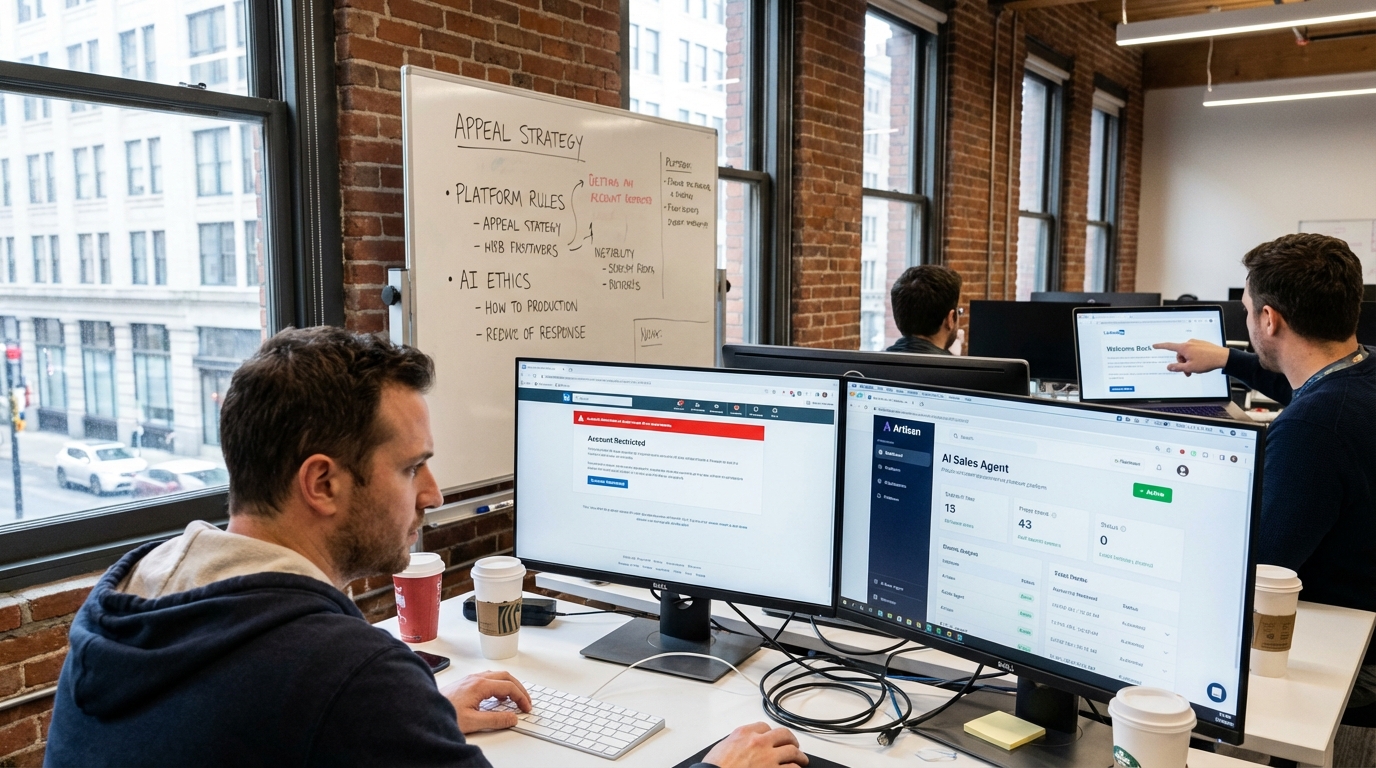
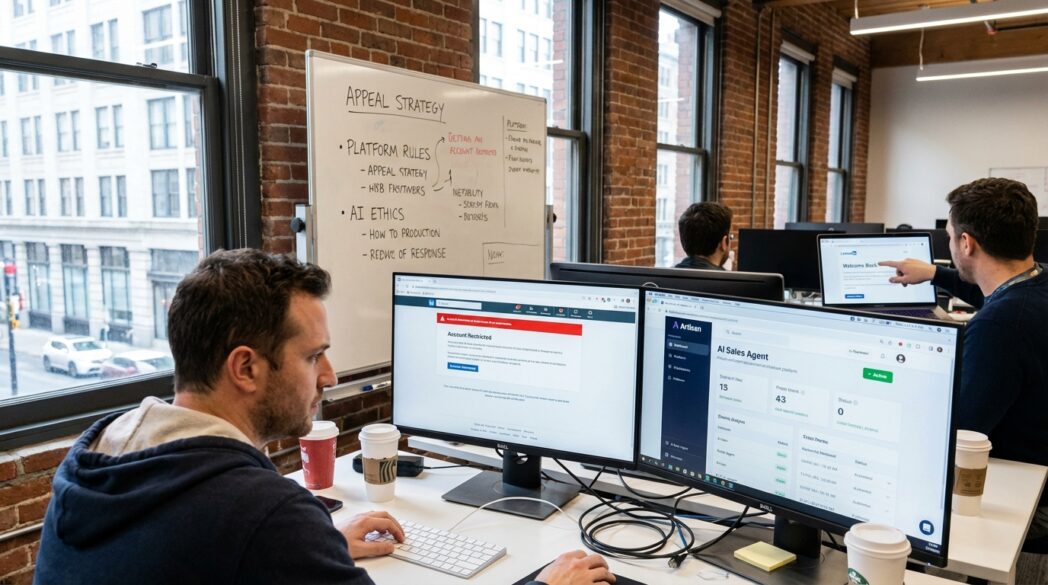
On December 19, 2025, the enforcement team at LinkedIn sent an email. It wasn’t a friendly “hello.” It was a notice of enforcement action.
Almost immediately, Artisan AI went dark.
If you tried to visit their company page, you saw nothing. If you looked for the profiles of their executives or employees, you saw a generic error message: “This post cannot be displayed.” It was as if the company had never existed on the platform at all.
Jaspar Carmichael-Jack, the CEO of Artisan, confirmed the news to reporters. He admitted that his startup had effectively been banned while LinkedIn conducted a review.
For a company that builds tools specifically designed to work with LinkedIn, this was a catastrophe. The ban lasted for roughly two weeks. For fourteen long days, Artisan was locked out of the world’s biggest professional network.
Why Did LinkedIn Pull the Plug?
When a company gets banned, rumors start flying instantly. The internet loves a good mystery, and people immediately started guessing why Artisan was kicked off.
There were two very different stories being told.
The Official Story: Rules and Trademarks
According to Artisan and the reporting from TechCrunch, the ban wasn’t technically about “spamming” people with AI. It was more about the rules of the road—specifically, trademarks and data.
Artisan’s CEO said LinkedIn had two main problems with them:
- Using the Name: Artisan used the word “LinkedIn” on its own marketing website. They used it to describe their features or compare data. LinkedIn is very protective of its brand name and didn’t like it being used that way.
- The Data Chain: This is the complicated part. LinkedIn claimed that Artisan was using data brokers—third-party companies that sell lists of information—who had scraped LinkedIn without permission.
“Scraping” is when a computer program visits a website and copies all the information faster than a human could. It is against LinkedIn’s Terms of Service. Even if Artisan didn’t do the scraping themselves, using data from someone else who did scrape it was still a violation.
Because of this, LinkedIn restricted all Artisan-related accounts. They didn’t send a personal note from a specific person. They communicated through an anonymous enforcement email address, which is standard for big tech companies.
The Viral Story: The “Spam” Theory
While the lawyers were arguing about trademarks, the court of public opinion had a different idea.
On LinkedIn (ironically), posts started going viral. Sales experts and growth hackers claimed that Artisan was banned for “AI spamming.”
The story on the street was that Artisan’s AI agents—robots that act like sales people—were out of control. People claimed these bots were:
- Sending out mass automated connection requests.
- Blasting thousands of messages to people who didn’t want them.
- Violating the rules about how many messages you can send in a day.
Viral posts claimed this led to bans for the company page, the founders, and the employees.
Some people looked at this event and saw a warning sign. They called it a “death sentence” for the AI SDR model. An SDR is a Sales Development Representative—the person whose job it is to find new customers. The critics said this proved that platforms like LinkedIn will crush any tool that uses “spray-and-pray” tactics (sending the same message to everyone hoping one person replies).
So, who was right? It turns out, both sides might have a point. LinkedIn rarely tells the public the full story. But we know that data scraping and automated spam usually go hand-in-hand.
The Return: How Artisan Got Back Online
After two weeks of silence, the lights came back on. Yes, LinkedIn banned AI agent startup Artisan, but now it’s back.
How did they do it? They followed the rules.
Artisan had to make some big changes to satisfy LinkedIn:
- They scrubbed their website. Any mention of the word “LinkedIn” was removed from their marketing.
- They did a massive vendor review. This means they checked all the companies they buy data from to make sure those companies weren’t stealing data from LinkedIn against the rules.
Once Artisan proved they were compliant, LinkedIn reinstated the company page and the employee profiles.
But here is the twist: The ban might have actually helped Artisan.
The CEO, Jaspar, said that once they “disappeared,” everyone started talking about them. The social posts about the ban went viral. All that attention reportedly boosted the number of people interested in buying their product. It’s the classic rule of fame: there is no such thing as bad publicity.
Now that they are back, Artisan is acting tough. They say they can “work around anything.” They claim that only a small fraction of their data actually comes from LinkedIn. To protect themselves in the future, they are adding more channels, like email and even outbound calling (robots that talk on the phone).
Meet Ava: The Robot Salesperson
To understand why this is such a big deal, we need to look at what Artisan actually sells.
Founded in 2023 by Jaspar Carmichael-Jack and Sam Stallings, Artisan is a graduate of the famous startup accelerator Y Combinator.
Their mission is bold. They want to replace “boring” work with autonomous AI agents they call “Artisans.”
Their star product is named Ava. Ava is an AI Sales Development Representative. She isn’t a human, but she acts like one. Ava can:
- Research new customers.
- Build lists of people to contact.
- Write and send messages.
- Follow up if they don’t reply.
- Book meetings.
- Update the company database.
In the beginning, a human had to check Ava’s work. But by April 2024, Artisan launched a version where Ava could do the entire outbound sales workflow end-to-end without anyone helping her.
The pitch is all about money. Artisan claims Ava is up to “96% cheaper” than human SDRs. She doesn’t sleep, she doesn’t get sick, and you don’t have to pay her health insurance.
Investors love this idea. Artisan raised about $2.3 million early on, then $11.5 million in a Seed round, and recently a massive $25 million Series A round. In total, they have raised over $35 million.
“Stop Hiring Humans”
Artisan didn’t just quietly build software. They screamed about it. Their marketing style is loud, aggressive, and designed to make people angry.
They ran a campaign called “Stop Hiring Humans.”
They put up billboards and bus stop ads in San Francisco and New York. The signs said things like:
- “Stop hiring humans.”
- “Humans are so 2023.”
- “Artisans won’t complain about work-life balance.”
People were furious. Critics called it a “dystopian nightmare.” In cities where people are struggling to find jobs and pay rent, telling companies to fire humans and hire robots felt cruel.
But the CEO defended it. He admitted it had a “dystopian vibe,” but he said they needed to stand out. And it worked—it got them noticed, and it got them sales.
They even pulled an April Fools prank in 2025 claiming the CEO had been replaced by an AI, which confused thousands of people.
This context is important. When LinkedIn banned them, many people weren’t surprised. Artisan had been poking the bear for a long time.
The Battle for the Platform
This story is bigger than just one startup. It is about how platforms like LinkedIn are fighting to keep control.
LinkedIn has strict rules against automated scraping. They want to protect the data of their users. They also restrict tools that automate messages because they don’t want the platform to turn into a spam wasteland.
In this case, the ban focused on data broker pipelines and trademarks.
LinkedIn is also building its own AI. They launched a “Hiring Assistant” AI agent for recruiting in 2025. Experts think LinkedIn might eventually build its own sales agents, too.
By cracking down on Artisan, LinkedIn is sending a message: “We own this playground. If you want to play here, you follow our rules.”
The Identity Crisis: Are You Real?
The Artisan ban touches on a deep anxiety we all have right now.
Artisan wants a future where “digital workers” do the boring stuff. Their pitch deck even talks about the goal to replace some human employees.
But this creates a problem. If a company uses AI agents to impersonate salespeople and send thousands of messages, how do you know who you are talking to?
If you get a message on LinkedIn, is it from a person who wants to help you? Or is it from Ava, who is just running a script?
LinkedIn is a professional identity network. Its value comes from the fact that real people are there. If it becomes flooded with bots pretending to be people, the trust disappears. That is why LinkedIn used the “nuclear option” of banning the startup. It was a signal to every other AI company out there.
Replacement vs. Augmentation
This saga highlights two different ways of looking at AI in the workplace.
View #1: Replacement (The Artisan Brand)
This view says we should use AI to replace humans. Why pay a salary when software costs less? This approach focuses on volume. Send more emails. Make more calls. Do it cheaper.
View #2: Augmentation (The Critics’ Choice)
This view says we should use AI to make humans better. Use AI to do the research so the human can write a truly personal, thoughtful note. This approach prioritizes quality. It warns that if you just blast out thousands of messages, you will get blocked as spam.
The experts watching this drama unfold believe that platforms like LinkedIn are siding with View #2. They will punish the “spray and pray” tactics that ruin the user experience.
What Does This Mean for the Future?
So, Artisan is back. But the world has changed.
For Startup Founders:
This is a warning shot. You cannot build a business that relies entirely on breaking the rules of a major platform. LinkedIn is watching. If you rely on scraped data or aggressive automation, you are building your house on sand.
For Sales Teams:
The fear is real. Roles like SDRs (Sales Development Reps) are at high risk of being automated. But there is a catch. The backlash against “Stop hiring humans” shows that people still value human connection.
For Everyone:
We are entering a new era. Job applications are flooding in by the millions because AI is writing résumés. Now, AI is doing the hiring and the selling too.
The Artisan story is a preview of the battles to come. It’s a clash between the efficiency of robots and the rules of human platforms.
Artisan might be back online today, but the debate they started isn’t going anywhere. As AI agents get smarter and more aggressive, the line between a helpful tool and a spammy bot will get blurrier.
One thing is for sure: The “wild west” of AI outreach is coming to an end. The sheriff is in town, and his name is LinkedIn. If companies want to survive, they will need to be smarter, more compliant, and perhaps a little more human – even if they are using AI to do it.
Frequently Asked Questions
Why was Artisan AI banned from LinkedIn?
Artisan was banned for using LinkedIn’s trademark on their website and for allegedly sourcing data from third-party brokers who had scraped LinkedIn profiles without permission, violating the platform’s Terms of Service.
How long was Artisan banned?
The ban lasted approximately two weeks, from December 19, 2025, until early January 2026, when LinkedIn reinstated the company after compliance changes were made.
What is Ava?
Ava is Artisan’s flagship AI product—an autonomous Sales Development Representative that can research prospects, send messages, book meetings, and manage the entire outbound sales process without human intervention.
What changes did Artisan make to get reinstated?
Artisan removed all mentions of “LinkedIn” from their marketing website and conducted a comprehensive vendor review to ensure none of their data sources were scraping LinkedIn profiles illegally.
What was the “Stop Hiring Humans” campaign?
It was a controversial marketing campaign featuring billboards and ads in major cities that encouraged companies to replace human workers with AI agents, generating significant backlash and criticism.
Did the ban hurt Artisan’s business?
Surprisingly, the CEO claimed the ban actually helped by generating massive attention and viral social media posts, which reportedly increased interest in their product.